


Author: Enkel Xhangoli, Nertila Dosti
The project for teaching through electronic tablets was supported by two governments, but it is not feasible due to the lack of infrastructure in Albanian schools.
Stiven P. is a student at the "Sami Frashëri" high school in Tirana and as a result he had to complete five of the subjects in his class through electronic tablets.
But, despite this, the high school student in the 11th grade shows that during the last two years he has managed to see them a little and use them even less, because, almost always, the tablets remain in the box.
"Tablets are only for appearance. They don't work. Many of them do not charge. The teachers are too lazy to take them out of the boxes and this year we didn't teach with them at all", says Steven, adding that last year they used them in the classroom only three times.
Meanwhile, an ambitious project of the Ministry of Education launched in 2013 predicted that electronic tablets would be used daily by 47 thousand students, in 60 gymnasiums across the country.
For its realization, the Albanian government received a loan of 3.5 million euros from the Austrian bank. UniCredit, in May 2014, with the justification of the inclusion of technology in what it called 120 "intelligent" classes.
The project aimed to enable high school students across the country to learn some school subjects through electronic tablets, which require an internet connection to function.
An investigation by PSE shows that, three years after the start of the project, high school students in Tirana and its surroundings cannot learn through purchased tablets.
With the start of the new school year, 2015-2016, the government promised that it would start a new stage of modernization in 60 gymnasiums of the country. About 47 students in 120 classes with 5 distributed tablets would no longer "need" the book, as they would find it digitized on tablets.
Each pilot school would be supplied with two digital laboratories, which would include: interactive projector, 40 tablets for students, 15 tablets for the teachers' lounge and 3 laptops for teachers.
The Prime Minister, Edi Rama, appeared enthusiastic at the "Sami Frashëri" gymnasium in 2015, when he declared that by 2018 every gymnasium class in Albania would be equipped with tablets.
But, a year and a half after this promise, the students of one of the best high schools in the capital, "Sami Frashëri", cannot use the tablets, mainly due to lack of internet.
The project that would include technology in high school lessons had its origins in May 2013. At that time, the Minister of Education, Myqerem Tafaj, signed a loan agreement with UniCredit Bank Austria AG for an amount of 2.5 million euros.
After the political rotation of June 2013, the project was interrupted to restart in May 2014. The new government thought to add another million euros to this fund.
Lack of infrastructure failed the project
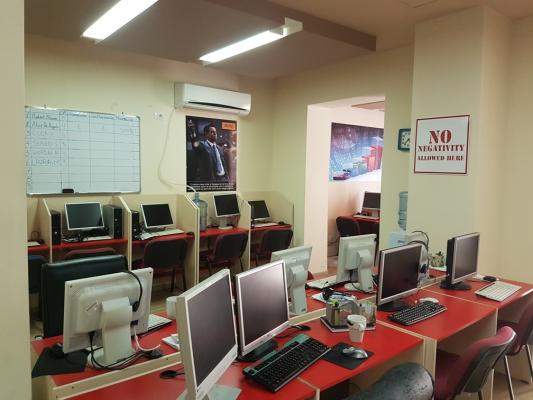
In the high school "Sami Frashëri" in Tirana, in addition to Steven, many other students claim that the lack of internet turns the tablets, which were planned to be used for teaching, into ornaments.
“The teacher could not include the test on them, as the tablets were not connected to the main computer. Of the 30 tablets that could be in the classroom, only one of them worked and connected to the Internet", says another student of this school who asks not to be identified.
In this high school, there are also those students who have no information about how an "intelligent class" can work. Out of 16 parallel classes of one year, only three of them have been selected to teach through tablets.
The project of modernization of the educational system in Albania through e-education envisaged the creation of 120 smart classes in 60 high schools, 43 in large urban areas and 17 in rural areas.
To guarantee the efficiency of the project, the Ministry of Education also stated in April 2015 that it has trained about 4000 teachers.
But, for the teachers, this training does not seem to have gone in the best possible way, since some students told PSE that they often help the teachers in using technological devices.
"There are children who, even though they have been trained, require our help to use the electronic board and tablets. They do not attach much importance to the use of tablets and neglect them", says a student who will not be identified.
The "Ismail Qemali" high school is one of the schools with a good reputation in the capital, but even there electronic tablets have not been used for a year and a half.
"We again teach with the book. The tablets were "stuck" due to the lack of internet", says a student in the second year of this high school for PSE.
The Educational Directorate of Tirana also distributed 25 tablets to the "Eqrem Çabej" gymnasium in June 2016.
Today they are in one of the school warehouses due to the lack of accessories and this is confirmed by the director of this gymnasium, Gëzim Koçiu, for PSE.
"Tablets cannot be connected to the central unit. The electronic board is missing. We do not have the financial means to cover these expenses. We are waiting for the investment from the Education Directorate", he said.
The IT teacher at this high school emphasizes for PSE that the tablets remain unopened in the warehouse of this school until the technical conditions for their use are met.
"We don't even have a classroom suitable for their placement, as there are no plugs. The tablets were taken and are currently in the school's warehouse," she says.
The Educational Directorate in Tirana admitted to PSE that the high school "Eqrem Çabej" is not yet part of the project schools with digital classes, although the basic materials have been distributed there.
"In this school, not all the equipment has been distributed to enable the development of learning in the digital format... (the project) cannot be done within one year in all secondary schools in Tirana, as the cost is very high, but it it will extend to years", - it is emphasized in the answer.
In high schools in other cities of the country, the situation with tablets is even more problematic.
PSE has contacted students in cities such as Elbasani, Fieri and Gramshi. The common denominator is: there are tablets, but they are not used.
"There are only two classrooms equipped with tablets in the school. Students change every year.
One of the classes does not have internet and we cannot work with the tablets", says D. Aliaj from Fieri.
The students of the "Luigj Gurakuqi" school in Elbasan and those of the "Shefqet Guzi" high school in Gramsh say the same thing.
PSE has requested official information based on the law "On the Right to Information" from the Ministry of Education and Sports for the smooth running of the process.
"The project has been completed in 60 schools at the national level: the phase of investments in the infrastructure of the laboratories of these schools, which enables the application of contemporary technologies of the integration of tablets in education", - is written in the response of the ministry.
The letter does not detail the 60 schools selected for this project, which it considers successful.
The interest of PSE was answered by the Deputy Minister of Education, Nora Malaj, who explained the purpose of the project, but not the problems encountered during its implementation.
She said that, "it was intended that students and teachers should not only get the information at the right time, but also in a contemporary way".
PSE also contacted the head of the project, Ornela Koleka, who was not ready to provide information about its progress.
The former Minister of Education, Myqerem Tafaj, who was also the initiator of this project, in a statement about PSE, considers it unjustifiable to increase the loan received from Unicredit Bank Austria AG with one million euros.
"We have left this project in the negotiation phase. The project would start with the tenth grades in some subjects and then it would extend to all years", said the former minister.
The government has already begun to repay the loan of 3.5 million euros.
Today it cannot be said with certainty that at least one "intelligent class" is fully functional.
This, despite the ease with which a significant sum was allocated to a project that attempted to incorporate advanced technology in the absence of basic, supporting infrastructure.
The Ministry of Education's ambitious project, supported by two governments, appears to have been just an intelligent tendering process.
Fortunately, it has not yet been proven that the "intelligence" of Albanian classrooms is related to electronic tablets.
Photos by Fortesa Latifi, Nertila Dosti and Enkel Xangoli