


Author: Andrea Dangli
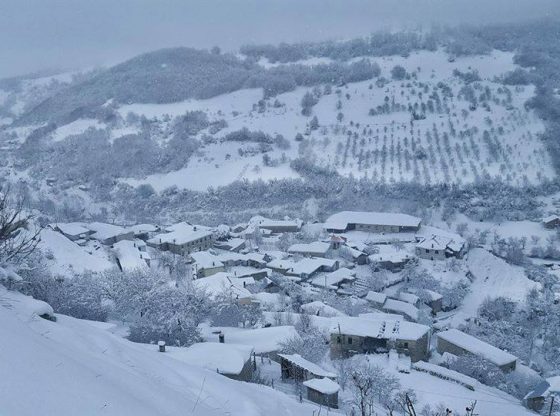
Have you ever heard of a village called Arrëze? Maybe you haven't heard much about it, since the seasons have taken care to hide it among dozens of colors for the curious eyes.
Spring covers it with flower petals, summer with the green of the trees, autumn with the gold of the leaves, while winter hides it beautifully among the whiteness of the snow. This colorful village is located 56 km from the city of Korça, 26 km from Bilishti and just a few steps away from the village of Dardhë, on whose shoulder it stands. The two villages, located at the foot of Mount Gramoz, used to be very similar.
Pears with stone houses, also Walnuts with stone houses, one with cobbled alleys, the other with cobbled alleys, green center one, green center the other, wonderful cuisine here and there, but… countless tourists from one side, fearful oblivion on the other.
They felt equally pampered by the generous nature, but not by the fate that embraced them differently. Somewhere he gave well-being and vitality, while, just a path further, he left behind misery and loss.
"So it was written for us", - says Bujar Hoxholli, village headman, regarding the contrast between Arrëza and Dardha.
Residents also remember that Dardhë village has been increasingly favored by the authorities.
"And how can tourists come, when we don't have a road to bring vehicles to the village, but we still use animals for transport like in the stone age? Why does Dardha have the infrastructure in time and we have nothing?", - is the question posed by the residents, as they argue why they have not been able to have the lives of their neighbors.
So close and so far from each other, the twins have followed two opposite paths, despite the fact that a tourist, what he is looking for in Dardha, can find equally amazing in Arrëza.
Pine, beech and oak are not absent here either. There are also special medicinal plants or dozens of floral scents. They place the village in a green armchair that deeply fills you with breath and regenerates your lungs. The human hand in this area seems not yet eager to deface the wonderful environment. The gurgling of the Devoll river, which flows calmly through the village, also proves the generosity.
But Arrëza is hard to find on the map and not in magazines, books, guides or tourist recommendations.
The amazingly built houses on each other's shelter still keep the old tradition, customs or legends, written in carved stones, well-paved courtyards and wide alleys. The inhabitants find it difficult to escape the comparison with the famous winter village that lives with tourists, while, instead, they themselves are condemned to survive on the little income they collect from exhausting work in agriculture and livestock.
If we pay attention to the television chronicles, where dozens of tons of products are shown thrown into the waters of Devolli, it is the villagers of this area who are the first to throw a year's sweat into the river, because there is no market to sell them. Under these circumstances, the morsel cannot be secured.
In 1990, there were 1010 inhabitants, while today, years later, there are only 638 people left, whose mission seems to be to keep the village "open". Almost half of the residents fled, taking with them longing for their homeland and the hope that the direction of developments in the area will one day change direction for them to return.
Perhaps, simply, a road built for them would be the bridge to civilization. A ring was once promised between Korça, Dardha and Bilishti, where Arrëza would also be a part of it, but this project still sleeps in the drawers of the Ministry of Transport.
Today, Arrëza is told by the stone, it is spoken by tradition and, apart from the geographical level, it is raised on a pedestal by the natural values and the cultural heritage that it bears witness to. The village that has been sleeping for years today wants to wake up and tell us who it is. The nut has something to tell us.
Photo: Andrea Dangli