


Albania is facing one of the biggest challenges of its higher education in recent decades. The numbers show a worrying situation, with many branches at risk of closing due to lack of students. Although there has been government intervention through the stock exchanges, the crisis continues to worsen and the results are not what was expected.
Author: Besjana Çelaj
Faced with the risk of the "disappearance" of teachers, physicists, agronomists..., because young people do not prefer to study for these "professions", the government decided to support the so-called "priority branches" with scholarships. The decision taken two years ago to finance 35 programs (the Language-Literature program, the Natural Sciences program, as well as branches related to agriculture and tourism), has not yet produced the expected results. In these programs, 2.760 students have been enrolled in seven universities, but the initiative has been criticized from the start.
"I don't understand why these priority branches have been announced," says Gevio Tabaku, who adds, "to my knowledge, no study has been done to see what the needs of the labor market are, so that the ministry can then decide that what are those branches".
"We have more national needs than the market", - says the education expert, Ndriçim Mehmeti.
- The branch of Teaching, - he says, - is a national need. It is more important than Robotics, which may be a market need". Even Mehmeti says that "a serious and annual study is needed".
Students are not satisfied
"The scholarship for priority programs was a trap. They informed us about the criteria after registration," says DP, 19, a student of the Mathematics department.
At the beginning of registration, they were promised scholarships, even if the students were not from the elite group. After the registrations, the faculty informed them of the criteria that had to be met, such as a 9.5 average, to graduate in a priority branch and at least 3 years after completing their studies, they had to work in Albania.
"Currently in our class only one student is a beneficiary of the scholarship", said DP, a student of Mathematics. Only 18 students are registered in the Mathematics branch, but only 10-13 students attend regularly, because "they are registered in this branch only for the promised financial support".
"We were very disappointed, one thing was said and another was done", says MK, a student at the Faculty of Language and Literature.
"We organized and decided to boycott the lesson and protest for the right to the scholarship and of course also for the diploma, which would be held hostage to us. The protest lasted 1 week, but without result and without any reflection from the institutions", says MK
"Students need guarantees", - says the employment expert, Erion Muça. He adds that this decision should include a preliminary job guarantee, so if you are signing a contract for the student to stay in Albania for the first 3 years after studies, then sign a guarantee contract for the student's employment during these years. so that the student is more convinced of his choice.

Despite all the support with scholarships, the number of students registered in recent years in the Teaching branches is decreasing. One reason may be the low salary.
"Even the sanitarians of QSUT have a higher salary than primary school teachers. Educators or teachers of primary education are paid less than 47.000 lek per month, while the sanitary workers of the Health and Welfare Center are paid 52.000 lek per month", says Ndriçim Mehmeti.
Other reasons are the infrastructure, the lack of digitization and the non-updating of curricula and textbooks.
Scholarships, as much as a salary, but students are reluctant
"210 minimum wage scholarships have already become effective, which have been made available to our universities, 80 of which are scholarships, which have benefited from the Agricultural University of Tirana", - said the Minister of Education and Sports, Ogerta Manastirliu, in a public outing.
"Minimum salary scholarships are a support for students, for our programs of strategic interest for the country, but this is also one more guarantee that tomorrow we will have qualified professionals in these fields, who are of interest to the development sectors, but are also with interest also for the labor market", the minister added, among other things.
At the University of Tirana, 34 students benefit from financial support in the amount of ALL 40.000/month for the academic year 2022-2023; but the number of students receiving scholarships in public universities is low. In Shkodër, only 6 for the past academic year 2022-2023 and only one for this year. At the University of Vlora, only 8 students benefit from the scholarship, while at the University of Elbasan, only 2 students received the scholarship. At the University of Durrës, 25 quotas for financial support have been approved.

The budget for financial support is ALL 15.000.000.00. The Ministry of Education says that the approved fund has passed to every institution of higher education, which distributes it to the beneficiary students. Quotas for students studying in these branches have also been doubled.
Although scholarships are being offered, the number of enrolled students remains low. There were expectations that at least this decision would meet the minimum number of students in the priority branches. At the University of Tirana, from the moment of the announcement of priority branches in 2022 and until 2023, there were only 332 registrations.
The shrinking of universities
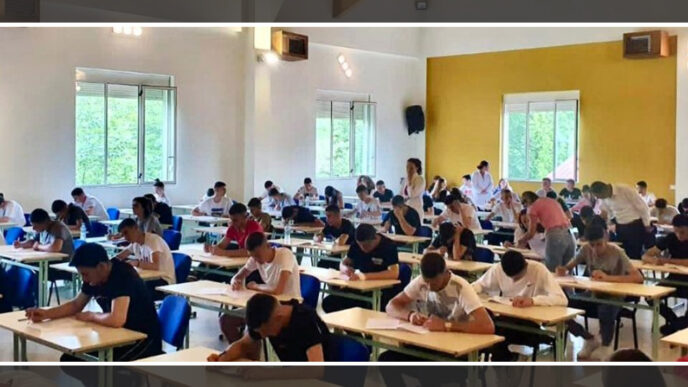
Albania is experiencing a crisis in education. Many branches have closed or are on the verge of closing due to lack of students. If in 2013 there were a total of 176.173 students in public universities in the country, today there are about 50 students less.
Teaching branches were among the most popular, but in the years 2013-2023 for the priority branches we have 1.534 fewer students. The main reason why fewer young people sit in university auditoriums is emigration.
In public universities, we have 24 branches closed and 15 more are at risk of being closed. Currently, with the decision of the Academic Senate, the proposal of the Faculty of Social Sciences for the closure of 4 second-cycle study programs has been approved. Also, at the University of Korça, 4 study programs have been closed, while three other branches are at risk of closure. At the University of Shkodra and the University of Durrës, no study branch has been closed since 2013 to 2023. The opposite has happened at the University of Gjirokastra, where 7 Bachelor and Master study programs have been closed and two first-cycle programs are on the verge of closure.

At the University of Vlora, 3 study programs (Physics, Chemistry, Italian) have been closed. At the University of Elbasan, 6 study programs have been closed and seven more are in danger of being closed. Nearly 50% of branches are on the verge of total closure. The reason for the closure is the lack of students, the preference to study abroad and the lure of the Medical branches (mainly Nursing and Informatics).
According to employment expert Erion Muça, the mentality created in the last ten years among students has also had an impact on this decline. He said that, “students are fond of high-income professions.” According to him, the mentality of recent years has a great influence on students’ decision-making, as they are now inclined to choose those branches that bring them more income or immediate income, as well as professions that give them freedom in the future, such as working as a freelancer and not for someone else.
Despite the policies used through scholarships for the branches selected as priority, the situation continues to be the same and the expected change has not occurred.
Mr. Muça says that another reason is the fact that public education is still with the old methodology, where teachers and lecturers simply convey the information written in books, not applying the philosophy of logical understanding, in order to develop the progress and creativity of pupils or students, so that when they enter the labor market, it will be easier to adapt.
On the other hand, the education expert, Ndriçim Mehmeti, says: "The government should increase the salary for these professions".
If the salary were higher, then students would be more motivated for these professions and then yes, the government has followed the appropriate policies to improve this situation, which we are encountering year after year as a fatality.
The challenges faced by the higher education system in Albania are great and manifold. From declining enrollment to the possible closure of essential programs, the situation calls for urgent attention and innovative solutions. While the scholarship program has begun to be implemented, the roots of the crisis are not only financial. Investments in infrastructure, curriculum modernization and competitive salary structures for teachers are essential to attract and retain talent in Albania.
This article is part of the Investigative Journalism Laboratory project, which is financially supported by the Public Relations Office of the US Embassy in Tirana. The opinions, findings, conclusions, and recommendations expressed are those of the author(s) and do not necessarily represent those of the Department of State.