


While the promises of the Municipality of Tirana for the quality of public transport over the years are approaching European standards, the reality of the service is still far from what is claimed. With excessive delays, urban overcrowding and a fragmented service with tools from a few decades ago, passengers complain of a disconnection from the reality of the management of the institution.
Author: Marina Zela
From constant traffic jams, to unstable schedules and overcrowded urban areas, Tirana's public transport system faces a host of challenges, leaving passengers frustrated and in dire need of problem solving.
It's Monday. It's almost 9:00. Ardita Reshiti is waiting at the Kombinat-Kinostudio bus stop to take the first of the two urban buses she uses to go to work every day.
"They never have a schedule," she says, answering our question about when the bus comes. Depending on traffic, the route I take on the Kombinat-Kinostudio line takes 15-20 minutes. After getting off at the first urban bus stop, I have to walk 5-7 minutes to get to the Green Line station , where I usually wait 5 to 10 minutes and in the worst case, 15 minutes," says Ms. Reshiti.
For Ardita, using urban people to go to work every day is a challenge. She lists some of the reasons that turn her daily journey into a challenge, starting with the high number of people, unpleasant smells and delays that are not absent, especially in the afternoons.
"I would add to this list the absurdity that, in addition to the biller, someone from the general control comes to check the biller and the passengers in turn, whether we have made the payment or not," she says.
Similar problems also appear in the daily life of Sierra Bulku, a student at the Faculty of Medicine, who must travel first with the Jordan Misja-Qyteti Studenti line and then with the Green Line , to attend lectures every day. The problems with this line are even more pronounced; delays lasting more than 1 hour, overcrowding with passengers and the lack of urban residents during dinner hours are among the most important.

The same concern is shared by Nadirja, who, in order to go to university, has to take the Selitë-Allias line.
"Every day I have to wait over 1 hour at the station and almost another hour to reach my destination. During the summer, the situation becomes even worse, because the air conditioners never turn on."
Ersida Teliti, Executive Director of the Albanian Consumer Center , a non-profit organization that aims to protect and represent the legitimate interests of consumers, indicates that issues regarding service quality are among the most addressed by citizens.
"Frequency, station placement, lack of vertical and horizontal signage for these stations are the problems regarding the quality of service; if we look at the contracts they have with the municipality, it is found that voice stations , movement maps are missing and often the bill collectors are forced to shout."
Promises that were not kept
In the last decade, the only promises that never end are those made for public transport in Tirana. If every promise given in relation to this sector had been kept, Tirana today would have dedicated lanes, electric lines, buses that come every 3 minutes, electronic ticketing and service conditions of a high level.
The Mayor of Tirana, Erion Veliaj, promised dedicated lanes in 2015. On December 18, 2016, he promised electronic tickets within the year. Then, on August 26, 2017, he promised to start testing electric buses and after 4 years, on July 24, 2021, he presented the first 20 Go Green buses , some of which were hybrids (diesel/gas). These are just some of the promises made almost a decade ago, none of which have been kept in full and most of them have been forgotten.
Officially asked about these promises, the Municipality of Tirana says that they are in the phase of implementing electric buses. The municipality gives the same answer for the dedicated lanes, stating that they are part of the BRT study, which will be made available at the right moment with the completion of the last details of the process.
"Regarding the movement schedules of urban transport vehicles, we inform you that the approved schedules for the lines are currently applied", - officially says the Municipality of Tirana, implying that none of the employees, who work in the transport sector public transport of this institution, has not gone down to the field to see the real situation.
Urban transport, experts blame the municipality
The finger of interest groups and experts in the field for this urban transport situation is directed at the municipality.
Dashnor Memaj, head of the Urban and Interurban Transport Association , says that public transport has long raised concerns about the smooth running of the service.
"The improvement of the infrastructure, the removal of some fuel taxes, the reduction of the sales VAT threshold, the reimbursement of the categories that travel for free and the impact on the increase of the salaries of the sector, given that there is a mass exodus of employees," remain concerns. he says, listing a number of problems. He says that the cooperation with the Municipality of Tirana has been a relationship of requests and promises.
"There was never a final solution, to have better quality service, better tools, higher speed of movement", - he concludes. Asked about the frequency of vehicles on the lines, Mr. Memaj says that this is not in the hands of the operators, as long as the urban dwellers move along the road with private cars and due to the traffic, the speed is very low.
On the other hand, expert Rixhin Qoshja says that private operators should not be seen as the source of problems, but as the source of the solution.
"It is natural that each of them is in this business to win and they will try to achieve their profits by all means, even to the detriment of the quality of the service, therefore a change of the financial scheme is needed, as for example compensation from institutions for the categories that get this service for free", he says, adding that there are successful examples in the Balkans and beyond.
"Tirana is lucky that for more than two years it has had the German assistance of GIZ for the improvement of the public transport service", he says, adding that it is the duty of the transport specialists in the Municipality of Tirana to correctly implement the experience of taken.
For Mr. Qoshja, public transport is the "backbone" of a city, having a significant impact on easing traffic and, therefore, air pollution.
"All this will be realized, when this service will be able to compete with personal car transport in expanding the coverage of the service and increasing the commercial speed", he says, stressing that today Tirana still has areas not covered by the service public transport, which must be served as soon as possible.
Ersida Teliti, Executive Director of the Albanian Consumer Center , lists a series of shortcomings in the urban and interurban travel system, starting from the lack of signage at stations and to the placement of stations in inappropriate locations, such as in roundabouts.
"It is found that maps, voice stations , movement maps or other data are missing and often the billers are forced to shout," she says, adding that they have complained many times to the Consumer Protection Agency in the Municipality of Tirana, but, although there is a positive spirit, there is no major change on the ground. Another problem, which Ms. Teliti emphasizes, is the age or seniority of the buses that are used, because they do not comply with what was foreseen by the parties in the contract.
Situation on the ground: Delays, lack of air conditioners and overcrowding
Based on the promises made, interviews with experts and actors in public transport, we decided to spend a day traveling by bus on several lines in the capital.
On line no. 15, Kinostudio-Kombinat, the most mentioned problems are related to the confusion of this line with Tufina. There are cases where the urban writes: Kinostudio , but in fact goes to Tufina and other times where it writes: Tufina and goes to Kinostudio.
"From all the fatigue I have at work, I have to stress, if the city will send me to the station or if I will stay in the middle of the road", - says a citizen, who adds that this often leads to conflicts with the biller.
On the other hand, in some specific areas, such as hospitals, Selvia or the December 21 intersection , there is overcrowding at the stations.
Waiting is another problem that citizens face all the time.
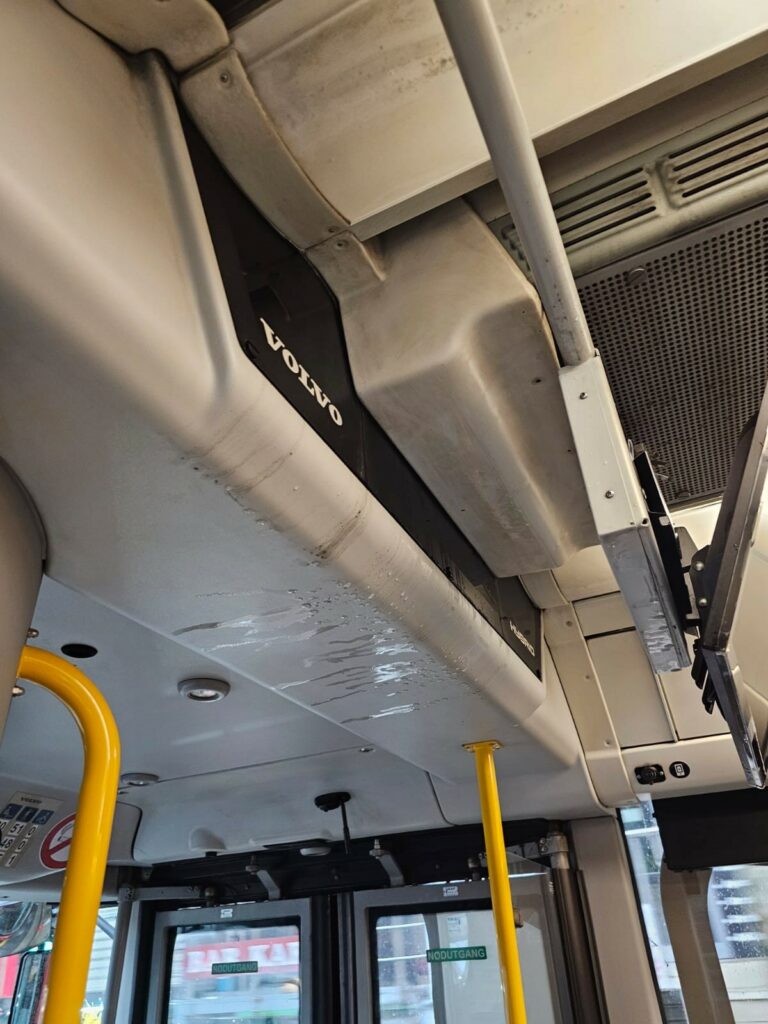
At best, the wait is 10 to 15 minutes, but there are cases when this wait goes up to 40 minutes, especially during dinner hours. And while temperatures are increasing day by day in these summer days, the non-use and malfunctioning of air conditioning continues to remain problematic. In most cases, air conditioners are not used due to the higher fuel consumption, as some drivers and billers say " off the record ", but there are also cases that do not work or even worse, water leaks inside the urban.
The promises in almost a decade are many and often the social profiles of the leaders of Tirana Municipality show a situation far from reality. It is unclear if anyone from this institution has ever used public transportation, which they promote at every public outing.