


Author: Alfred Zylyftari
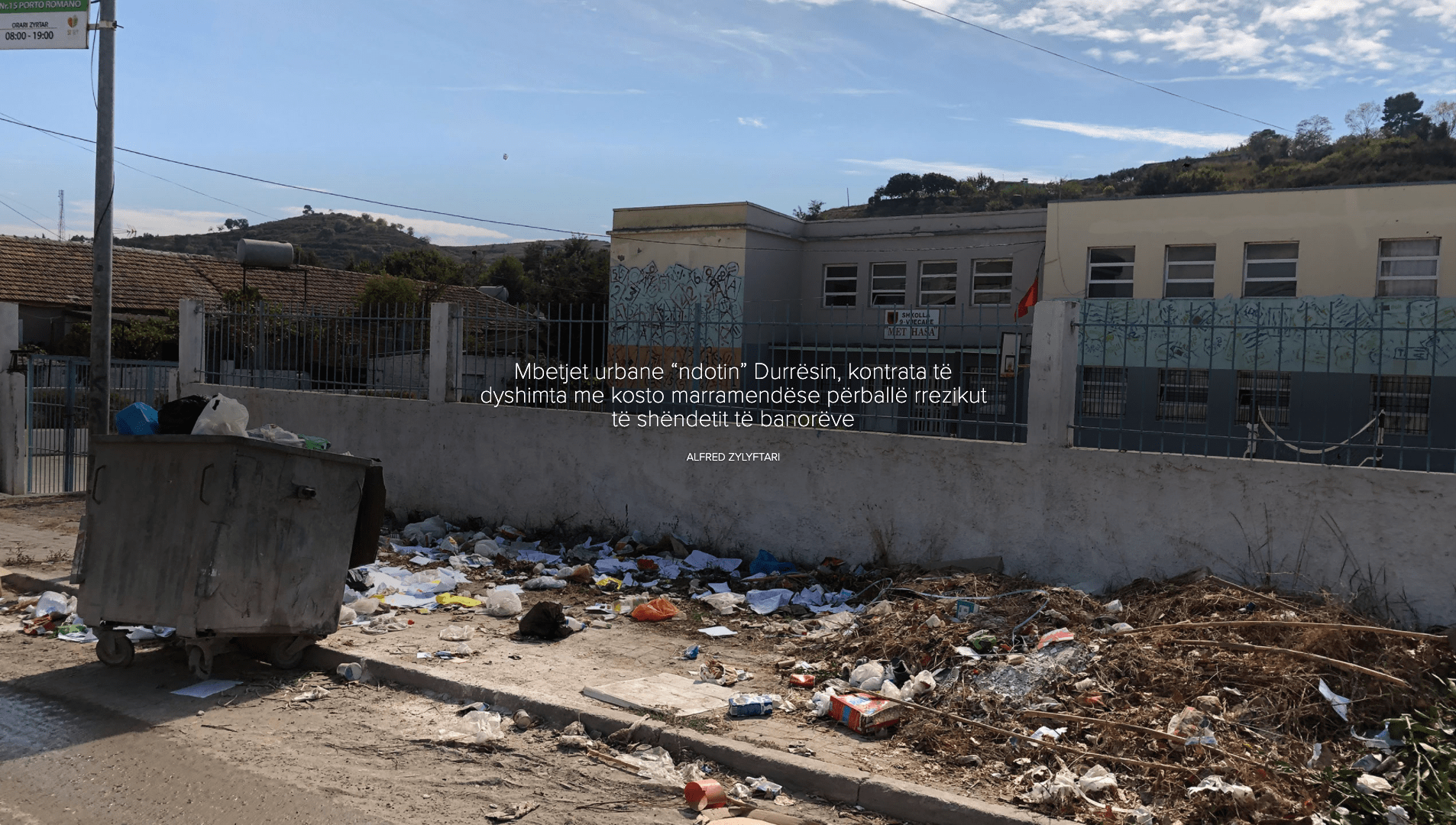
For months, Durrës has been in a state of collapse due to urban waste. The whole tourist season passed with problems for the cleaning of the city. Neighborhoods and administrative units are cleaned, only when containers and the surrounding sidewalk or street overflow. The observation in the month of July to September of 2021 showed that the peak reached exactly in July and the most problematic areas were identified: Lagjja 13 or the beach area, Spitalla, the area of the former Swamp and Arapaj. Also, Lalzi Bay and Rodoni Cape, which, although they are suburban areas, are often visited by tourists, again had the same problem with urban waste. On the way from Gjiri i Lalzi to Cape Rodoni, you are faced with "mountains" of garbage, which have obviously not been cleaned for days. Some Polish tourists, who were in the area, expressed surprise at how it is possible for this natural beauty to be neglected by local institutions.

Tourists also enjoy the sea of garbage
Durrës is the second largest city in Albania . It has over 200,000 inhabitants and during the summer season is visited by more than 150.000 tourists. The city, soon, within the framework of a strategic investment, is expected to increase the number of tourists and daily visitors. But, in the current situation, waste management is seen as a problem, which could negatively affect the city's tourist potential.
Business administrators say that waste is a big problem, because, in addition to the diseases it causes and the bad smell, it creates a bad image in the eyes of tourists. A hotel owner, who had garbage bins in front of his business, said: “Not cleaning the garbage is a constant problem. These bins are the first sight for tourists before they enter the hotel and there have often been complaints about the bad smell. We have contacted the municipality, but they are cleaning them for the time being and then letting them pile up. I hope that a long-term solution will be found, because tourists are not here all year round, but for us who stay here all the time, it is more of a problem.” Many hotels and bars in this area also raise the same concern.
The impact of environmental pollution on the reduction in the number of tourists is also acknowledged by Kliton Gërxhani, vice president of the Association of Tour Operators Agencies in Albania. " Environmental pollution always affects tourism. Even when they don't say it directly, you can see it in the reviews they leave on the internet or in the lack of quality tourists coming and their replacement by poor tourists, who also accept pollution and dirt for the low price," he explains.
A decade of strategies and decisions, but no visible changes
In May 2020, the Council of Ministers issued a decision on the strategic policies of the National Urban Waste Management Plan , which notes that only four landfills are operational in Albania : Bajkaj (Saranda), Bushat (Shkodër), Maliq (Korçë) and Sharrë (Tirana). It reports that during 2018, around 923,316 tons/year of urban waste or 60,61% of the waste, which is calculated as the amount generated in the country, were deposited in these landfills, of which only 401,755 tons/year (or 26,37% of them) are deposited in sanitary landfills , while the rest or 13,01% of solid household waste is disposed of in a completely uncontrolled manner. This reveals another problem with the urban waste management system, that of mismanagement by local government and lack of cooperation with the central government for the proper implementation of these strategies.
The monitoring developed for this strategy is based on indicators according to the 2009 Decision of the Council of Ministers on the rules and procedures for the drafting and implementation of the National Environmental Monitoring Program with indicators such as: annual production quantities; distribution of waste by municipalities and regions; percentage content of polluting components and the commodity composition of waste.
According to this decision and strategy, the ministries responsible for agriculture, infrastructure/transport, health and industry are obliged to complete the annual waste statistics reporting format and submit it to the National Environmental Agency by February 10 of each year (Point 7.2 of the Strategic Policy Document and National Integrated Waste Management Plan , 2020-2035).
The Albanian Center for Quality Journalism addressed the KTA with a request for information on the annual reports from these departments, but this institution did not make the reports available to us, nor was it informed, if any. The Regional Environmental Agency, Tirana, Durrës, Dibër confirmed that it has not conducted any inspections regarding solid waste in the territory of the Municipality of Durrës.
"After the closure of the Porto Romano landfill due to exceeding the capacity of this landfill, by decision of the Albanian government, all inert waste generated by the reconstruction process after the earthquake of November 26, 2019, was decided to be collected and deposited in the former Porto Romano urban waste landfill to carry out the encapsulation of this point", - was the only official response from this institution.
The Agency, referring to Law No. 139/2015 “On Local Self-Government”, justified the lack of this data, explaining that “the full management of urban waste is a direct legal competence of municipalities, which control this process through the tendering of the collection, transportation and final disposal service of urban waste, through service contracts”. Based on this argument, it was requested that “statistical information should be requested from the responsible, competent structures, the Municipality of Durrës and the State Inspectorate of Territory Protection, Durrës Regional Branch”.
At the same time, with the definition of the general, comprehensive strategy of urban waste management, the Decision of the Council of Ministers also defines the tasks for the Ministry of Environment on the drafting and monitoring of the implementation of general policy documents of regional plans for waste management . Asked about the strategy for the Durrës area, until the date of publication of this article, this institution has not yet returned an exhaustive answer.
This problematic situation with urban waste management has been reaffirmed in international documents on monitoring Albania's path towards the European Union, with the European Union reports on Albania, which highlight, among other things, alarming problems such as: the partial extension of coverage with waste management Services; the lack of sufficient waste collection and disposal; the limited amount deposited and treated in landfills ; the presence of a large number of landfills (permitted and unauthorized), which are outside sanitary and engineering standards; the limited number and poor quality of waste collection and transportation equipment; the lack of waste separation at source and the low recycling rate; the lack of infrastructure for integrated waste management; the incomplete implementation of the law and, in general, of by-laws; as well as the poor interaction and coordination of central government structures with local governments and other interested sectors.
Residents: Cancer is being slandered. Doctors: Pollution also causes cancer
The general practitioner, MS, says that the non-cleaning of urban waste causes many problems in the community, such as diseases: cancer, pulmonary, blood and skin diseases, therefore the relevant institutions must find a final solution. We contacted the Ministry of Health and DRSH Durra by telephone, but they refused to comment.
The toxicologist, Alban Haxhi, explained that pollution from garbage can bring serious consequences to human health, such as the aggravation of chronic pulmonary and neurological patients, the aggravation or occurrence of cancerous diseases in people with problems or genetic predisposition to cancer and the sick with liver problems or those with cardiac problems.
"Exposure of people to combustion dust makes them more at risk of developing cancer, because the epithelial cells of the respiratory tract, which are functional cells to remove waste, are changed; these cells turn into flat cells, which no longer remove this waste through coughing or various secretions that the respiratory tract produces, but are forced to keep it, accumulate it there, becoming a risk factor for cancer of this tract. So, we have an increase in the cancer factor in the respiratory tract. The other has a lot to do with carbon compounds, which are also intoxicating in human metabolism and can damage both the nervous system and other organs, such as the liver, kidneys, etc. This damage has an endless range of diseases ", - explained the doctor.
Residents are frustrated by this situation. “ They are slandering us about cancer ,” said one of them, while another said: “It would be good if journalists came here every day, because that is the only way the municipality can get moving .” All residents unanimously say that this situation must change, that there has been no solution for many years and that the municipality is playing with their lives. The municipality says that waste is currently being deposited in the Sharra landfill , a procedure that has been reported by the media and previously as having corruption implications, but this is not seen as a final solution.
Between the Adriatic Sea and the "toxic sea" in Porto Romano
In the new cross-sectoral urban waste management strategy for the years 2020-2035, it is also noted that near the city of Durrës, the area of Porto Romano remains one of the most polluted areas since the early 90s. The report estimates that the presence of a large amount of hazardous chemicals, deposited, such as hexachlorocyclohexane and chromium, pose a risk to the health of the population and the surrounding environment.
Over the years, foreign donations have made it possible to undertake cleanup campaigns in this area, donations such as that of the World Bank in 2004, which enabled the cleaning of an area of 78,000 m2 , and the Dutch government fund in 2010-2011, which enabled the cleaning of 3 hot spots, collecting around 60,000 m2 of contaminated land in special buffers.
However, despite various, partial interventions, the problems were also evident following the unveiling of a new waste management plan in the Durrës area, which reiterated the problems of using the Porto Romano area as a waste disposal site. urban waste of the city of Durrës and surrounding areas. This strategy pointed to the fact that the area was already highly polluted, endangering the environment and the health of both residents and landfill staff, who rarely use protective equipment.

Considering the situation on the ground, this strategy suggested the closure of this urban waste landfill within 2015 and the opening of a new plant with modern conditions and strategic measures for the protection of the environment and public health. However, such a step was never taken. On July 11, 2018, by decision of the Municipal Council, it was proposed to build a landfill in the village of Manëz (Durrës), but the municipality did not have sufficient budget to establish this plan. Later, the final closure of the Porto Romano landfill was decided , but without finding a new solution for the disposal of urban waste, and the rehabilitation of this area into a park for residents was decided through a 15 million euro project, which in itself has raised doubts about its future.
The final solution to the coastal city's urban waste management after a problematic tourist season came suddenly, quietly and through an agreement reached without any public information.
How is waste treated in Tirana and Durrës by the same company?
On September 27 of this year, the Municipality of Durrës announced that the company Integrated Energy BV SPV had been declared the winner of the tender with the object “Urban waste disposal, Municipality of Durrës”, a contract that obliges the coastal city to deliver waste to the Sharra landfill in Tirana. The contract , valid for a period of 48 months, has a value of 1,126,035,200 (one billion one hundred twenty-six million thirty-five thousand two hundred) lek excluding VAT.
According to the tender data, only this company participated in the procedure. The municipality reports that this was the most economically advantageous offer based on price, while there were no other offers. OpenData has marked this tender with a red flag [1] for lack of competition and a procedure with direct negotiation.
The company Integrated Energy BV SPV sh.pk, concessionaire/PPP, which was specifically established within the framework of the concession contract for the construction of the Tirana landfill and incinerator, has as its object the construction, administration, operation and transfer of the latter, and the production of energy for the contracting authority (against further payment). Its parent company turns out to be GeoGenix BV to the extent of 100%. According to data obtained through the OpenData Albania portal , GeoGenix BV (formerly Integrated Energy BV ) is a company operating under the laws of the Netherlands, established on 19.08.2016 and registered on 29.04.2017, with number in the Amsterdam commercial register 66671752, with address at Joop Geesinkweg 701 , Amsterdam, with administrator Georgi Leonidovich Birman.
In the period 2018-2020, the company was also managed by Almares Management BV , a subsidiary of Residence Corporate Services BV . The Dutch company, Integrated Energy BV , in June 2019, was denounced by a local newspaper for having won the tender to build the waste incinerator in the capital of Zimbabwe, Harare, in violation of the legal procedures of public tendering, news that also echoed in the Albanian media. It immediately threatened to sue the media that published the news with excessive amounts, reaching the value of 500 million dollars, a tactic now known for intimidating news editorial offices.
Referring to the contract between the Municipality of Durrës and Integrated Energy , the company is expected to treat a total of 320.000 tons of waste over a 4-year period.
Total contract value 1,126,035,200 Lekë
Total waste in tons 320.000
Value per ton 3,518.86 Lek without VAT - or 4,399.00 Lek with VAT
The calculations show that the cost per ton, according to the contract, will be around 36 euros, the same cost as that applied for the disposal of urban waste by the Municipality of Tirana. For 2020, the cost per ton in the US was on average 53 dollars , which means that Albania has it only 15 dollars cheaper per ton. The cost in Albania is close to the cost of landfilling in European countries, such as Spain, Hungary, Latvia, etc. Our neighbors, such as Greece and other countries such as Bulgaria, Lithuania, Malta, Portugal, Romania, Slovakia, have the lowest tariffs , which raises doubts about the methodology used to evaluate the cost applied by the company and accepted by the Albanian government and local authorities in the cities of Tirana and Durrës.
ACQJ sent an official email request to the Sharra landfill through the company's spokesperson , requesting information on whether urban waste from the cities of Durres and Shijak is deposited at the Sharra landfill ; whether there is an agreement with these municipalities and how long the contract is. As of the time of publication of this article, no response has been received to the questions posed.
Experts, it must be built landfills in Durrës, the contract in Sharre, with a lot of costs
During the last years, the actions of the central and local government influenced the creation of a problematic situation for waste management in the coastal city, which marked the critical moment in the summer of this year.
Economic expert Fatos Çoçoli believes that the contract with Integrated Energy is not appropriate because it is costly and unsustainable. According to him, the best and most sustainable solution for the city of Durrës is the construction of a landfill.
“ A terrain selected by the municipality, purchased by it, to be modified for the processing of the city's waste. Other additional costs, like the proposed solution, which is an alternative, have to do with the cost of transportation from Durrës to the Sharra landfill in Tirana; and everything else is an uneconomic solution ”, – he says. He believes that the solution offered is not the right one. “ The first, initial plan, which is the most economically affordable for the municipality's finances, is the construction of the landfill. The landfill can cost as much as 5 million euros, but you have it and it serves you for 1 or 2 centuries. While a 20-year solution, proposed as an alternative, by taking it for processing to the Sharra landfill, the first will be more expensive at the level of 60% or 70%, the second, is not permanent”, – he explains.
The need for local and central government to follow the principle of a sustainable development in access and management of waste is also raised by expert Selami Xhepa.
"The approach to waste management is fundamentally wrong and costly for the country, as well as against the principles of sustainable development. The very changes from one form of management to another, as in the case of Durrës, show at best the lack of a clear vision in management policies and, at worst, the corrupt practices that exist in this sector ," he said.
With the end of the tourist season, it seems that the mountains of garbage on the roadsides have diminished, partly due to the lack of tourists and day visitors. However, the situation remains alarming in a city of more than 200.000 inhabitants, which has not yet found a definitive solution to a basic need such as urban waste management that justifies the cost. Currently, Durrës is paying more for the disposal of urban waste than many European cities and it remains unclear how the municipality will meet the financial terms of the newly signed contract with the Tirana landfill concession , as long as the lack of funds and opportunities has been the central justification for the failure to manage the situation during the city's most profitable period.
The tourists have already left. With the arrival of the winter season, the traffic of daily visitors from Tirana is getting rarer, but the traffic of the highway between the two cities has been increased by trucks, which transport garbage to the Sharra plant, increasing the environmental pollution along the length of this axis.
[1] A Red Flag is a fact, event, or set of circumstances, or other information, that may indicate a concern or exposure, as well as evidence of a potential legal compliance risk for illegal or unethical business conduct, particularly in relation to corrupt practices and non-compliance with anti-corruption laws. The assessment for these categories is performed automatically, with predefined analytical filters. ( OpenData Albania )