


Author: Denis Tahiri
Every day that goes by for every unexecuted decision of the European Court of Human Rights is a day that removes millions of Lek from the pockets of Albanians. But not implementing a decision of the Strasbourg Court not only causes financial costs for the citizens and the country, but also brings political costs. Sokol Puto, a lawyer who has been following the Strasbourg cases for a long time, mentions for "SIGNALIZO" that the effects of such cases, no matter how big or unknown, can negatively affect the negotiations for the European Union.
"The increase in interest is the legal and financial aspect, while in the political aspect it is the attraction of attention or pressure that the Committee of Ministers of Europe can use, and we must not forget that the Committee of Ministers also passes the non-implementation of decisions to the European Commission, and in this context, the EU is also looking at the respect of individual rights in Albania, and it is something negative that tomorrow, the day after tomorrow, it may face in the process for membership in the European Union that it is doing," says lawyer Puto.
Starting from big sensitive issues such as the illegal detention in detention of the two accused of the tragedy of Gërdec, who won financial compensation from this court for 16 months in detention until the punishment of Albania for the return and compensation of the property of some families , the decisions of the Albanian courts showed that they did not reflect basic human rights such as freedom and property. But the arrogance in making decisions, ignoring and evaluating the legal guarantees that must be followed, have almost always had serious financial consequences and a bill of several million euros. One such decision is the demolition of the "Jon" complex in Vlorë to pave the way for the construction of the pedestrian walkway of this city. For this building, an institutional "ping-pong" took place where one institution blamed the other, for violating the rules for providing the necessary documentation, but officially no one was brought to the dock for these claims of the officials.
Everyone talked about breaking the law, but no one in the dock
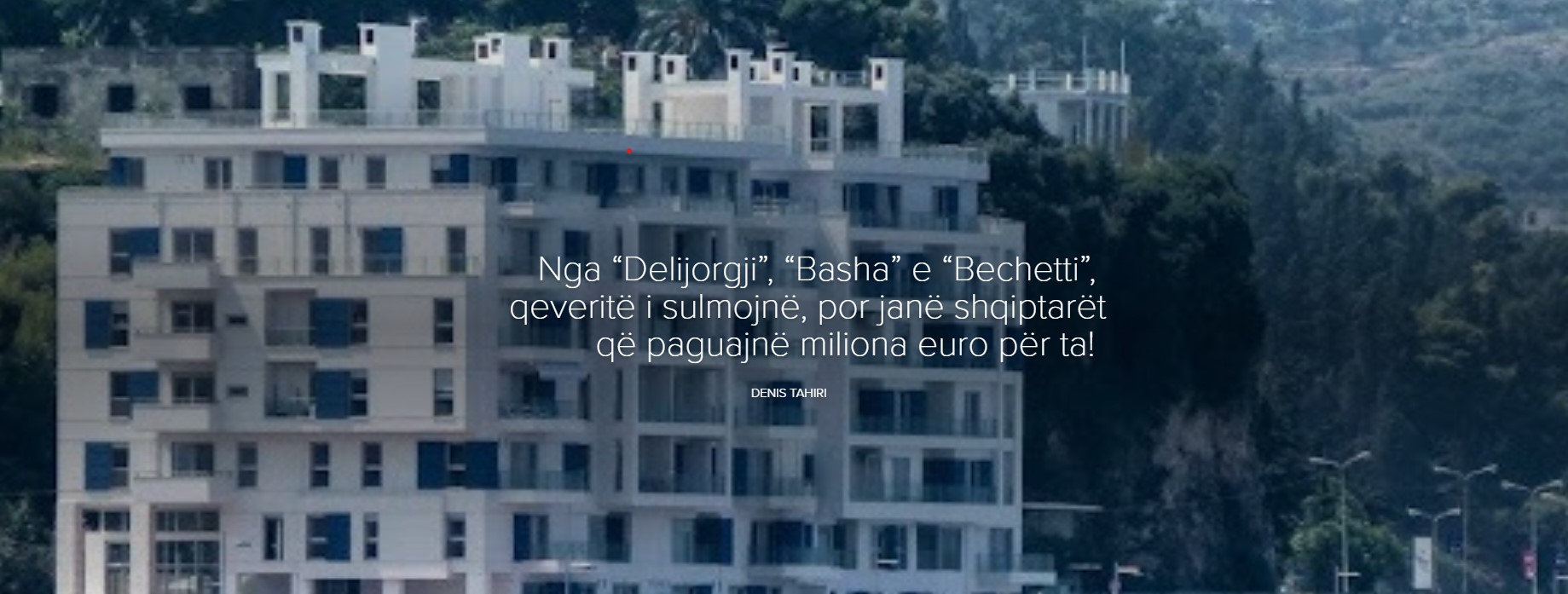
"For the realization of the Lungomare project, it is necessary to combat informality, regarding unauthorized constructions in the coastal area, as well as to avoid heavy traffic. The project foresees the creation of green spaces, as well as the creation of designated places for parking vehicles ," it was stated at the time about the Belgian studio's project for the axis that was labeled as the "Lungomare" of Vlora. Among the buildings that were affected, part of the collapses was also the "Jon" complex, where Xhafer Isufi, the father-in-law of the opposition leader, Lulzim Basha, was an investor.
Among the first who assessed that the object was in the wrong place, was the deputy. The Minister of Transport and Infrastructure, Ylli Majani, who stated that the granting of the construction permit for this building was irregular.
" It is a consequence of a multitude of absolute invalidities, of a multitude of flagrant violations of Albanian law ," Manjani insisted publicly.
The municipality of Vlora was also implicated in a multitude of accusations of violating the law for providing the necessary documentation, but the former mayor of the coastal city at the time would say that he had nothing to do with this and that: "The construction permit was granted by the regional KKRT in 2010, which at that time consisted of many members from the Democratic Party."
Representatives of the majority denounced only in the media about the shadow of illegality in the equipment with the necessary documentation of the complex, but no one went to the prosecutor's office to report any official who should be held responsible. The same thing happened and after the remote-controlled explosion of the building, there was no investigation into those who gave the order to demolish the building outside the legal standards of expropriation, as long as a court order was in effect prohibiting the demolition.
The same mistakes that make millionaires of political opponents
After the decision by the European Court of Human Rights, with a value of 16.806.282.37 euros for all those affected who were damaged by the authorities, property in Vlora, which included inflation and interest from 2013 to 2017, the Prime Minister Rama would declare in a television studio that he would do the same.
"I would do it 1000 times, if I could go back 1000 times. We made a legal expropriation and the complainants did not dispute the expropriation, but the figure. They were dissatisfied with the figure determined by the government and for this they went to court. The expropriation was done because all those who had bought apartments, a certain number of families, had to be compensated for that amount, and in the case where the court has made its own assessments and given its own conclusions, it is the court. We as a state are preparing an appeal at another level in Strasbourg and we will look at the conclusions. But what Vlora has won and what tourism will win, the economy in Vlora cannot be compared to any kind of discussion that is taking place today".
From the battle that took place in the Grand Chamber with the appellant Albania, the injured citizens won.
Even the Albanian institutions against the government
“ The interim order, addressed to any official body, was issued with the aim of preventing any possible demolition of the applicants’ building and was to remain in force until a decision had been given on the merits of the case. Before the domestic courts had decided on the merits of the case, the Council of Ministers decided that the residence should be expropriated in the public interest and the building should be demolished. Therefore, the implementation of the interim order and the outcome of the main proceedings became redundant. The domestic courts at all levels noted that the Albanian authorities had not respected the interim order. The national authorities had not respected the interim order in practice”, the decision of the European Court of Human Rights states. And precisely the haste of the Council of Ministers, where, as the international court also notes, is exceeding its powers. Among other violations that the international court found was the ban on the applicants in the lawsuit accessing their properties for a period of one month, thus effectively losing full control over their properties and the ability to use them.
"The continued denial of access with the aim of demolishing the settlement constituted an interference with the peaceful enjoyment of their property, an interference which was not lawful under domestic law, because the authorities had disregarded the interim order issued by the domestic courts," the Albanian state's violations are further enumerated in the decision of the International Court of Human Rights.
But seen from a comprehensive angle, the former State Attorney General, Ledina Mandija, says that the entire expropriation procedure in Albania was abusive.
"The domestic courts delivered justice, not the European one. The domestic court took a precautionary measure, after they started the demolition, without expropriation acts. The court decided to suspend the works and after the decision was issued, the government began expropriation procedures while it had already demolished the thing. The injured parties appealed to the European Court of Human Rights, while they continued the trial of the merits in Albania. The European court took as a precedent the Italian case where there was a case in the grand chamber where a de-facto expropriation was made, then you pay at the market value of all the property you took due to the violation of the procedures," she says.
The interest of the state is higher than that of the banks, but also the political cost
" Albania has not executed it. A decision is given and the decision must be executed, if the party refers to the Grand Chamber, within three months, the Grand Chamber must express its opinion. Albania has referred to the Grand Chamber and it was not accepted. The Grand Chamber has rejected Albania's request and the decision should have been implemented. After the first three months, interest begins and is paid in terms of the amount awarded by the Court. Currently, the Albanian state is causing greater economic damage to itself," former State Advocate General Ledina Mandija told "Sinjalizo". Meanwhile, the decision of the European Court of Human Rights regarding this issue includes interests of a high value.
The value of the compensation that this court decided for the 20 appellants is a figure of 14,222,986.00 euros. This value is added to inflation from 2013 to 2017 and is calculated to reach the cost of 795,719.65 euros. But to this value is added the interest during the years 2013 to 2017 calculated by the court in the amount of 1,545,551.63 euros.
But from 2017 to 2021, nothing happened and if the state decided to implement the decision at this moment, the figures of millions of euros will have to be multiplied further even for these four years of interest. So simply put, the value of 16,806,282.37 euros goes over 18 million euros.
The former Attorney General of the state, Ledina Madija, states that during her time she followed the practice of implementing the decisions of Strasbourg as quickly as possible so as not to allow the increase of interest.
"Usually, we have always tried to enforce the decisions of the European Court to remove this part of the interest. We could have negotiated with the owners because usually our cases were in the millions, but generally we tried to implement them because of the interests," she says.
The institutions are silent
In the Albanian courts, the case is still in the Supreme Court, which will judge it on its merits. But experts in the field find it very difficult to overturn the foundation decision, which would also lead to a review of the Strasbourg decision.
"It is unlikely, because to be honest, it is a very arrogant and very abusive procedure. Because the way it was done is very abusive and the chances that the Supreme Court will dismiss it as a case are very small. Everything was done without procedure. The European Court has given a final judgment on it and if it happens that the Supreme Court gives a different decision, there may be a request for a review of the decision, but the chances of that happening are very small," predicts former State Attorney General, Ledina Madija.
Regarding the issue of non-implementation of the decision of the European Court of Human Rights on this matter, "SINJALIZO" addressed all the institutions involved in the implementation of this decision, starting with the State Attorney's Office. But the only response from the media office of this institution was the announcement that it was on vacation and therefore there was no one in the office to answer.
As an institution involved in the compensation procedure and the implementation of the Strasbourg court order, the Ministry of Finance stated that: " The Ministry of Finance and Economy has not implemented the ECHR decision in the case of Sharxhi and Others v. Albania. Furthermore, we clarify that, both in cases where the value of the obligation is below 10,000 Euros, and in cases where the value of the obligation is above 10,000 Euros, the initiator for the execution of the ECHR decision is the State Attorney General's Office."
But sources at the State Attorney's Office announced that the request for the implementation of this decision was made by them, and even VKM was compiled that would implement this decision of the European Court of Human Rights.
ACQJ also directed you to the press office of the Prime Minister's office, asking for a response from the head of this office regarding this matter, but there is still no answer. Just as it started, in the complete lack of transparency, it seems that this story will continue, where the Albanian state seems determined to make a group of people millionaires, where the costs of the mistakes of some people, as always, are the Albanian citizens who will pay, maybe this time even more expensive than the court decided. This is a mistake with premises to be repeated. Even with the "Bechetti" case, the same thing is expected to happen, although the government officials insist that "the Italian businessman does not have to receive any money", the fact is that he has won an amount of 110 million euros from the European court. Again, these millions will be taken from the State Budget, where the Albanian citizens are the financiers.