



Regina Pope
Problems with journalists' salaries, delays or non-receipt of them, are consequences that come from an unregulated labor market, but also from a tacit compromise between employer and employee.
Initially, there are journalists who agree to work without contracts and be paid in cash. At first, the compromise is accepted to gain experience, but also because they do not have a better option. Thus, some journalists find themselves in an informal market, which brings job insecurity, loss of years of work and violation of journalists' freedom.
Eni*, a journalist who has been in the profession for 11 years, today does not recognize 9 years of her work, because for this entire period of time she had to work without a contract. Her story began with five years of work on portals and then at Shijak TV and Fax News, where she was not paid insurance. The salary was received in cash, sometimes in full, sometimes in part.
"I called the Fax managers several times to cut my salaries and terminate my employment, but I did not complain to the inspectorate. Many of my colleagues have done this and have not received their salaries. Since they have not received any response from them, it seemed pointless to me," she says.
This happens for the part of the salary that is formally received at the bank, while the informal part remains unpaid in most cases, especially when the journalist decides to leave the job.
"The moment you take it upon yourself to complain, it means you have made the calculations with yourself to leave. If journalist rights, labor relations and contracts worked, then there should be a place where you could complain and then receive an answer, without being forced to leave," says the journalist.
"It is a worsening situation. From the data available to the Albanian Journalists Union, it results that in more than 10 of the country's audiovisual media there has been a lack of correctness for almost 2 years in the non-payment of social contributions of media workers and mainly journalists," says Aleksandër Çipa, president of the Albanian Journalists' Union.
He explains that employment contracts are formulated by the media administrator and signed by the journalist, but without negotiating financial rights and criteria in cases of non-compliance with deadlines; thus, it is not determined who pays the penalties and what they are.
This has led to irregularities with salaries, lack of bonuses or other benefits.
"Journalists' salaries, unlike the salary system that changes in the Republic of Albania, often remain unchanged over a 10-year period. This has led to a decrease in the desire to be a journalist and to exercise this duty alone," the head of the Union concludes.
"The lack of long-term contracts, partial or non-bank payments, and extended working hours show that insecurity and exploitation of the workforce have become part of the daily fabric of the media industry," says journalist Ola Mitre, emphasizing that this job insecurity does not only have economic consequences, but directly affects the quality of journalism.
From the data of barometer for the year 2024-2025, we see a deterioration in informality indicators. The contract trap is used as a tool to maintain control over media workers. The number of those who admit to not having a regular contract has gradually increased in the last three years and has doubled, from 6% in 2023 to 12.9% in 2025.
“Uncertainty is reinforced by the nature of contracts; a journalist with a short-term contract is more likely to fear editorial pressures and subject himself to self-censorship, for fear of non-renewal,” says Mitre.
Is the Labor Inspectorate doing its job?
From the request for information addressed to the State Inspectorate of Labor and Social Services, data on inspections carried out in the last two years in the media have been provided, resulting in a total of 184 inspections: 106 in 2024 and 78 in 2025.
Data for previous years are missing, as there was no specific division in the monitoring reports to clearly indicate inspections in the media. “… media activity is classified in the group 'Other', which also includes activities such as Services, advertising and market research, creativity, arts, entertainment activities, etc.” – states the Inspectorate’s response.
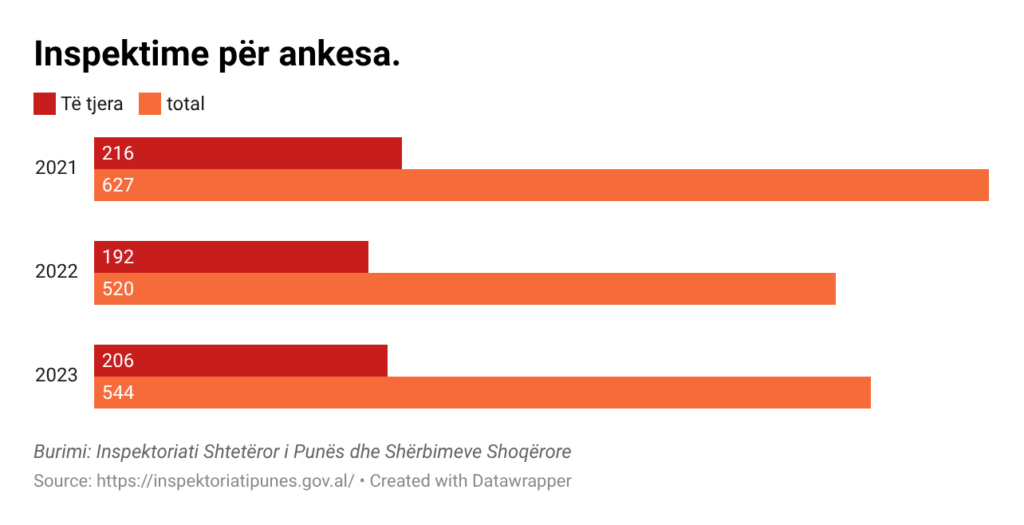
According to data from these reports of the IHS, from 2021-2023, more than 1/3 of all inspections were carried out for the "other" category due to complaints. In these three years, a total of 34 fines were imposed.
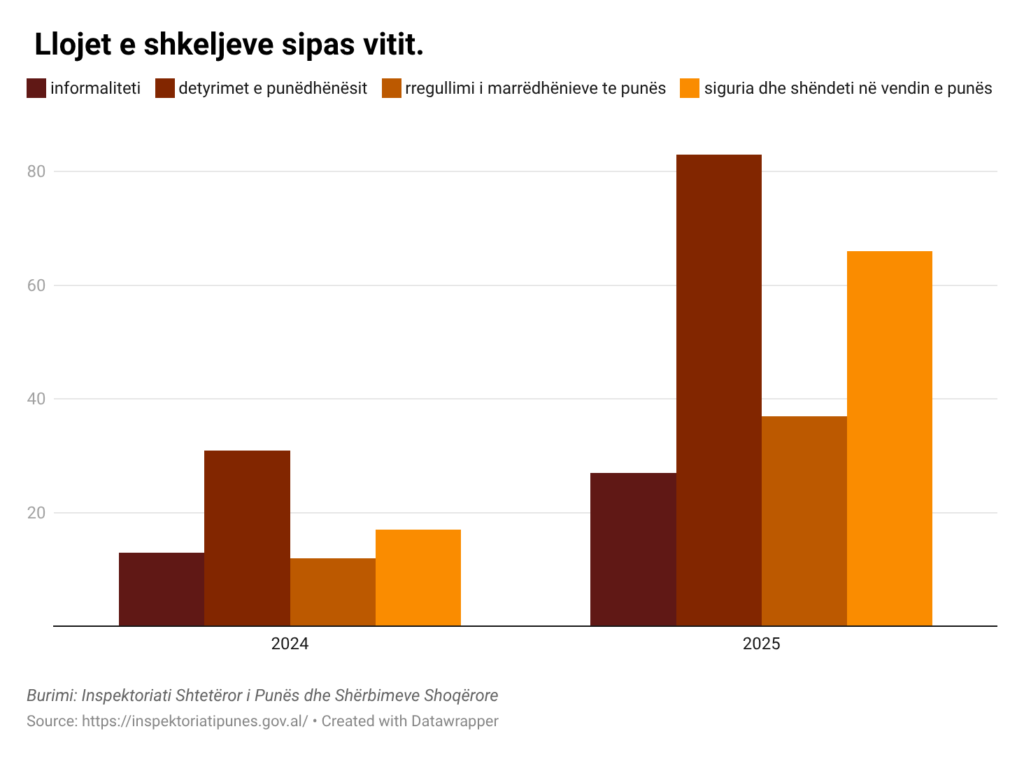
The highest number of violations found in 2024, 83 of them, belongs to the category "Employer's obligations", which follows the same trend in 2025, and although with 31 violations their number remains much higher than other categories. In 2024, 149 cases are violations of the Labor Code, which include violations with wages and contracts, while in 2025 there are 52 cases.
A total of 70 complaints were received from 2021-2025, and of these, only 3 fines were imposed.
According to the testimony of journalist LM, who has worked at MCN television for three years, there have never been any inspections by the Institute of Public Health.
"They never came and the last fine there was imposed in the case of a public figure, who publicly denounced it and then the Labor Inspectorate remembered to visit the television premises and impose fines," he says.
Requests for information sent to the official email addresses of the media outlets mentioned in the article went unanswered. Shijak TV, Fax News, and MCN TV were unreachable, while News24 had not responded by the time of publication of this article.
Why are there no court cases?
The clash with the media seems to be a long and tedious process, which is reinforced by the data obtained from a request for information addressed to the First Instance Court of General Jurisdiction in Tirana, which resulted in only 17 substantive cases under review with the subject matter of "lawsuits for employment relations".
According to AC, a former News24 employee, "No one has the time and energy to follow a process that drags on in a system where the owners of these television stations have connections with prosecutors and judges. So facing off at the doors of the courts, when you know the development, is an option that you don't consider at all."
Isa Myzyraj, president of the Albanian Journalists Association, says that the mechanisms exist on paper, but function poorly in practice.
“The Labor Inspectorate rarely intervenes and usually only after public pressure. Court proceedings are long, costly and often unaffordable for a journalist who does not have financial stability. AGSH demands regular employment contracts for all journalists, dignified salaries, effective legal protection and real punishment for violators of labor rights.”
Bleriana Bino, director of the Center for Science and Innovation for Development (SciDev), speaks about the shortcomings that make the judicial process difficult for journalists in our country. There is a lack of legislation, the empowerment of independent organizations and, according to her:
“Some improvements have been made, at least at a formal level, to strengthen the measures and obligations that the state has to protect journalists, but they are not sufficient; the impact in practice is very weak and is not yet felt. For example, free legal aid is not yet an option for journalists.”
From the request for information addressed to the Albanian Radio Television, information was obtained that there are 46 decisions of the First Instance Court of Tirana with the object of judging unfair dismissal from work, taken against the interests of RTSH in the last 3 years. There are 39 final decisions from the Court of Appeal.
The total economic bill of these decisions is around 28 million lek. For 2024, the value of payments for court decisions with this object is 12,541,372 lek, while for 2025 it is 26,274,143 lek.
Journalist independence and media freedom
"When you face reality, you realize that you can't make any difference in this country, so over the years you have two choices: either you go against your principles or you retreat into silence.", says a former News24 journalist.
In 2025, economic pressure was one of the biggest problems affecting media freedom, from Reporters without Borders report.
According to expert Bleriana Bino, this is a result of the combination of media ownership structures with other political or economic interests, which do not allow sufficient space for journalists to secure their rights.
"There is a layer of unfair pressure that comes from the mismatch between interests that promote certain content agendas versus what should be the advancement of the public interest and the public agenda.", she says.
"The financial model is both the problem and the solution at the same time."", concludes Bino, emphasizing that diversifying this model is vital to reducing the vulnerability that media have to funders. This can be done through membership, subscription, donations, etc.
"Transparency in media ownership is required, a clear separation between political and editorial interests, as well as real guarantees for the independence of editorial offices. Only in this way can we talk about free media and independent journalism.", says the head of the AGSH.
Myzyraj calls it dangerous to normalize this situation, when in fact it is a serious violation of labor rights, which in any other sector would be treated as serious abuse.
In Albania, it is often not about direct censorship, but about a phenomenon described as "media capture", where a small number of actors control a large part of the media market and audience.
Professor Ervin Goci, from the Department of Journalism and Communication, says that to improve the situation, legal and institutional reforms are needed that guarantee the transparency of media ownership, limit market concentration, protect the editorial independence of journalists, and guarantee media freedom and pluralism.
The law should be aligned with European standards such as European Media Freedom Act (EMFA). A system should be created that makes the real owners and beneficiaries of the media transparent. This aims to avoid the concentration of ownership in a few hands and conflicts of interest.
"The European Union insists that journalists should not simply be the last link in the technical execution of a process, which has its origins much deeper and much earlier," he adds.
Goci argues that the journalist must protect his own news, while simultaneously protecting the weight of his own decision-making and his own social status in the workplace and within the framework of the profession. "It is absolutely not appropriate that a person, just because they are employed, should not have the freedom to imagine the quality of their work and their future."
He says that the independence of a journalist can be measured by the quality of information. Today, journalists are kept away from this and are not given the conditions to practice journalism on the ground, "This kind of freedom is denied to them by stripping them of all their resources, paying them poorly, and not providing them with the finances to conduct reports."
What is the future? Regarding the number of students in the journalism department, it has been declining. Pedagogue Goci says that the nature and difficulties of the profession may make students not go towards it. Meanwhile, they are given the opportunity to study in alternative fields according to their interests, which the department now offers with the changes in the labor market, where marketing, social media management, etc. are introduced.
Regarding the media landscape, taxpayers with a niche who exercise activity in the field of audiovisual, written and electronic media, according to the General Directorate of Taxes, are 1048 entities during 2024, with a total of the same number of employees.
According to the 2025 annual report survey: Monitoring Albania's progress on media freedom and the safety of journalists in line with EU standards, 44.8% of journalists say that there has been no change from 2024 to 2025 in terms of working conditions. A large proportion of journalists surveyed for this report, 41.5%, do not perceive any change in working conditions compared to last year. 36.8% of them perceive a deterioration.
Thus, the problems would be summarized in the compromises made by journalists themselves, the dysfunction of relevant instances, the media's dependence on its financiers, and pressures, whether editorial or from political power.
The bad thing is that this all revolves around the main role of the media, the primary job of the journalist, informing the public, which has remained secondary to these individuals who are trying to postpone the month like everyone else.acqj.al