



Ida Ismail
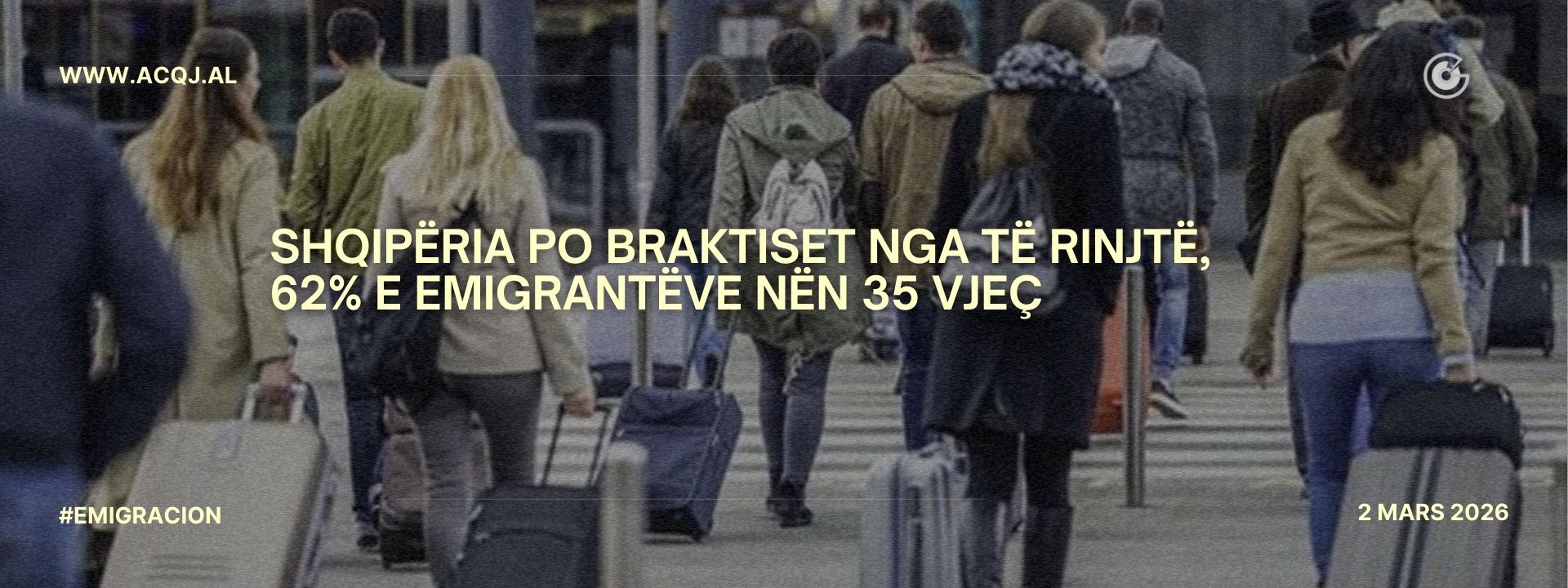
Our country is facing a new and accelerated wave of emigration, where young people and young families remain at the center of the departures. Data published by Eurostat show that during 2024 alone, around 44 thousand Albanians emigrated to European Union countries, further deepening the demographic crisis that has accompanied the country for more than three decades.
After the pandemic, the pace of emigration has accelerated significantly. According to Eurostat, for the period 2021-2024 alone, at least 180 thousand people left the country, not including data for Greece and the United Kingdom, the latter of which experienced a peak in departures in 2022.
The dominance of young people in the wave of immigration
According to Eurostat data for 2024, processed by Monitor, 62% of immigrants were under the age of 35. The largest group consisted of young people aged 25-29, with over 6 thousand people or 14.3% of the total. They are followed by the 30-34 age group, which makes up 13% of the total.
Another worrying phenomenon is the departure of young families with young children. The age group under 15 years old accounted for about 18% of those leaving, which shows that emigration is no longer an individual phenomenon, but a family movement with long-term consequences for the population.
Meanwhile, a significant portion of the experienced workforce is also leaving. The 35-49 age group accounted for 20% of emigrants in 2024.
According to labor expert Gertjana Hasalla, unemployment figures in Albania remain high, especially for young people, while the quality of employment often falls short of expectations.
"People don't find themselves in employment. The labor market in Albania is not easy. Many choose to work two jobs," says Hasalla.
Not finding themselves in the domestic market, the expert highlights that some young people choose to leave the country for better prospects and more dignified salaries, seeing emigration as the only solution for economic and professional stability.
The exodus of young people and changing lifestyles have also led to a sharp decline in birth rates. In the early 90s, Albania registered 82.125 births per year. By 2025, this number had dropped to just 21.425 births, a decline of about 74%.
The fertility rate has fallen to 1.21 children per woman, well below the replacement level. Progressive aging, youth emigration, and changing family patterns have fueled one of the deepest demographic crises in the country's modern history.
From INSTAT data on emigration, the difference between those leaving and those returning confirms that the country continues to lose population in a steady manner.
The figures show that Albania is losing the most vital part of its population, young people and young families, facing a demographic challenge with long-term consequences for the country's economic and social development. Albania today faces major challenges in terms of the policies it must pursue in order to curb the departure of young people from the country. The economy is weak and uncompetitive and job offers in the European market are increasing, forcing many young people to see emigration as an alternative for a better future./acqj.al