


Author: Klevis Paloka
With the argument that it will reorganize and restructure the transport service due to citizens' complaints and inspectors' monitoring, the municipality of Tirana announced that from June to the end of August the general subscription will be removed. From this measure, it was shown that subscriptions for special lines that are sold normally would be excluded, while for general subscriptions, September was seen as the month when they will be put back on sale. The months of June, July, August are considered by the Municipality of Tirana as a period during which the city's public transport operators will be required to restore the full conditions of service provision, according to the terms of the contract, providing full service with 100 percent of capacity of means in operation.
But the decision of the Municipal Council of Tirana, which was met with protest, once again brought the problems of urban transport in Tirana into focus. Although the problems were exposed more clearly during the pandemic, for citizens, everything is related to the financial effects that are caused in their pockets, but also the quality of this service.

" Once they raised the price of tickets and passes, now they are removing the general pass altogether, under the pretext that they will reform urban transport, but in fact the opposite has happened, conditions have worsened more and more ," begins his story, 50-year-old Fatmir Sefa, who, due to his work as a plumber, is forced to move from one urban area to another.
Sefa does not hesitate to call the cancellation of the subscription an economic loss, since it forces him to pay a dedicated ticket for every bus he takes.
" We are spending our salary on tickets, it's up to us to work for tickets because I have to buy three tickets, since I change three different buses a day to go to work. So far I have not bought any tickets and I change the urban bus 6 times a day, I spend 240 lek a day on tickets. It's not a political issue, this is directly a matter of pocket money ," the plumber concludes.
Even for Shpresa T., who works as a sanitary worker in two different places in Tirana, the removal of the subscription costs a lot, after the first day of June she is forced to buy two or three subscriptions to reach her destination. And according to the woman, the citizens were ignored even though they are part of the community and they needed to be consulted.
" I work in two different places as a sanitation worker, and I have to go from one end of Tirana to the other. The general subscription was more economical, since you buy it and travel on any urban line, while now I am forced to buy 2-3 subscriptions, since I change 2-3 urban lines a day. I have to take the urban line "of the ring road", "New Tirana" and "Combinat ", says Shpresa.
Like Fatmiri, for Hope, the impact on family income is negative.
" The little salary I get, now I have to leave half to pay for the line passes, because even buying tickets every day doesn't make up for it. I hope this will be removed as soon as possible and the general passes will be restored to us ," the 53-year-old appeals.
Citizens were not counted
The Director of Complaints at the Albanian Consumer Protection, Hasan Stafa, tells the Albanian Center for Quality Journalism that with this decision the opportunity has been removed not only from the capital city, but hundreds of citizens who come from the districts and have economic difficulties because they live on rent or in peripheral areas of Tirana. That's why Staff, to be more specific, talks with numbers.
" Public transport is used by over 423 thousand residents of Tirana and the entrances and exits from the districts. About 146 thousand general passes have been removed. Over 90 thousand workers in the following subjects have been penalized: tailors, call centers, construction, public health workers, police, students, pupils. Over 70 thousand are housewives, job seekers, pensioners and disabled people ", Stafa counts the effects.
According to him, even though there has been an increase in the price of both the ticket and the subscription, as well as the urban lines, but also the general one, more than half of the means of public transport do not meet the basic standards.

" 70% of the means of transport do not meet basic standards, seats, ventilation, distance, air conditioners. The price is abusive, as consumers are being extorted and very little has been invested. We will ask that consumers protest, by increasing their travel, starting with 2 days a week, as removing the season ticket costs about 27% of the income from the pocket of private sector employees ", concludes the Director of Complaints for ACQJ.
For his part, the executive director of Qëndresa Gytare, Rigers Xhemollari, sees the removal of the general subscription as a decision of the City Council in the interest of businesses and public transport operators and not in the interest of citizens. According to Xhemollari, an important legal link such as the hearing was overlooked.
" The decision to remove the general subscription from circulation for 3 months is a decision with a direct financial effect on the residents of the capital, and as such, an important legal link such as the public consultation process was bypassed. Do citizens agree, why is the subscription being temporarily removed and how does it affect the restructuring process?
Secondly, the Municipal Council has a representative role to make decisions in the interest of those it represents, that is, the citizens, in this case the Council has made a decision in the pure interest of business and public transport operators, who are expected to have a financial breathing space from this decision to put their entire fleet to work, but by emptying the pockets of residents on a daily and direct basis ", says Xhemollari.
Multiple costs
That's why the leader of Qendresa Gytare emphasizes that the removal of the subscription will have a multiple cost to the detriment of the students.
" As long as there are no general or student passes in circulation, the cost to citizens with low economic income and students will be 3 to 6 times higher than with passes. Today, someone who previously traveled two bus lines with a general pass will pay 3200 lek more than they used to, while a student will pay about 3800 lek more, costs that directly affect the lives of these citizens ," emphasizes the head of the Citizens' Center for ACQJ.
Civic initiative
Immediately some activists of the "Political Organization" organization took an initiative to sign a petition to change this decision. According to the activist, Klodi Leka, this reaction has come as a form of expressing citizens' dissatisfaction with the situation in which the public transport service is located.
" In fact, it was not just our idea, it is a kind of dissatisfaction of the entire last decade, we can say, the last 10 years of citizens with the state of public transport in Tirana, which is increasingly aggravated and worsened and often has both mental and professional costs for citizens. Even seeing the massive dissatisfaction of citizens with the fact that the general subscription was removed, we took this initiative as activists to sign a petition, to submit to the Tirana City Council and the Mayor, Erion Veliaj ", says Leka.
The 29-year-old emphasizes that there has been a great awareness of ordinary citizens who have reacted in their own way.
" In 5 days, about 8 thousand citizens have signed, but we expect more than that, since there has been a sensitization of citizens to sign it. There are about 220 thousand citizens who use it in their daily lives and are people who, with their work and activity, keep Tirana afloat. It's not just about the signatures, it's not just a matter of numbers, it 's a matter of high social sensitivity that affects the working classes ," said the 29-year-old.
Sakaq Leka shows how much is the economic cost that is added by removing the subscription.
" As we have seen over the past five days, the category that has signed this petition the most is that of sanitation workers, as their complaint is that now that their bus pass has been removed, half of their salary goes to buses. Another category is that of construction workers.
"From a calculation we made, it turns out that in a family of three, where both parents work and their child is a student, the social cost goes from 4000 lek to 5000 lek per month, and as family members are added, the social cost also increases ," says Leka.
What happens to the subscription?
At the end of December 2015, the Municipal Council made the decision to increase the bus ticket price by 10 Lek, increase the price of the general subscription by 400 Lek, while the single line subscription increased by 300 Lek. The Mayor of the Municipality, Erion Veliaj, at that time justified the increase in the ticket price as there would be reform and modernization of urban transport in Tirana.
Even in the decision taken by the Municipal Council, it is emphasized that the electronic ticketing system will be introduced in the urban transport lines.
" The ticketing and subscription card system will be electronic. In electronic ticketing, categories of people who benefit from free travel as well as students will be provided with personalized cards. Until the application of electronic systems, it will operate according to current ticketing and subscription card standards ," the decision of the Tirana Municipal Council states.

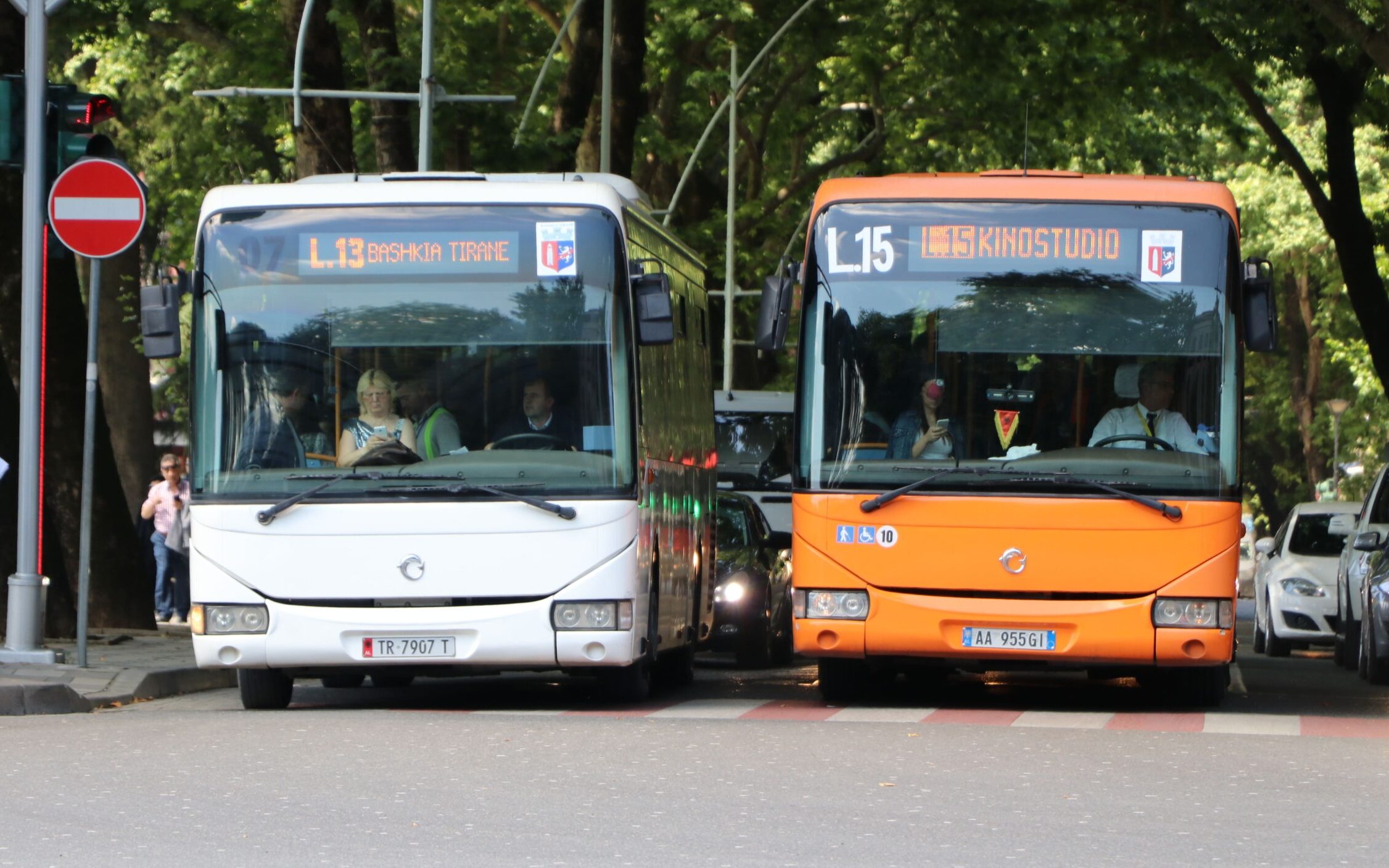
But a simple observation of the main urban lines in Tirana shows that the conditions are the same as in 2016, and have even worsened. The electronic ticketing system is missing. Another big promise of Mayor Veliaj was the replacement of buses with electric ones. But the facts show quite the opposite, and even this matter has been completely forgotten.