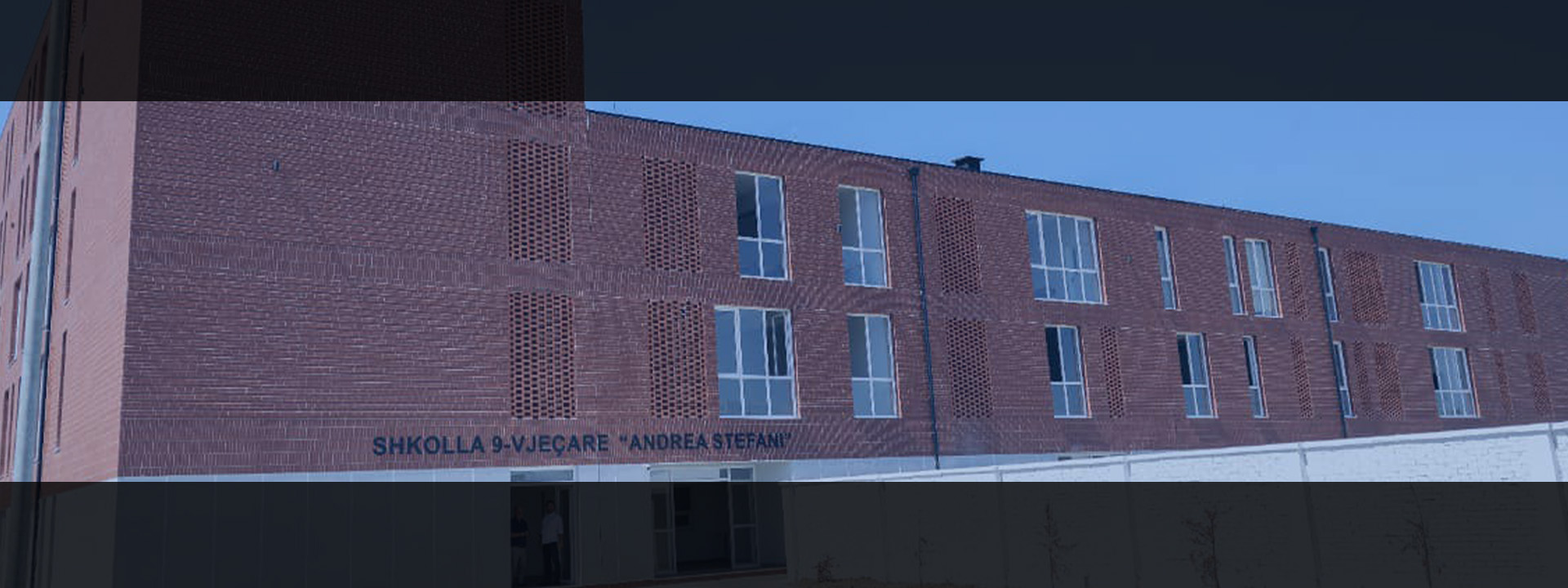



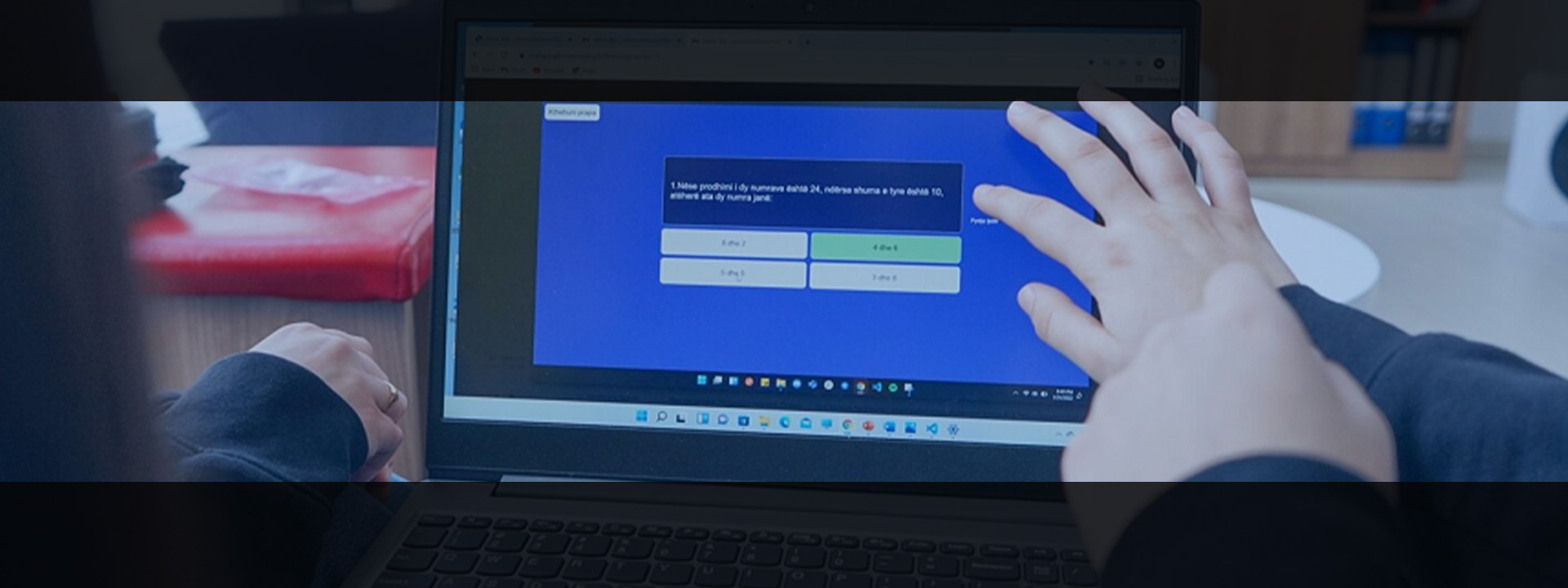
Information and Communication Technology (ICT) is in the curriculum of first grades in selected pilot schools in Albania for the academic year 2022-2023. But in the same year, 91 public educational institutions were equipped with depreciated computers. The increase in funds within the digitalization of schools is not enough and teachers are facing difficulties in their work.
Author: Dallandyshe Xhaferri
At the start of the 2022-2023 school year, the former Ministry of Education, Evis Kushi, presented as an innovation the inclusion of the subject of ICT (Information and Communication Technology) in the curriculum of the first grades in 100 pilot schools. In the context of the digitization of teaching Services, the enrichment of laboratories and school libraries, for the first time in the budget of the Ministry of Education and Sports, a higher amount of money will be allocated compared to previous years.
"This year, a very high budget has been allocated, like never before, 5 million euros," said Kushi.
According to public data, 10 million ALL from the budget of the Ministry of Education for the year 2023 went for the purchase of electronic equipment, computers for public schools of basic education.
We directed you to the General Directorate of Pre-University Education to find out if public schools are equipped with technological tools such as computers, which are necessary in teaching in the context of the inclusion of digitization in the teaching curricula.
In the response received by "Sinjalizo" from this directorate, it is stated that for the 2022-2023 school year, the number of public schools equipped with depreciated, i.e. non-functional, computers reaches 91.
"From the processed information (received from the DRAPs) it results that the number of educational institutions with functional computers is 1090 compared to the 1181 public educational institutions we have in total," - it is written in the response of the General Directorate of Pre-University Education.
In other words, based on these figures, it results that in basic education institutions there is less than one functional computer per school.
The MAS budget has again seen an increase for 2024. It increased by 10.7% compared to last year, reaching a value of 52 billion and 223 million lek. From this budget, 110 million lek has been approved to be made available for the purchase of electronic equipment and computers for basic education. “The budget will finance the creation of friendly classrooms for the installation of 216 Smart Labs, which will enable the expansion of programs from the first, second and further grades of the new coding curriculum in schools, and will also continue to support didactic equipment for science laboratories in schools,” it says on the official website of the MAS , although the teaching of Information Technology for the first grades has started since the last academic year, 2022-2023.

ICT in schools without computers
Despite the increase and forecast of the MAS budget for the digitization of schools, teachers of the ICT subject this academic year also face the lack of infrastructure to carry out the lesson in the right way.
Gerta K., ICT teacher for 5 years in Tirana, admits to "Sinjalizo" that even in cases where public schools, 9-year old or High School, have computer rooms, the computers are not always functional.
"They have computer rooms, but not all computers always work. I don't believe that it is necessary only under these conditions, they need more updated ones, which means functional computers with internet access, electronic boards, projectors," she says, adding that in cases where teachers lack digital devices in schools, they find the solution individually. "When devices are missing, I use a personal computer, laptop or the student's textbook."
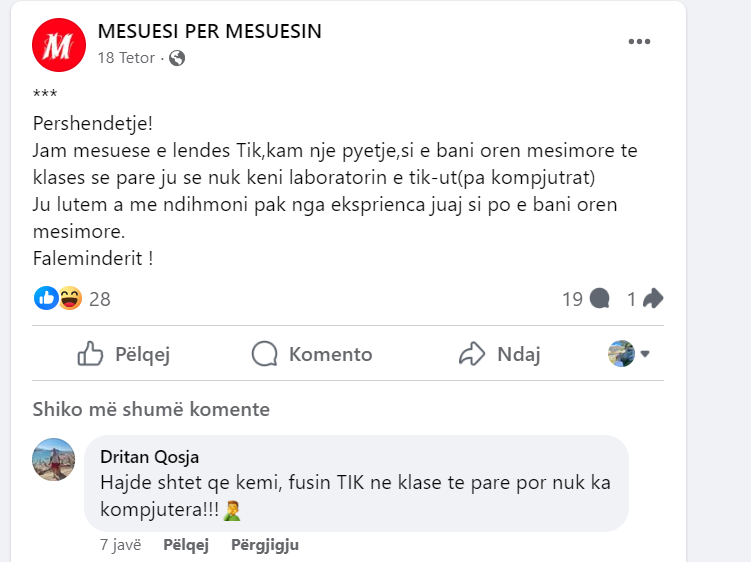
Teachers have not hesitated to share the problem of the lack of computer equipment in public schools, even on online platforms. "I am a teacher of ICT (Information and Communication Technology), I have a question, how do you conduct the first grade lesson since you do not have an ICT laboratory (without computers). Please help me a little from your experience how you conduct the lesson", - this is one of the many anonymous posts on the platform "Teachers for Teachers" , where teachers seek help from each other's experience to conduct lessons at a time when schools lack the necessary infrastructure.
AT, a primary school teacher in one of Berat's 9-year schools, tells "Sinjalizo" that the number of computers in schools is not enough for each class.
"As for ICT, there is one cabinet. I have sent students there twice since the beginning of the academic year. The reason is that they are busy with the 9th grade classes. There are 3-4 parallels, there is no time for the fourth and fifth grades," she says, adding that another problem is updating Information Technology books in schools.
"I, as a parent, ask my child to account why he gets this grade in ICT and he answers me that the program included in the book is not updated like in the computer. I received this answer three years ago from one of my primary school students, that he was confused between the information in the book about the program and what he saw on the screen".
Millions of ALL for digitization since 2015
For almost a decade, the digitization of schools, the creation of smart classrooms and the provision of digital educational Services have been designated as priorities by the Ministry of Education and Sports.
In 2015, the then Minister of Education and Sports, Lindita Nikolla, declared that through the $3.5 million project, all high schools in the country would be able to have their own digital classrooms.
"Thanks to the Albanian government's investment of 3.5 million dollars, this new methodology in smart classes is now a reality in 60 high schools across the country, and I believe that the students' results will be a model of success. We are determined not only to make this methodology efficient in other subjects, but to extend it to all high schools," said Nikolla, emphasizing that smart classes were the implementation of the government's program, while the creation of online SMIP (Pre-University Information Management System) records would not be left behind.
Also, Prime Minister Rama, during a public appearance at the "Sami Frashëri" high school, stated at the time that within 2018, all high schools in the country would move into the digitalization phase.
"In three years, all high schools in our country will move from the stage they are in today, to this new phase of modernization of the knowledge system," the Prime Minister declared. After almost 4 years since 2018, digitalization has not yet been extended to all high schools in the country, while in the pilot schools that were included in this project during 2015, digital classrooms have limited use.
Bukurija, a former graduate of the "Dhaskal Todri" school in Elbasan, says that digital classes are used by students only when they have to present projects in certain subjects.
"There are 2 digital classrooms and they are used by students when they present projects at the end of the quarter or at the end of the year. It depends on the importance of the assignment given by the teacher," she explains.
While the budget for digitization increases, educational institutions continue to face the lack of technological infrastructure. In addition to the difficulties of developing the ICT subject, according to the International Student Assessment Program "PISA 2022" for 15-year-old students, Albania ranked 62nd in the ranking of 80 countries participating in the assessment.
According to the results of the assessment of students' knowledge, Albania has dropped by 47 points in reading from 2018, receiving 358 points. Meanwhile, in science, students' knowledge was assessed with 376 points, 41 points less than in 2018.
This article was created based on input provided by individuals who have chosen to speak up. Share your story, empower others and be an agent for change. Visit the website: www.acqj.al/sinjalizo-dhe-ti/