


Author: Klevis Paloka
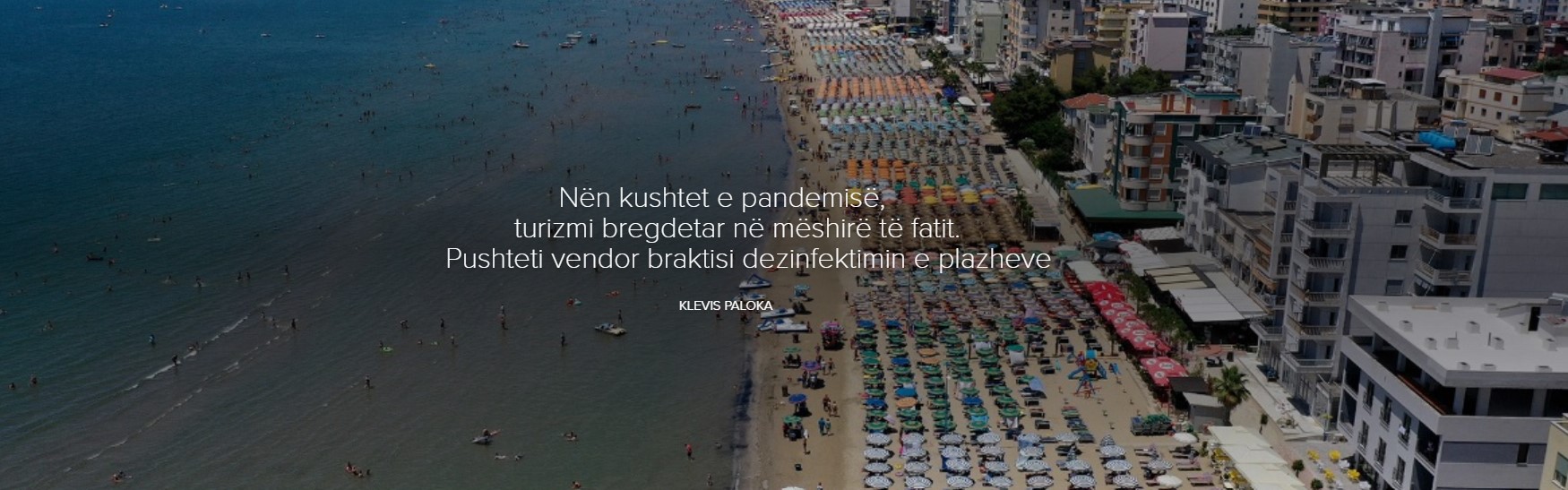
Public health expert Ilir Alimehmeti reiterates that the disinfection of beaches should not be neglected, even more so in times of pandemic.
" Disinfection of beaches and any tourist environment should be carried out normally, as always, to prevent infectious diseases in general ," says Dr. Alimehmeti for "SINJALIZO!".
But for the second year in a row, even though this summer season, like all over the world, was affected by Covid-19, the conditions to ensure the safety of beachgoers left much to be desired. So the documents show how the Ministry of Health and Social Protection together with the Ministry of Tourism and Environment in cooperation with the National Coastal Agency approved the joint order for the "protocol of anti-covid-19 measures during the tourist season".
Among many criteria, one of the measures defined in this protocol is the disinfection of their premises by the owners of private entities. But before this criterion that is assigned to private entities, the municipalities that own the beaches should carry out their disinfection at the beginning of the season.
At this point, the Ministry of Health and Social Protection responds, " Disinfection is a process carried out by local government ," it says in the response to the Albanian Center for Quality Journalism.
But some of the municipalities that manage the beaches along the coastline did not provide funds for this process.
" The Municipality of Saranda has not held a tender for the disinfection and cleaning of the beaches on its territory for 2021 and for the summer season ," states the official response of the Municipality of Saranda to ACQJ.
In addition to Saranda, other municipalities, such as Himara, Vlora and Shkodra, also acted in the same way.
" In the Himara Municipality, no tender has been held for the cleaning and disinfection of beaches for 2021 ," the Municipality's response states.
" The Municipality of Vlora emphasizes that to date it has not conducted any procurement for the purpose of disinfecting and cleaning beaches ," the Municipality of Vlora told ACQJ.
Even the Municipality of Shkodra has not conducted a tender for beach disinfection.
Only Durrës was disinfected
The only municipality that has conducted a tender and that has foreseen in the draft budget of 2021 for the disinfection of beaches is the Municipality of Durrës.
" Regarding the Tender for disinfection, we would like to clarify that: From the 2021 Draft Budget approved by the Municipality of Durrës in the foreseen items, in account no. 602, (operating expenses & maintenance), the Municipal Enterprise Plazh has planned a small-value procurement for disinfectants worth 480,000 Lekë. The winning company is "Zeqiri Shpk", for the "purchase of Helm Citroforte, disinfectants" worth 418.800 Lekë with Procurement Order 'No. 8 dated 11.05.2021" , it is stated in the official response of the Municipality of Durrës.
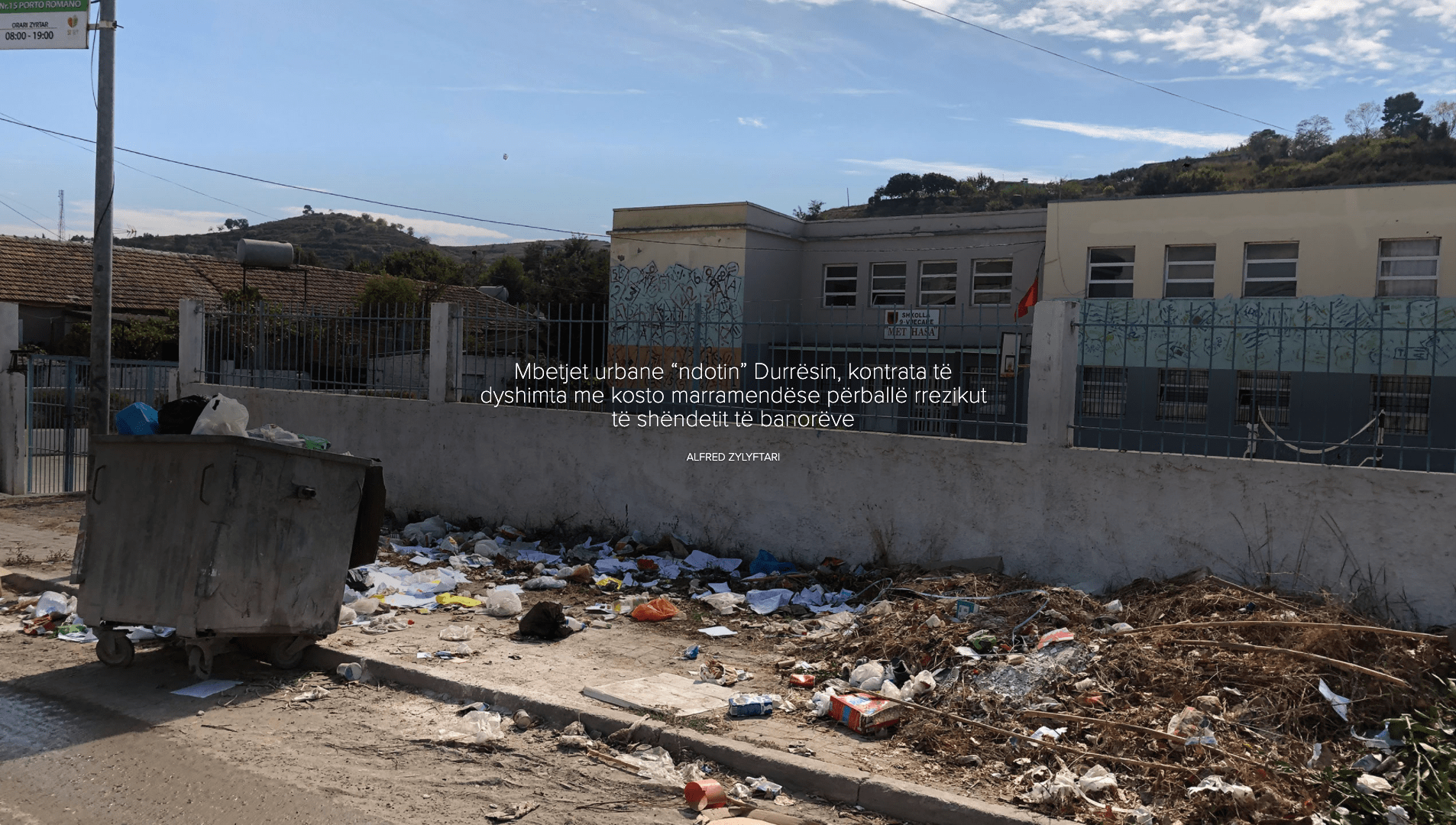
But even though tenders for disinfectants and also for the cleaning of these beaches have been foreseen, the beaches in the Durrës area are the most problematic in terms of waste cleaning. Overflowing garbage bins occupied not only the main roads but also the businesses along the coastline of this city.
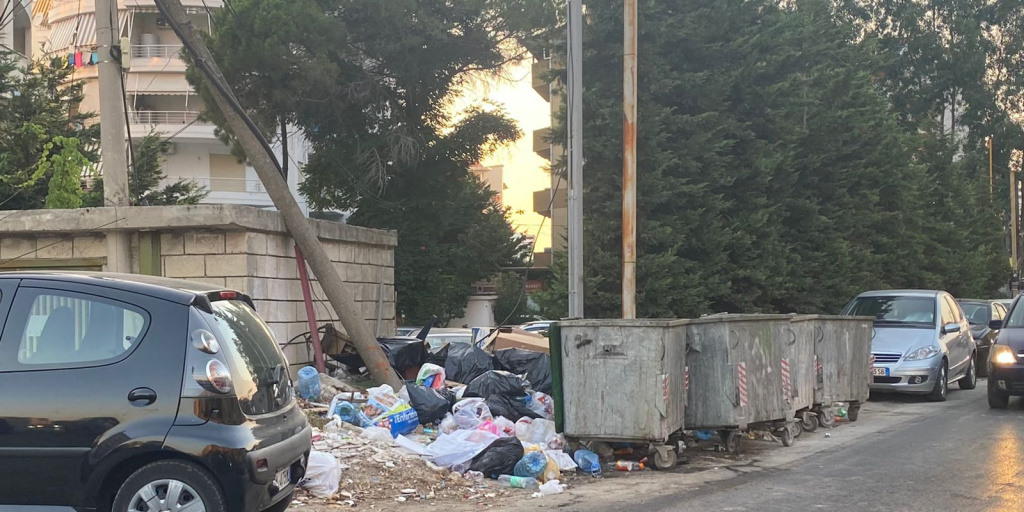
" The cleaning of the city is carried out by enterprises under the Municipality, namely the Durrës Municipal Service Enterprise and the Beach which cleans the area (Plazh, Shkozet, Rrashbull). NK Plazh with its vehicles removes urban waste, including inert, seaweed, wood, etc. These vehicles make 1–2 trips every day. In the tourist season that starts in May, the number of trips they make can increase depending on the waste until the end of the season at the end of September ", emphasizes the Municipality of Durrës. But in fact, reality shows otherwise.
" They are cleaned, but the waste needs to be cleaned twice a day, these people only clean it once and as you can see, it looks pretty dirty ," says a resident of Durrës. Even the images of the garbage dumps on Golem beach clearly show negligence in regular cleaning by the Municipality of Durrës.
Businesses are equally indifferent
In addition to disinfection by local institutions, subjects have an obligation to disinfect their premises every day, but this is not done by almost any subject.
"I've been here since the beginning of the season, and I haven't seen the hotel premises disinfected, nor the beach or pool area ," signals an employee of a hotel in the Himara area on condition of anonymity. He is not the only one, others write to "SIGNALIZE!".
"The beach in Durrës is full of seaweed" writes a citizen, according to whom even the announcement that this beach would be cleaned was just propaganda.
Controls and inspections
In order to control the implementation of these measures, it was decided that monitoring should be done by the National Coastal Agency and the State Health Inspectorate.
According to AKB, from the beginning of the tourist season until the middle of August, in 82 cases the inspectors have carried out verifications on the ground.
"We have conducted 50 controls, 32 inspections, of which we have imposed 25 administrative measures, 8 fines for lack of a beach station contract worth 1.600.000 lek and we have given 17 warnings for failure to meet the criteria according to VKM 171/2019 ," the AKB's response states.
While for the respect of health protocols, the competent institution to carry out the inspection was designated the ISSH.
ACQJ contacted the Chief Inspector of ISHH, Vjollca Braho, to ask about the monitoring that has been carried out during these times on the beaches, but did not receive any response.
From an observation on the website of this institution, it can be seen that daily monitoring reports have been published in the field, but the results and data on what has been concretely found are missing.
For his part, the hotel employee in the Himara area says that he has never seen any inspection group in his workplace, neither for the implementation of anti-covid measures nor for the implementation of VKM 171/2019 on the stations of the beach.
They all say the same thing: there are problems with the protocol
The non-implementation of anti-covid measures by the subjects is also confirmed by Zak Topuzi, chairman of the Albanian Tourism Association.
" Of course, there were entities that did not implement the measures and were out of control, but the clients themselves were the ones who reported them to the police or social networks ," Topuzi told ACQJ.
Although it is regulated by law and a special VKM such as VKM 171/2019 , one of the problems that continues to appear on Albanian beaches is the space that must be left by people who rent a beach station for public use.
In many beaches of the country, there is a lack of space that should be left for the general public to use the beach.
This issue is also highlighted by the High State Control in the audit done and describes the 80% private and 20% public ratio as unverifiable in the field.
" The 80% private and 20% public ratio is unverifiable in the field, considering that it refers to a general territory for application, and not specific to each beach area. Consequently, the 20% public space, from an objective legal obligation, turns into a subjective obligation, because in the absence of a planning determination by the Council of Ministers, it is left to the discretion of the municipalities as to where this band will be applied ," the KLSH audit states.
Also in this audit it is stated that the 20% that is reserved for the public constitutes a beach territory that is not suitable and accessible for citizens.
" From field observations it results that the 20% reserved for the public constitutes a beach territory that, due to hygiene problems or remoteness, is not suitable and accessible to citizens. This causes a fulfillment of the legal obligation only for statistical effect, and not in the function of guaranteeing public access to the beach ", emphasizes the SAI audit.
While unlike Albania, our neighboring country, Montenegro, which has a shorter coastline than us, has determined by law that any entity that rents a beach station is obliged to leave 50% of the beach for public use. of the space he rented, so there is a ratio of 50% private and 50% public.