


Denada Jushi
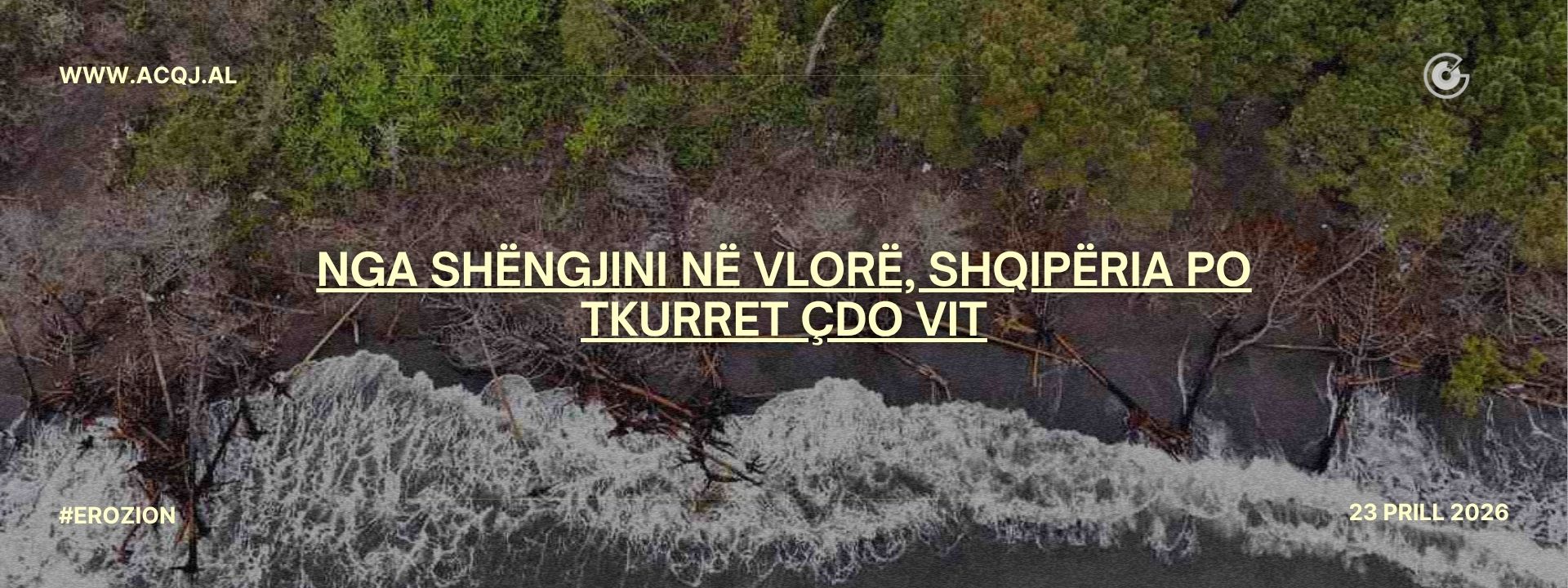
Agimi has been a resident of the Shëngjin Lagoon for three decades. He built a three-story villa across the national road, when the sea was far from his house. Today, in winter, he says there are times when water enters the first floor by crossing the road. The reason? Erosion.
"Every year the sea comes closer to our house, causing damage. We try to put a few sandbags in every year with our son, but it's becoming insufficient."
Albania is one of the countries with the highest erosion in Europe. It could be in the top 5, says environmental expert Olsi Nika.
Erosion is a natural process that means that the soil is worn away by water or wind. But in Albania, this process has gone out of control. This is due to the relief, climate change, but also by the hand of man.
About 20-30% of the territory is considered affected by erosion, while in certain areas losses reach up to 20-30 tons of soil per hectare per year. In total, the phenomenon has affected about 350 thousand hectares of agricultural land, more than half of it.
A study of recently published by Enkelejda Kucaj, Sherif Lushaj and Marilda Osmani on the geospatial modeling of erosion in Albania confirms that the problem is no longer just a visual perception or local alarm, but a measurable phenomenon with concrete data.
According to research, about 70% of the country's territory is affected by erosion in various forms, while only 10% remains minimally affected. The study highlights that each year the Albanian river network transports over 60 million tons of sediment towards the Adriatic Sea. At first glance this may seem like a natural process, but experts warn that river interventions, dams, diversions and the use of inert materials have disrupted the natural balance.
For expert Jak Gjini, erosion is a problem that is also aggressively affecting the coastline.
"Coastal erosion has reached almost critical and irreversible proportions. We are not talking about theory, but about a huge loss of territory."
Experts say that Albania is losing land and losing it fast.
In many coastal areas, according to the study by Kucaj, Lushaj and Osmani, the sea continues to encroach on land, while the sediment supply that once fed the beaches and delta has been significantly weakened.
The Lezha area and the western lowlands are among the most exposed areas. At the Kallmet monitoring station, which represents an area from Shkodra to near Durrës and Tirana, plots without plant cover lost an average of 32.4 tons of soil per hectare per year. In the same area, plots with perennial meadows lost only 9.96 tons.
“Albania is not a flat country. Interventions on steep slopes, such as deforestation, accelerate erosion,” explains Nika.
Gjini emphasizes that one of the main factors is interference in rivers.
"Dam construction and stream changes have disrupted the sediment supply. The coast is no longer naturally nourished."
This means that the sea continues to take land, but the land has nothing left to "return".
Shëngjini, Tale, Patoku, Semani and even Vlora, this phenomenon is present.
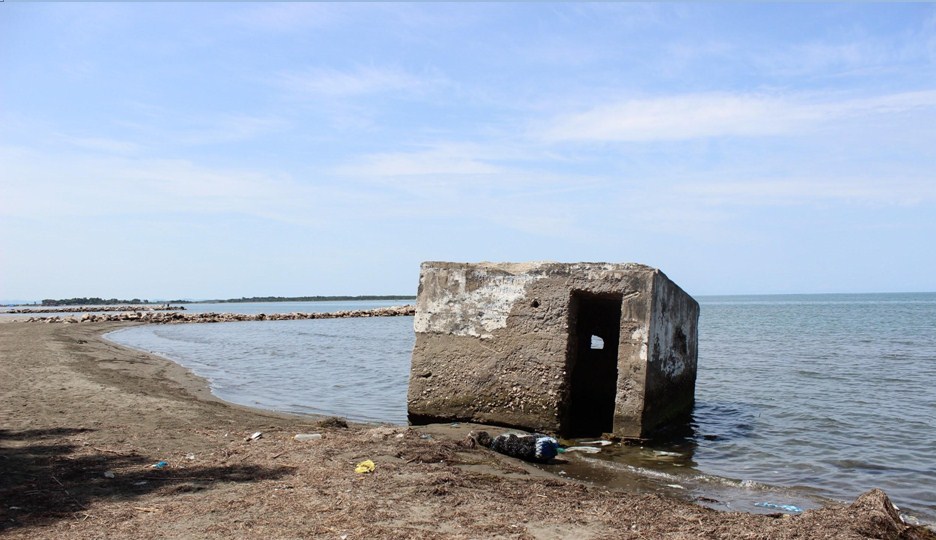
In areas such as Shëngjin, Velipoja, Durrës, Divjaka and Semani, the coastline is retreating at a rate of 0.5 to 2 meters per year. In some segments, the losses are even greater.
According to data from expert Jak Gjini, we note that from the mouth of the Buna to the Mati, an average of 6.67 hectares are lost per year. In the Kune-Vain area alone, over 362 hectares of land have been lost. In a few decades, the sea has advanced up to 400 meters inland.
So, according to this data, it is not about an isolated or specific area, but about a process that is affecting the entire coastline.
Construction, accelerating the disaster!
Theoretically, Albania has restrictions, starting from urban plans that stipulate that constructions should not come closer than 200 meters from the sea line. But if you take a walk in Shëngjin and Durrës, the constructions are only 20 meters from the water, constructions on sand.
As usual, the laws in the country exist, but are not enforced.
Unfortunately, erosion in Albania is not just a product of nature. It is accelerated by a series of human factors, such as:
Deforestation, which leaves the land unprotected, has been an ongoing problem for years. Then, another problem is unplanned construction, especially on the coast.
One of the main problems has been the interference with rivers and dams, which intercept sediments and prevent the coast from filling.
And finally, the biggest alarm, but one that is faced with indifference in our country, is climate change, which increases the intensity of rainfall and storms.
“Climate change is not the root cause, but an accelerator of an already weakened system,” says Gjini.
All of these causes also have their consequences, which are not only related to the environment, but also to the economy, agriculture, and many important sectors.
One of the most obvious losses is the loss of fertile land, reducing agricultural production, which is one of the main sectors in the country.
Every year the risk of flooding increases, damaging agricultural areas, lagoons, and entire villages.
Likewise, erosion does not spare coastal tourism.
Where should we learn from?
Albania is currently only observing; interventions and planning still remain distant.
But EU countries have built a system where they have taken concrete steps towards this phenomenon.
One of the preventive measures is the funds that European farmers benefit from if they protect the land; they are forced to maintain plant cover.
Meanwhile, the European Environment Agency continuously monitors land changes and guides policies.
Massive reforestation programs have been developed in countries like Spain and Italy, while the Netherlands has built advanced coastal protection systems.
What is evident is prevention, not interventions after damage has occurred.
In Albania, according to experts, the problem is not a lack of knowledge.
“An integrated approach between rivers and the coast is needed,” says Gjini.
While Nika says:
"Solutions take time. Any action today will have an effect in 20 years."
Experts are divided on several points of view:
Jak Gjini proposes interventions such as breakwaters and the restoration of dunes to protect coastal areas. While Olsi Nika is skeptical of artificial structures and supports natural afforestation.
But both agree on one point: a long-term and integrated strategy is needed.
Today, erosion is not talked about much. The consequences are starting to be visible, even though the losses are small, year after year.
But, as experts warn, if it continues at this pace, Albania will no longer be the same map we know today.
Because, unlike many other problems, this is not an issue that has easy or quick solutions.
Land that is lost today will take centuries to regain.
But when will we understand this?
Agimi in Shëngjin doesn't ask for much, he just wants the sea to stop coming into his house. But this simple request is becoming increasingly impossible. Because while he fights the waves with sandbags, the institutions debate whether the problem exists./acqj.al