


Ida Ismail
This year has started with a number natural disasters for citizens of different areas of Albania. On a typical morning after intense rainfall, entire families in different areas of the country were forced to abandon their homes, while roads were covered in water and agricultural land turned to mud.
What was once considered a rare episode is now becoming a recurring reality. Shkodra, Lezha, Durrës, Fier and Lushnja are just some of the areas that are increasingly facing flooding. However, in official documents and risk maps, some of these areas are classified as low risk or outside the problem areas. On paper, the risk seems to be non-existent; on the ground, flooding occurs whenever there is heavy rain.
On paper, the areas are safe. On the ground, they flood.
Urban planning and public investments are based on flood risk maps published by State Authority for Geospatial Information (ASIG). Areas are classified according to statistical probability, “1 time in 50 years” or “1 time in 100 years”. In practice, areas considered low risk have been flooded several times within a decade. On official maps, areas like Maliqi in Korça or parts of Lezha appear to be out of danger, while the reality on the ground shows the opposite.
Water resources management expert Erjon Kalaja, with extensive experience in hydrological modeling and water infrastructure planning, explains that the problem begins precisely with these maps.
“The maps do not cover the entire territory of the country and have been drawn up mainly within the framework of donor-funded projects, not based on the real needs of the territory. Many areas such as Lezha, Gjirokastra, Korça and other regions have not been included at all in hydrological modeling projects. In practice, this means that the risk exists, but it simply does not appear on the map,” he explains.
According to him, the lack of mapping does not mean a lack of risk, but a lack of information: "When an area does not exist on the map, it does not mean that it does not flood. It only means that the state has chosen not to see it."
However, it is precisely on these outdated maps that building permits are issued, development plans are approved, and millions of euros are invested in public projects. Albania is experiencing long periods of drought followed by very intense rainfall in a short time.
"The existing infrastructure, designed on historical data, cannot handle these new loads. We continue to design with the logic of the past, while the climate has entered a completely different reality," warns Kalaja.
Urbanization on former marshes: a recipe for permanent flooding
Intense rainfall is not the only cause of the constant flooding. They are also a direct consequence of mismanagement of the territory and the lack of long-term planning. Local government expert Agron Haxhimali, an expert on local policies and urban development, sees the problem as a consequence of development without vision.
"Cities have developed without a clear strategy and drainage systems have been neglected. The real dysfunction of the system turns every episode of intense rain into a national crisis," he highlights for ACQJ.
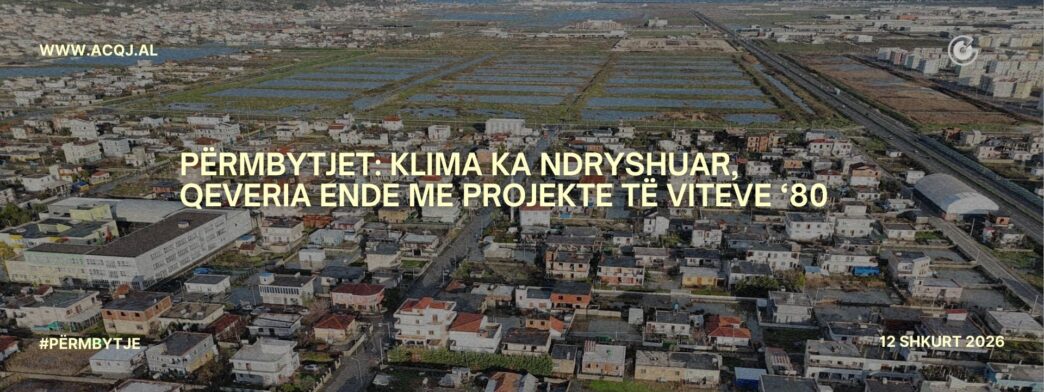
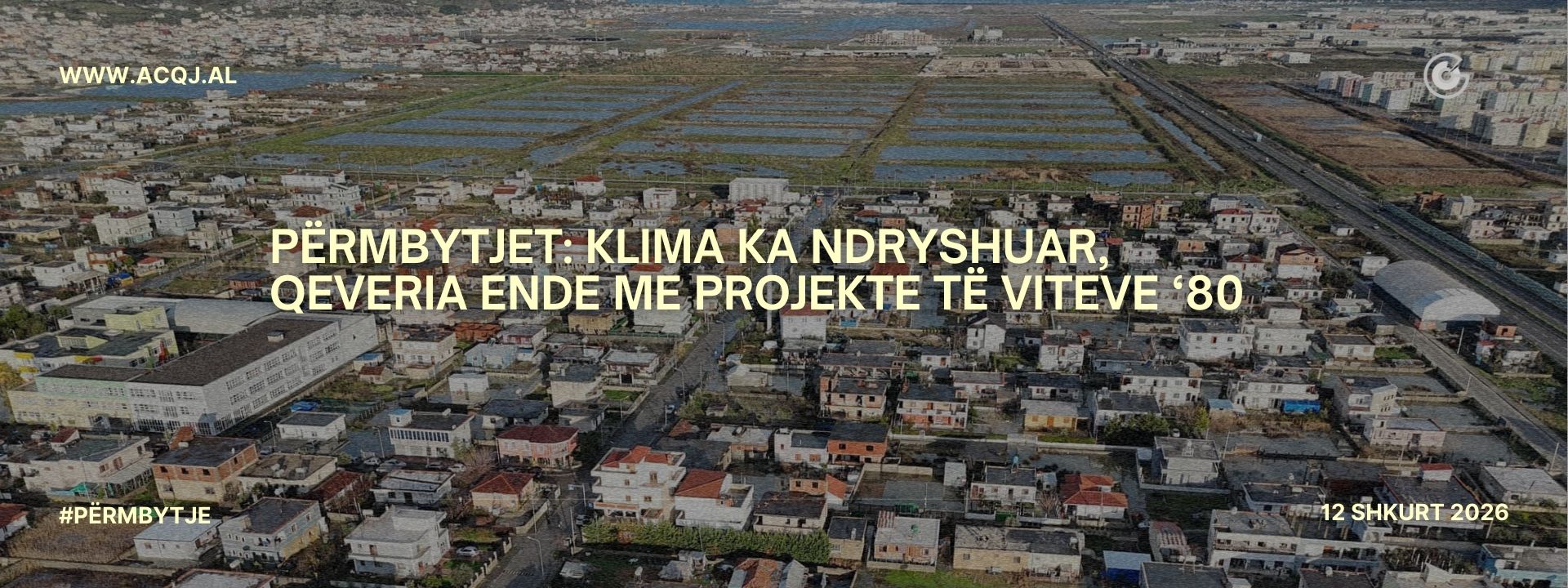
Former marshes, low-lying areas and riverbanks have been filled with construction without hydrological studies and without protective infrastructure. Durrës is one of the most significant examples. Areas such as former marshes, Katundi i Ri and Sukthi flood almost every time there is rainfall, because the territory has been urbanized ignoring the history of floods.
"The riverbed in many areas has become a time bomb, with sediments, construction and zero maintenance. Floods do not only come from the sky, but also from the land that we have neglected. We have built on former swamps and then we wonder why the water seeks its own territory. Concreting does not make water disappear," Kalaja underlines.
Experts speak of failed planning. The government insists that investments have increased.
The government has dismissed accusations of negligence, stressing that the drainage infrastructure has been functional and that the hydropower plants have been working without interruption. Prime Minister Edi Rama has stated that last year alone, around 25 million euros were invested, while in the last decade, around 250 million euros were invested in canals, embankments and dams.
However, Rama himself acknowledges the limits of this system: "When rainfall exceeds projected safety levels, flooding of vulnerable areas is inevitable."
According to official data, intense rainfall in the first week of January flooded 13,211 hectares of agricultural land and 1587 homes. 339 people from 51 families were evacuated. The government has guaranteed compensation for those affected, but financial data shows a stark contrast: while investments in infrastructure have increased, funds for Civil Emergencies have decreased.
Civil Emergency Funds have decreased from 5.4 billion lek in 2025 to 5.2 billion lek for 2026. The Director of Civil Emergencies, Haki Çako, has acknowledged the existence of arrears: "There are unpaid liquidations since 2019, amounting to 195 million lek."
A documented national danger
According to the World Bank, Albania has the highest level of risk from natural disasters in Europe. Global Risk Index for 2021 shows that the country's economy is particularly exposed to floods and earthquakes. On average, about 30 people are affected by natural disasters each year, and over 95% of Albanian municipalities have been hit by a disaster at least once. The report warns that climate change could further increase the severity and frequency of weather-related disasters, making the human and economic costs even higher.
"Without updated maps, without investments driven by real risk, and without a long-term vision for the territory, Albania will continue to flood every year," emphasizes expert Kalaja.
Until planning adapts to the new climate reality, floods may remain less a natural disaster and more the result of human choices.acqj.al