



Television advertisements or more widely, of pharmaceutical drugs, such as those without a doctor's prescription, or food or medical supplements, have become a daily reality for the Albanian consumer, with television personalities and professionals in the medical field dedicating minutes or their influence advertising these products. All this in violation of the law, and with no agency that undertakes the task of monitoring or punishing violators of the regulatory framework in force.
Author: Megi Cuka
Dealing with the issue of publicity in public spaces, on television or even online, of medicinal products and medical supplements is not within the competence of the National Agency for Medicines and Medical Devices or the Audiovisual Media Authority, as well as the Electronic Communications Authority and Postal. As often, the burden of protecting the health and interests of the consumer falls on the uninformed consumer.
It often happens to us that when we are watching TV, opening Facebook, Instagram or online media, we see various advertisements promoting a supplement or medicine which guarantees the magical cure of a growing number of diseases that require medical specialization. In most cases, these ads say that consumers can use the product without a doctor's prescription, without explaining their contents or side effects.
Are there risks for individuals using these pharmaceutical products?
Fatmir Brahimaj, the president of the order of doctors in Albania, in a post on the official website of the order of doctors, calls for these advertised drugs not to be used by individuals, because they are not controlled.
"Looking at these advertisements as a professional, I think that more attention, care, control and accountability are needed for them because they contain a lot of untruth. Their messages are not appropriate and it is not known where the responsibility lies, such as: in their drafting, acceptance and transmission to the public, etc...." - He wrote in the post made on the page.
He also states that health advertisements bring impact and consequences on health, on doctor-patient relationships.
"As a result, the mismatch between expectations and results brings problems to the disappointed individual, up to the analysis and judgment of responsibilities. Generally, these advertisements require: Truthfulness of content and respect for medical ethics." - he adds
In a monitoring done on television, Klan TV, Top Channel and Report TV, we noticed that there are many advertisements for pharmaceutical products and medical supplements, more than 23 medical supplements, where some of them are presented as follows: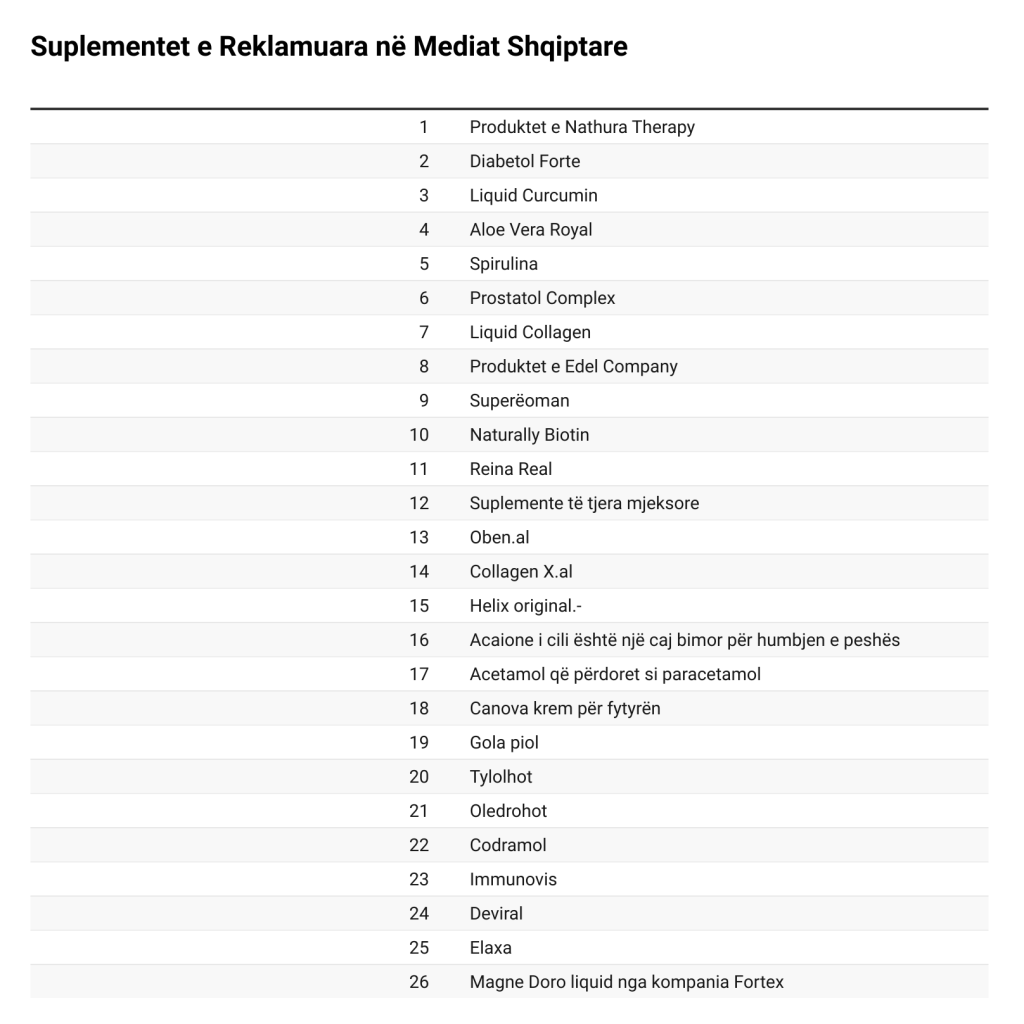
All these supplements continue to be broadcast daily on Albanian television, and no authority undertakes to monitor this process, and the potential risks for consumers.
Are the relevant authorities responsible for this issue?
The National Agency of Medicines and Medical Devices is the authority responsible for monitoring medicines in Albania. Following an official request for information addressed to this institution, ACQJ was informed that the supplements mentioned above are not authorized for marketing and use.
"From the verification of the data in the "Register of Drugs Authorized for Trade in the Republic of Albania, for "Liquid Curcumina", "Spirulina", "Prostatol Complex", "Superwomen", "Collagen X", "Helix Original", "Acai One", 'Selenogin", it results that these products have not applied for authorization for trade and consequently are not authorized for trade as a "drug" by the AKBPM. The AKBPM has not approved any promotional material for the above products" . - It is stated in the institution's response.
What remains to be clarified is whether these supplements contain elements that require prior authorization from the relevant institutions from the Albanian legislation, a question that has not been answered by any of the institutions asked.
The letter also explains that: According to Article 7 of the Order of the Minister of Health and Social Protection No. 25 dated 17.01.2019 "On the approval of the regulation on the advertising of medicines" point 1 "Advertising directed to the population is permitted only for medicines that are part of the list of over-the-counter medicines (OTC medicines)."
On the other hand, the authority of the Audio Visual Media states that it cannot stop the advertising of these products, it is marketing like any other product.
But how do patients react in pharmacies?
Currently, there are a total of 813 drugs in the list of OTC drugs, which are drugs that are given without a doctor's prescription. These drugs are allowed to be advertised under certain regulations.
Albania has approximately 1679 pharmacies, the majority of which are in Tirana. Pharmacists, some of whom were interviewed by ACQJ, on condition of anonymity, express concern about products being sold without a doctor's prescription, and that some of them are advertised by public figures, whether television personalities or heads of public medical institutions.
A pharmacist in Tirana says that the most requested/sold products are pain relievers.
"Patients come to the pharmacy convinced to get the product that it has no side effects, they refuse to be advised that if a pain reliever can have a side effect of increasing blood pressure, or their excessive consumption causes side effects in the stomach. For example, excessive use of Paracetamol gives side effects on the liver. They should definitely consult the doctor and the pharmacist, but they only take into account what is said by public figures and are inclined to believe them."
"If they have health problems or a side effect from a medicine, they come and see me, while before buying it they don't even accept my explanations because they are convinced that it is good for them because they heard about it from X famous character on television," she concludes.
Referring to these responsibilities, one of the institutions with direct responsibility for protecting the rights and health of citizens is the Consumer Protection Agency. In an email addressed to this institution in order to obtain information on the responsibility they have in relation to this issue, AMK informs ACQJ that the problem in question is outside the legal competences of this institution.
Rules that exist but are not enforced
The failure to enforce the law, the lack of control and measures to prevent potential abuses, is one of the biggest concerns that arise with television, radio or static advertisements in the public, taking into account the provisions of the Regulation on the Advertising of Medicines , which, among other things, stipulates that: " It is not permitted for the advertising of medicines addressed to the public... to include the recommendation of health professionals or scientific researchers, or to include in the advertising persons whose popularity may stimulate the use of the drug; ", referring here precisely to television presenters, well-known characters who are liked and have an influence on potential viewers, or even professionals in the field.
In the first months after the publication of this Order, television stations banned the advertising of drugs by public figures and initially it seemed as if this regulation was being respected, however, this did not last long. Day by day, advertisements were added, reaching the point where they became an integral part of the daily programs, or those of the weekend, during which televisions have the widest viewership.
In the AKBPJ's response to the ACQJ's request for information, the latter emphasizes that "Treating the issue of advertising of the above products [OTC drugs] is not within the competence of the National Agency for Medicines and Medical Devices", despite the fact that this regulation specifically charges this institution with monitoring this phenomenon.
In all requests for comment sent to various monitoring institutions that have the task of protecting the interests or health of consumers and citizens, the permanent refrain that has prevailed is the lack of competence on this matter. But is there an institution that is responsible for controlling, verifying and monitoring the advertising of these products?
It often happens that we also see on the urban linajts in Tirana, posters pasted in the urban areas of the city with drugs to fight body pains or the common flu, products that often contain paracetamol or codeine. One of the institutions responsible for this issue is the Municipality of Tirana, which, in response to a request from ACQJ for comment on this issue, also expresses incompetence and directs us to the Ministry of Health and the relevant institutions [AKPBJ].
Experts: To create mechanisms for the verification of every advertisement of medical products
In relation to genuine advertisements for products that may have unconfirmed effects or are unlicensed, the responsibility falls directly on the distributor of the product and the institutions that have the duty to control the quality and authenticity of the products.
"It is necessary to have legal and institutional instruments to pre-verify every medical product advertisement before it is broadcast ," says Koloreto Cukali, Executive Director of the Albanian Media Council, regarding the ethical issues of advertising in the media, without supervision.
"The media cannot be held responsible and cannot verify every product it advertises through a business transaction. Otherwise, it is up to the media to verify every banana, washing machine or tourist package for which it has a contract to advertise. On the contrary, the media bears full responsibility for occult advertising - advertising that is camouflaged as "news". - he adds.
"In these cases, it is a direct violation of the Journalist's Code, and can be considered a deliberate deception of the public. Such violations are committed with the intention of financial gain in deceiving the public, so such cases should be reported and sent to court by the injured parties." - concludes Cukali for ACQJ.
European countries or further afield have set strict rules regarding the advertising of medicines in the media or public places, with countries such as the USA where this task is undertaken by the US Food and Drug Administration (FDA), the Federal Trade Commission (FTC), Germany with the Freiüillige Selbstkontrolle für die Arzneimittelindustrie eV (voluntary self-regulation for the pharmaceutical industry), a private industry association, of which most pharmaceutical companies in Germany are members, and the Health Sector Advertising Act, the United Kingdom with the Medicines and Healthcare Products Regulatory Agency, or France with the Agency for Health Product Safety.
Albanian institutions and the regulatory framework in this field are analogous to sister agencies and rules in other European countries, but the implementation of the law has remained an orphan, with no institution taking over the task of consumer protection.