


With the outbreak of the COVID-19 pandemic on a global scale, Albania, like all countries in the region, faced an increase in the number of infected people, which at the beginning of this year led to the near collapse of the hospital system! Many people chose to be treated in home settings and private hospitals and often used medications that were not found in the protocols of state hospitals and in some cases received drugs trafficked from neighboring countries.
But what made the Albanians to treat themselves privately and lose faith in state hospitals? Was it a spirit of mistrust towards the quality of the service, fear of the protocols used or suspicion of the medicines in state pharmacies?
Three protocols against COVID
At a time when many of the world's top medical institutions have made their COVID-19 treatment and care protocols public in order to gain the trust of the general public, it is almost impossible to find any information on this issue on the website of the Ministry of Health or the Institute of Public Health.
ACQJ addressed the Ministry of Health with questions about the protocols used in COVID hospitals for the treatment of COVID-19 patients , and the latter, in a general response, specified that “the anti-COVID protocols used in Albania were developed by the Covid hospitals themselves with the suggestion and guidance of the WHO. COVID Hospital 1 has implemented three protocols. The first COVID-19 Clinical Management Protocol (February 14, 2020) was developed by adapting the guidelines of the WHO and several infectious disease associations and hospitals in advanced countries of the world. The second Covid Management Protocol was developed on May 21, 2020, while the third protocol (January 21, 2021) is a review of previous protocols.”
"COVID 2 Hospital has built its protocol based on 6 WHO guidelines: pneumonia protocol, pulmonary thromboembolism, respiratory failure, respiratory distress, non-invasive and invasive ventilation, and oxygen therapy. The treatment protocol for infected people at home was approved by order no. 579, on October 14, 2020." , - the ministry's response read.
The Regional Cooperation Council ( RCC ) , based in Bosnia and Herzegovina, with the outbreak of the pandemic and based on the experience gained in the first months of dealing with this disease, in cooperation with the Italian government, has distributed to the Western Balkans the Italian guidelines and operational protocols for the treatment of patients with COVID-19.
Given the current situation in the fight against the COVID-19 outbreak in the Western Balkan economies and Italy's extensive experience in treating infected patients, the Italian government has contributed to the region's battle against the spread of the virus by sharing its operational guidelines for the treatment of COVID-19 patients.
This Council, at the request of the Italian Embassy in Bosnia and Herzegovina, has ensured the translation of the protocols into the languages of the Western Balkan economies and has distributed them to governments throughout the region for further sharing with their respective doctors. The Albanian Center for Quality Journalism had a communication with RCC, where the latter was asked if they have received any reaction from the Albanian state regarding this protocol they have distributed and whether this protocol has been implemented, and whether it is being taken into account by the Albanian government.
In its response, the RCC said that monitoring the implementation or consideration of this protocol is not within their competence and in the communication with the Ministry of Health and Social Protection we were told that to build anti- COVID protocols in Albania, WHO guidelines were followed, protocols of various hospitals in the world, online video conferences with directors and doctors of international hospitals and conversations with teams coming to Albania from the WHO, but without giving a concrete answer, whether these protocols were used or taken into account. Some doctors say that in Albania the problem has not been the health protocols, but the conditions for implementing these protocols, leading to a situation in which distrust of the state system has forced the public to find alternative means of treatment and where deaths due to COVID during 2020 have been exponentially higher than in countries in the region or the EU.
Pandemic, but in borders with open doors
Albanian citizens who wanted to travel to EU countries and beyond have faced many difficulties in crossing the border in recent years. Until May 2021, only Albanian citizens who were in possession of a residence permit for the countries they were traveling to or had a special reason to move, such as for health or business reasons, were allowed to cross the border. This travel permit initially had as an essential condition the possession of a PCR test and then, with the start of the vaccination campaign, the vaccination certificate. However, many countries did not recognize the vaccines used in Albania, as some of the latter were not recognized by European or American authorities , further complicating the movement of citizens abroad.
At the beginning of June, Albania almost “parted” with COVID . The number of daily infections nationwide reached only two, but the situation turned around within a few weeks, when the number of daily infections reached 1000, due to the open-door policy at the Albanian borders.
In June 2021, most European countries opened their borders to all Albanian citizens, who were required to have a vaccination certificate, or a PCR test , or a rapid test. This process was in stark contrast to the procedures put in place for foreign or Albanian travelers entering Albanian territory. Foreign travelers who wanted to visit Albania had it very easy to enter our country, as neither a vaccination certificate nor a test was required until September 2021.
Asked about the quarantine and health verification protocols at the territory's entry points, the Ministry of Health pointed out that, since June 2020, the latter has issued the relevant orders for the tracking and notification of suspected COVID-19 cases at airports and border points nationwide, and a number of subsequent orders amending the latter. However, how effective these orders have been can hardly be confirmed.
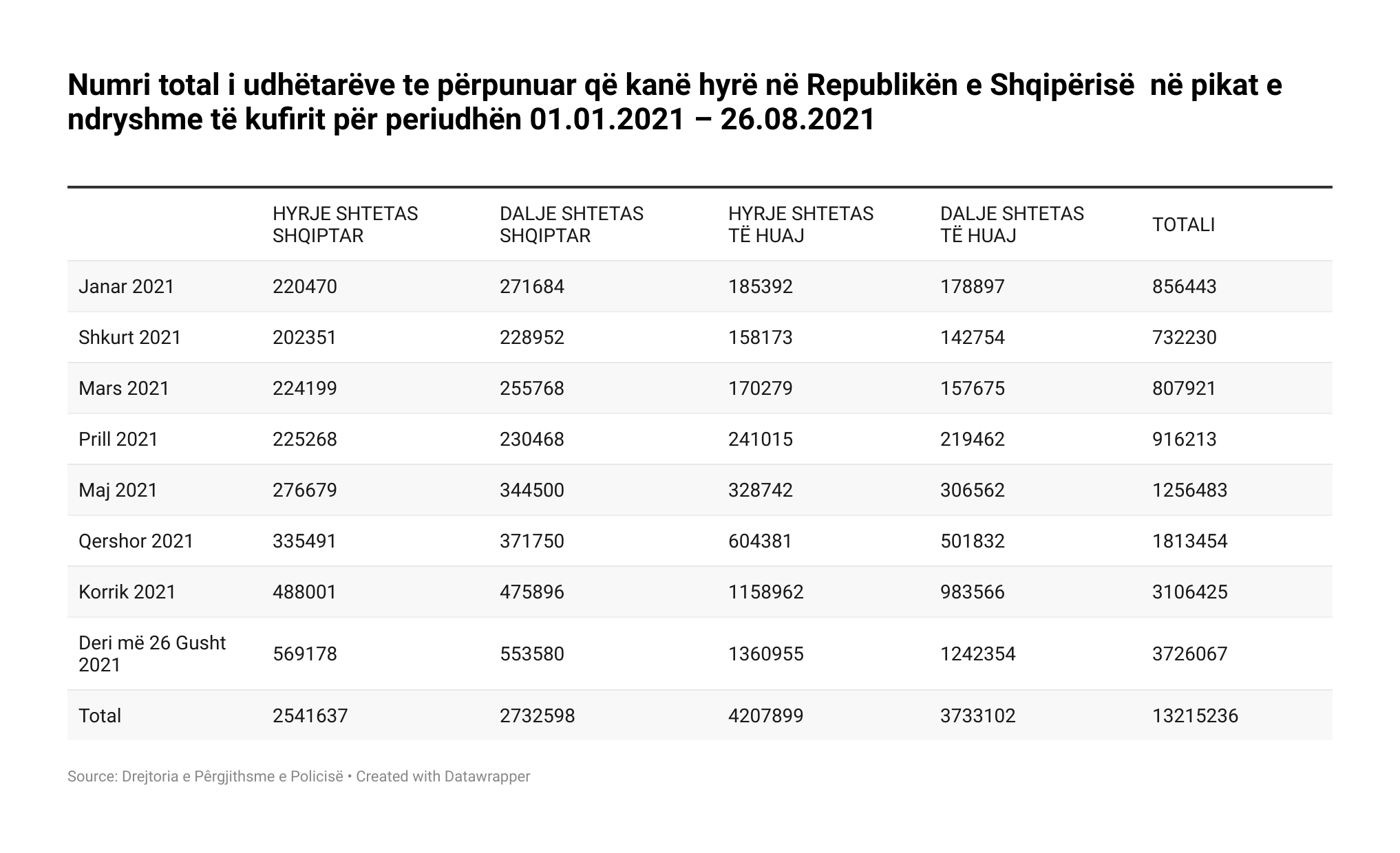
In the time frame January 2021-August 2021, more than 13 million travelers traveled to the territory of the Republic of Albania from various border points, with about 6.7 million travelers entering the territory of the Republic of Albania and 6.7 exiting the territory, most overwhelming of which have not respected any quarantine protocol, seeing that the largest number of travelers was precisely during the tourist season, the months of May-August.
Tritan Shehu, former Minister of Health, when asked by ACQJ regarding the protocols applied by the Albanian state for all persons entering the territory, stated that "Albania should have implemented the protocols of European countries regarding tourists."
From Kosovo alone, around 1.1 million citizens have entered during the summer months. With the start of the tourist season, the number of infected people in Kosovo and North Macedonia began to increase exponentially, with the peak of infections precisely during the summer months. Although the majority of tourists in Albania were from these countries, and the numbers of infections and deaths in the respective countries were constantly increasing , the Albanian government did not take any preventive measures and entry at the border from these countries was free, without a vaccination certificate and without a test until the end of the tourist season.
The number of foreign citizens, according to the Ministry of Tourism , entering Albania during the first eight months of 2021 is 4.384.072, of which 2,177,412 are Kosovar citizens and 448,370 are from North Macedonia, with more than 790,000 and 110,000 travelers from these countries respectively during August alone.
Asked why strict travel restrictions have been imposed on Albanian citizens, measures that are not reciprocal and whether such a thing endangers public health, Ilir Alimehmeti, a clinical epidemiologist, said: "The documentation at the border, the protocols that were to prevent the spread across borders, we have clearly noticed that they have failed everywhere, so it never happened, not even at the beginning of the pandemic, when it was easier to block cases, it could not be done, not anymore now that the infection is community-based. This has remained more like inertia, that they continue to require documentation, but clearly it cannot block the virus, requiring pieces of paper. Even people who have been vaccinated, have the possibility of being infected and as a result, through these measures, we cannot stop this virus. I use the expression: The sun is not covered with a sieve. In this regard, no one is protected. So, it does not matter that for us to go outside, we have stricter protocols than those who have it easier to get inside. The difference "This element is not big."

According to police data, we see that during the period January-August 2021, citizens from India and Bangladesh also entered the country, respectively from India, 6034 and Bangladesh, 1347. In these countries, in this period, there was the highest peak of infected people and they have been able to enter our country freely, without any restrictions.

From field observations, on the coast during the tourist season, it was noted that no protocol to prevent the spread of COVID-19 was implemented in bars-restaurants and other public spaces , despite the fact that such protocols have been in force throughout the period. Often, it has been the local and central authorities themselves who have organized and allowed events with the participation of hundreds of thousands of citizens, violating the orders and regulations issued by them.
Photographs of various events, organized or allowed by the local and central government in the municipalities of Tirana, Vlorë and Sarandë, on the social networks of these institutions or organizers
Asked about the possible connection between the increase in infections at the end of the tourist season and the correlation between infections in Kosovo and North Macedonia and those in Albania, epidemiologist Alimehmeti pointed out that the reason for the increase in the number of infections was the Delta variant . " If we look at this epidemiologically and compare it with the region, that is, with Kosovo and North Macedonia, which also have the largest number of tourists in Albania, we will see that they were at the highest epidemiological curve 2-3 weeks before us, while we came to this point 2-3 weeks after them. So, the peak in Kosovo and North Macedonia was on August 25, while in ours on September 8-10. So, about 2 weeks behind, which means that potentially in Albania the infections came from massive entries from Kosovo and North Macedonia. Would we have been able to stop it through control? I'm afraid not. We could have simply postponed it a little in time, but no, we wouldn't have stopped it ," says Alimehmeti.
In early September 2021, at the end of the tourist season, the government imposed strict measures on all travelers entering Albanian territory, requiring PCR tests and vaccination certificates, including citizens of Kosovo and North Macedonia. However, the damage had been done. From 5 infections per day during the first months of summer, in September Albania reached infection records with more than 1000 infections per day and with deaths gradually increasing in the following weeks. The following months showed a gradual and slight decrease in infection numbers, but the low figures of summer 2021 are not expected to be reached at least until the end of winter or the increase in the numbers of vaccinated citizens.
Albanians travel to Europe, but at exorbitant costs
At a time when travelers almost all over the world are required to produce only one vaccination certificate, Albanian or foreign travelers who must travel outside the Republic of Albania, beyond the travel costs that normally apply, also have additional costs in terms of verifying their status as not infected with COVID-19 . In the event of traveling to many countries in Europe or beyond, they are required to submit a PCR or rapid test to the border authorities, at a price many times higher than in Europe, regardless of their vaccination status.
From a simple online check, it is clear that rapid swabs in Europe are sold in supermarkets at a price of 1-3 Euros, while in Albania they cost more than 20 Euros in specific pharmacies, or at testing points at airports or border points. Often, in Europe, if a person is insured, PCR swabs are included in the free medical service, while in Albania, with the exception of cases where a person is suspected of being infected with COVID-19 , this service is only offered by private clinics in the country. This fact was also confirmed by the Ministry of Health for ACQJ , stating that for trips abroad, the medical administration does not offer the PCR swab service , but only in cases of suspected infection. Even in these cases, this swab performed at the family doctor cannot serve as a certificate for travel.
Various citizens interviewed by ACQJ , near the border crossings of Hani i Hoti, the port of Durres and near Rinas airport, stated that these prices are high for the budget of Albanian citizens. In many European countries, their governments subsidize or offer them free of charge to certain groups, such as pensioners or even students.
SV, a student in Austria, who is forced to travel to Albania from time to time to meet family members, when asked if the practice of the swab and its price in private practice is justified, tells ACQJ : "It is not justified, because it is a relatively expensive price, especially when we refer to Albania, which is a transitional developing country. Meanwhile, in other European countries the test is done for free, and even doctors can assist at home."
During 2021, ACQJ conducted a market survey of the PCR swab service for overseas travel in the cities of Tirana, Durrës and Shkodra, during June and October 2021. What is noticeable is that, in most cases, the price of this service has not only not followed the trends of reducing its cost, but is fixed in most operators at a price, which raises suspicions of anti-competitive practices and price fixing. The Ministry of Health itself has set a ceiling price on PCR swabs at the end of 2020 and it was a statement by the laboratories on the fixing of a common price in this same period, which raises suspicions of a tacit, illegal agreement between these operators.

Asked by the ACQJ whether there have been complaints from citizens about the price of swabs or rapid tests in private clinics and whether the institution itself has undertaken any administrative investigation into possible anti-competitive practices, the Competition Authority stated that no complaint has been filed with it and this institution itself has not undertaken any investigation mainly regarding these statements by operators and the fact that prices in the relevant market are almost the same.
Meanwhile, Ersida Teliti, Executive Director of the Albanian Consumer Center, says the opposite regarding this issue. In an interview with ACQJ , she states that in fact her center has filed a complaint with the Competition Authority due to the increase and fixing of the price of tampons. “ In fact, we have filed a complaint with several consumers, who wrote to us at the center’s address via Instagram , complaining about the price setting by the Ministry of Health, where theoretically, although it is an issue related to traders and since we focus on consumer protection and human rights, we initiated this complaint with the Competition Authority.”- she states.
In the complaint dated 28.12.2020, addressed to the Competition Authority, based on numerous complaints, the CCSH has requested the latter to launch an in-depth investigation and place the market under monitoring for all entities that offer the PCR swab service , and to launch an investigation and place under monitoring entities that offer COVID-19 tests , such as PCR , D-dimer , blood tests, etc., where an increase in prices is found.
Teliti states that " the focus of the complaint, although it actually seemed to affect and harm traders, is actually at the end of the day a consumer issue, focused precisely on the production of tampons in two, three or four entities formalized through an order of the Ministry of Health. This would in fact lead to direct distortion of competition, the inability to have discounts or other price changes in favor of the consumer, but, in conditions where in fact no one is affected and does not consider the quality or the way they are made, the effectiveness in the results, whether they are fictitious or not, would directly affect the consumer."
Although the complaint has been filed with the Competition Authority for a year and has been continuously followed up by the Competition Commission , no response has been received from the latter and no administrative investigation has been initiated on this issue. For Ersida Teliti, the liberalization of the service is the only way to protect the consumer's interest, a position that has also been expressed by Tritan Shehu, who says that "the liberalization of all testing, the liberalization of laboratories and the implementation of WHO protocols are the only effective steps for managing the situation."
According to Mr. Shehu, “in Albania there has been a huge lack of swabs, not doing swabs means not diagnosing, because COVID is diagnosed by swab and if swabs are not done… Reducing the number of swabs leads to hiding cases and tracking them. This is a big problem that Albania still has and in general the policies they have followed with testing are also a problem. Instead of liberalizing rapid tests, they are kept centralized and blocked for pharmaceutical companies and are not allowed to be brought to Albania. This is a big problem, it is a deeply wrong, centralist policy that seeks to hide the reality in Albania.”
Such a problem has also been noted by the Supreme State Audit Office, in its performance audit report on the management of the pandemic by state institutions, in which it found a series of violations by state authorities, among which was the inability of the Institute of Public Health, as the sole institution responsible for national surveillance and investigation of infectious diseases, to issue the results of relevant tests for the purpose of documentation or/and travel abroad of citizens.
In June 2020, the IHP addressed the Ministry of Health with a request that COVID-19 testing for documentation purposes be performed in laboratories outside the IHP, which are certified by the latter. Following this request, the Technical Committee of Experts decided to allow molecular testing, PCR for SARS-COV-2, to be performed in non-public laboratories for administrative needs, recognized by the Ministry of Health, violating the legal provisions according to the HLSH, because the certification of these laboratories cannot be performed by the Ministry of Health, but by the General Directorate of Accreditation.
At the same time, the Supreme Audit Office has found legal violations, both in performance and in terms of subsidizing and compensating for COVID-19 treatments or tests , as long as these procedures have been an excessive financial burden for citizens who have an administrative need, required by the Albanian state, in the case of teaching and employment in the state administration or for travel abroad for those who pay health contributions. More than a month has passed since the release of this report of the Supreme Audit Office and to date there has been no change in the procedures for travel outside the territory of Albania. Most European countries and beyond still require verification of a PCR swab , regardless of vaccination status and the state has not yet found a mechanism that does not burden the pockets of travelers.
While the WHO warns that Europe will face a severe pandemic situation by spring next year, in Albania those who need to travel face the highest prices in the region for PCR tests . The country is also facing many infected people who try to recover at home and end up in hospital when doctors have little to offer.
Albania is now facing the fourth wave of COVID and the number of infected and dead remains high, compared to Kosovo, which a few weeks ago seemed to be losing the fight against the virus. As of the time of publication of this article, only 33% of adults have received both doses of the vaccine. There are many reasons for skepticism about vaccination, one of which is doubt in what the authorities say.