


Andeta Kapa
"Write it on the list, please. When I get my salary, I'll come and pay it."
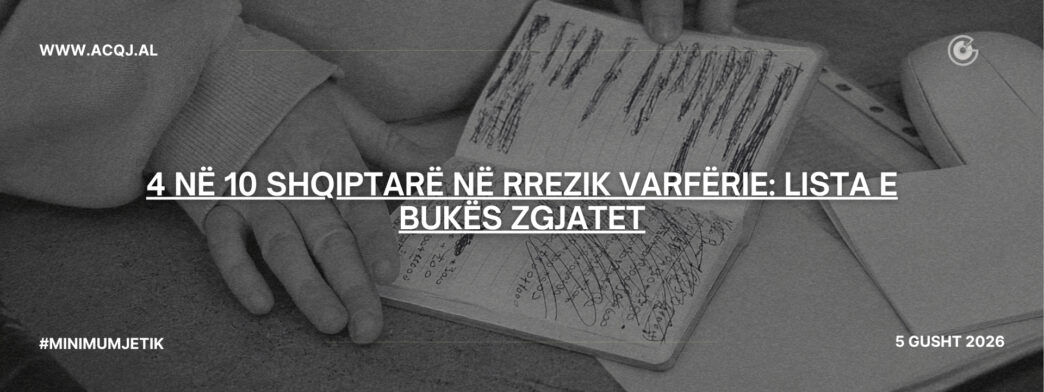
The salesman doesn't ask any questions. He opens a worn notebook, writes the customer's name, the date, and the amount. The bread, milk, a liter of oil, and a packet of pasta are put in the bag. Payment? She'll wait a few more days.
In many small markets in the neighborhoods of Tirana, this scene is repeated almost every day. For a significant portion of citizens, buying products "on the list" remains the only way to ensure basic food supplies until the end of the month.
The list is added.
“Yes, it's a practice that has been going on for years. They are mostly regular customers that we have known for a long time and who sometimes can't afford to pay their bills until the end of the month,” says Miri, owner of a supermarket near Vilave Gjermane. According to him, the list almost always ends up with the same products: bread, milk, oil, sugar, rice and detergents. “It's rarely about non-essential products,” he adds.
Miri points out that the phenomenon has become even more visible in recent years, especially after the rapid increase in prices after the Covid period.
"We've seen more families looking to get products on the list. There are also people who work full-time, but the salary is simply not enough for them."
We find the same reality in the Shkoza area. Donika, another market owner, says that this opportunity is mostly sought after by pensioners and large families.
"There are families who buy products several times a month and pay them off when they receive their salary, pension, or economic assistance," says Donika, the owner of the market.
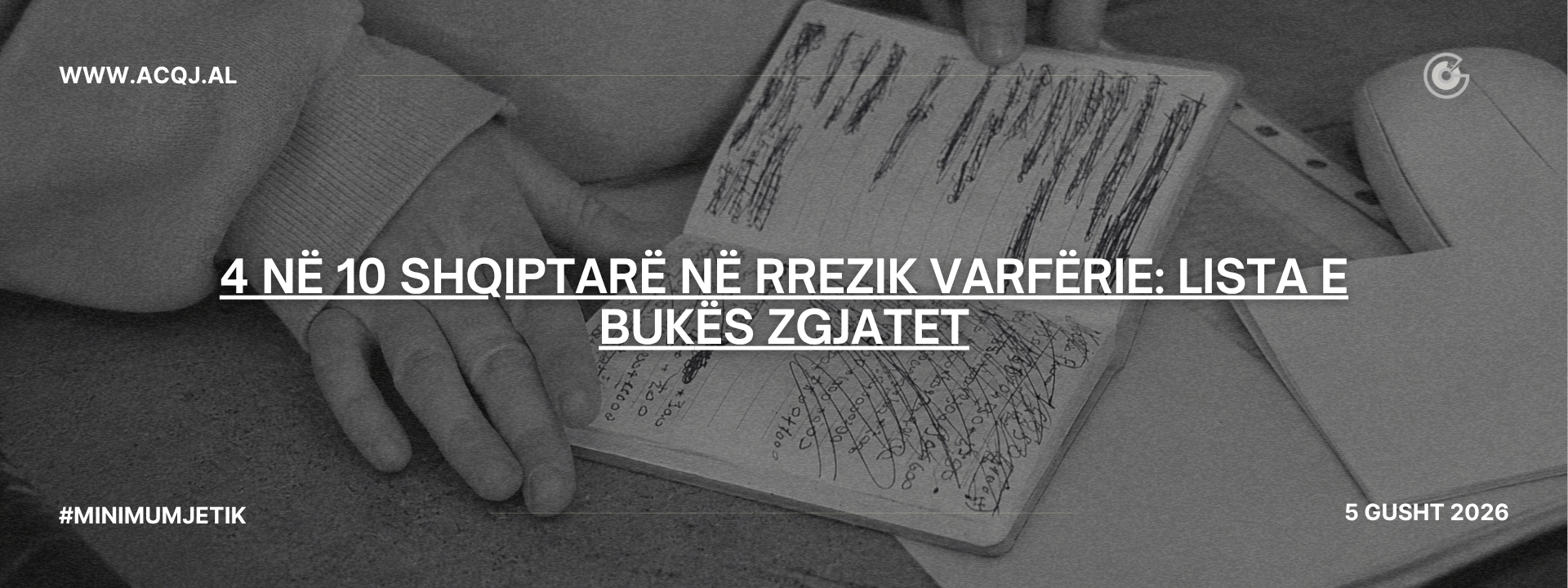
Debts are recorded in a notebook where the customer's name, date, and products received are noted.
"This situation also creates difficulties for us as a business, because we have our obligations. However, when you see that someone needs basic food, it is difficult to say no," she concludes.
While large supermarkets do not offer the option of shopping "with a list", neighborhood markets continue to offer it because they know their customers, a sign that solidarity is filling the gaps left by the economic situation.
An observation spanning five different neighborhoods of the capital – Shkozë, Vilat Gjermane, Laprakë, Rruga e Elbasani and Rruga “Siri Kodra” – confirms that debt notebooks (now sometimes also in the form of phone notes) are the survival mechanism for hundreds of families.
The vicious circle of poverty
Behind these notebooks lies a frightening economic scanner. According to Eurostat estimates, Albania continues to rank among the countries with the lowest purchasing power in the Western Balkans. Gross Domestic Product (GDP) per capita reaches only 42% of the European Union average.
More than statistics, this is a reality that touches family tables.
Mr. Gjergji, a father of three, tells with difficulty how inflation has turned his life upside down:
"The problem is that salaries remain stagnant, while prices increase almost every month. We have given up everything that is not vital. The hardest part is the emotional side, when you have to say 'NO' to the children and explain to them that we can't afford it."
4 in 10 Albanians continue to be at risk of poverty or social exclusion. “It is clear that poverty remains a structural problem,” says Kolindo Vjerdha, activist and representative of the organization “Qëndresa Qytetare”. A report by the Center for the Living Minimum, conducted in 2020 by Ilda Methasani, concluded that in Albania about 40% of the population lives on $5.5 or 410 lekë per day and, compared to other countries in the region such as Serbia, Macedonia, Bosnia and Herzegovina, Montenegro or Kosovo, this is the highest level of poverty.
According to Vjerdha, today we have about 461 thousand Albanians below the poverty risk threshold, while 40.3% of the population is at risk of poverty or social exclusion and 32.8% faces severe material and social deprivation. This becomes even more worrying if we look at the increase in the cost of living. “The poverty risk threshold is about 27 thousand lek per month, or 900 lek per day, while the overall price level has increased by about 21% compared to 2020,” Vjerdha adds.
According to Vjerdha, a representative of the organization “Civic Stability”, about 40.3% of the population in Albania is at risk of poverty or social exclusion. “The threshold for risk of poverty is calculated at about 27 thousand lek per month per capita, while the general price level has increased by about 21% compared to 2020,” he explains, also referring to previous studies on the living wage.
The paradox of economic assistance
Nationally, about 56,000 families are receiving economic assistance. Although the Ministry of Health and Social Protection reports a decline in the number of beneficiaries, which on paper may seem like an improvement, experts say this is more related to tightening criteria than to citizens becoming richer.
In Tirana, the Municipality officially treats 2,269 families with economic assistance, but this support remains a drop in the ocean.
The cost of living, especially for food, remains a challenge for many families in Tirana. Interviews with city residents show that a family of 3–4 spends an average of 35 to 60 lek per month on food alone, depending on the number of members and income. Meanwhile, the economic assistance that benefits families in need remains much lower than this cost, forcing many of them to rely on “list” purchases to secure basic products.
In 2021, the Ombudsman estimated the subsistence minimum at around 17,875 lek per capita, but today this institution raises the alarm that this value should be at least 23 thousand lek to cover minimum needs. As the spokesperson for the Ombudsman, Ms. Esiona Konomi, puts it: “The lack of an official legal reference value allows social payments to be kept at extremely low levels, violating the constitutional right to a dignified life.”
Granit Sokolaj, executive director of the "Alert" Center, explains that this system creates a trap from which families find it impossible to escape.
"When these citizens receive their salary or pension at the end of the month, a large portion immediately goes to pay off last month's debts at the neighborhood market. As a result, the remaining money is not enough and they are forced to open a new list again. It's a vicious circle."
This economic pressure not only affects food, but also forces families to sacrifice electricity, water, or heating bills during the winter.
While large supermarkets and international chains do not recognize such scenarios, small neighborhood shops are shouldering the weight of a social crisis. On the corner of the counter, next to the cash register, the debt notebook continues to be opened every day. For some, it is simply a notebook; for many others, it is the only guarantee that there will be food on the table at home tonight./ acqj.al