


Author: Denis Tahiri
It is October 12. At the threshold of a bar very close to “Air Albania”, Elton, a 19-year-old who works in one of the many bars there, watches with his eyes hundreds of Albanian fans entering the stadium. Elton should be serving customers, but the bar is empty. The conversation that takes place between him and the administrator is a prayer expressed in different ways. “God willing, they won’t close us, because then we can do anything, ” says the administrator who is also watching the flow of people. After waiting for a while he replies “ I don’t think so, otherwise they wouldn’t have let all these fans into the stadium. It wouldn’t make sense to close us.”
Among the fans who stood in line to enter the stadium without any social distancing measures was Klajdi Sadushi, 24. “ I bought a ticket for 10 thousand lek, we were a social group that went to watch the match,” says the young man, who mentions that he waited in line with dozens of others for over an hour. He says that no one asked him or forced him to wear a mask or to prove that they were negative. “There were police at the door, they checked our tickets and also did a physical check to make sure we didn’t have any strong objects, but no one asked us to wear masks, and besides, you couldn’t find any masks in the stadium during that match,” says the young man, who when asked if he was afraid of catching covid at the stadium said: “ To be honest, covid didn’t even cross my mind at all, there was that whole atmosphere there that you couldn’t even imagine that covid existed.”
Ana, a 29-year-old and ardent fan of the Albanian national football team, had a similar experience to Klajdi. She remembers in detail the moment she entered the stadium. " Entering the stadium was preceded by a police cordon to carry out preliminary checks. When I say preliminary checks, I refer to prohibited vehicles inside the stadium, but at no point were the officers required to wear masks. Dozens of football fans were waiting in front of the respective gates, without any extra distance or care due to the fact that the match took place in a Covid situation," says the 29-year-old, who when asked if she was afraid of a possible infection, says that it was a thought she described several times. " I had Covid in February of this year. But of course you couldn't claim that in the middle of the crowd you wouldn't have at least people and contact with someone infected or that the fans would cheer with masks and at a distance."
No protocol applies, 22 thousand fans in one stadium
Together with Klyd and Ana, 22 thousand people gathered at the stadium that day. For the match which took place under the conditions of the Covid-19 pandemic, the Albanian Center for Quality Journalism also addressed the media office of the Albanian Football Federation to get a statement on whether there was a permit to fill the stadium to full capacity or no. On the other hand, the Ministry of Health officially confirmed for ACQJ that at the time of the Albania-Poland match, the restrictions for the development of sports activities with 30% of the capacity for fans were in force. But even with these rules in place, the stadium was filled to 100 percent capacity. The General Directorate of the State Police confirms that permission has been given for the development of the national team match, but only with 30% of the stadium's capacity. As to why the protocol was not implemented in this case, and in the face of the facts where such activities with gatherings without restrictive measures turn into foci of infection, none of the responsible institutions gives an answer. Not a single seat in "Air Albania" turned out to be empty in this match, where the profits of the Albanian Football Federation captured an amount of about 500 million old ALL.
In the case of the match with 22 fans in the stadium, although the police permit was violated without hesitation and in flagrant conditions, sources close to the Police indicate that there is no investigation or any action by the Order Police regarding this event. But here there are shadows of doubt because if the State Police wanted to strictly implement the permission given, it was enough to look at the number of tickets sold a few days before the start of the challenge and it would have the opportunity to take measures. Even more so when just a few hours before the start of this match, the head of the AFL would declare that the tickets are 100% sold. Meanwhile, in a communication with the director of the Internal Affairs and Complaints Service, Muhamet Rrumbullaku, he confirmed to us that the SCBA has not started any process, even verifying whether there were violations by the State Police in guaranteeing the implementation of the anti-covid measures in force.
Even the Municipalities violated the order to ban gatherings
According to research by the Albanian Center for Quality Journalism, a change has occurred in the official gazette of the Ministry of Health's instruction on the ban on gatherings. According to this change, the ban on gatherings was prohibited until 4.10.2021. But even though this order was in force, this did not stop municipalities across the country from organizing mass gatherings. In the Municipality of Himara, there has been no shortage of festivals and gatherings. In this city, festivals have been held, starting with religious rites and continuing with organizations such as "The element Festival", "Southoutdoor festival" and "Turtle fest", which have gathered thousands of people. For these festivals, the Municipality of Himara officially informs us that: " All activities have been held respecting anti-covid protocols. Some of the activities that are local are planned in advance by the municipality and then approved by the Municipal Council, while another part are external organizations and the municipality is supportive." But if the anti-covid rules had been respected as the Himara Municipality claims, these celebrations should not have even been allowed to be organized, let alone officially supported.


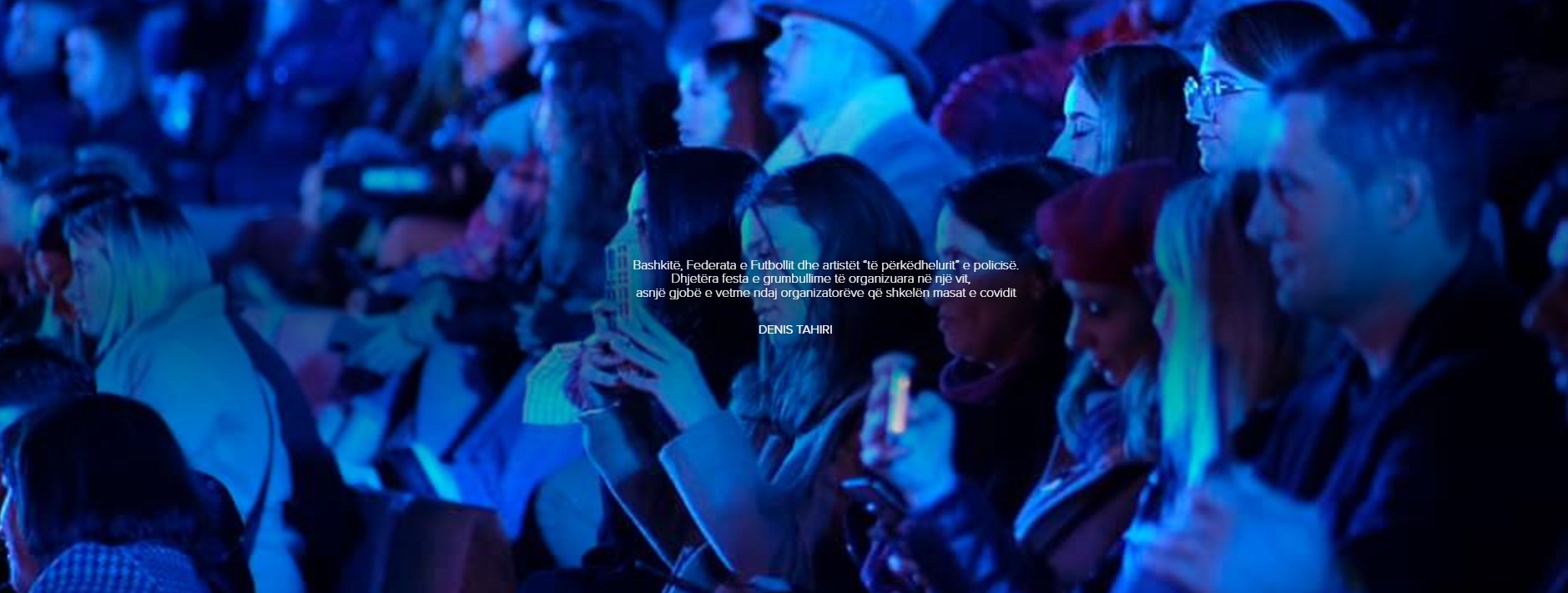
On the other hand, not even the Tirana Municipality is left behind in the organization of cultural activities, when by order of the Ministry of Health, the gathering of more than 50 people in both open and closed environments has been prohibited. On September 26, the municipality of Tirana allowed a festival in the amphitheater of the lake park, while on September 14, Ermal Meta's concert organized in the "Air Albania" stadium, even though the municipality had tried to respect the rules of social distancing, failed. This resulted in repeated violations of the restrictive measures in force. But even in this case, the fines and other administrative measures were also absent.


Officially asked the Tirana municipality, it states that it has not organized concerts or other activities with the participation of more than 50 people.
“The Ministry of Health and Social Protection has issued successive orders to prevent gatherings in closed or open places, which stipulate that: Gatherings of more than 50 people in open places are prohibited… In implementation of these orders, the Municipality of Tirana has not issued any permits for the development of cultural, sports, etc. activities”, this is only part of the response of the Municipality of Tirana, but what has happened on the ground is completely different. For more than two months, the ACQJ requested the Municipality of Tirana to make available all the permits that this institution had issued for various artistic, cultural and sports activities carried out from January 1 to September 1. But these documents were not obtained.
What do the experts say?
From the epidemiological point of view, experts in the field say that practice has shown that tolerance has increased. The clinical epidemiologist, Ilir Alimehmeti, talks about concrete cases of how gatherings affect the increase or decrease of infections.
"From an epidemiological point of view, we see that on September 13, schools opened and if you noticed, until mid-October we had a continuous decrease in numbers, which means that the collective immunity was sufficient for us not to have a problem opening schools, but even further, since high schools, for example, have larger gatherings and this was not accompanied by an increase in numbers on a national scale but a decrease. Which means that we have the tolerance as a population to keep schools open," he says, also giving cases where the acquired immunity of the population is defeated because of the numbers, " On October 12, we played the "Albania-Poland" match with 22 thousand people, and if you noticed, not only did the decrease in numbers stop there, but the increase began and two weeks later on October 27 is the peak of the increase and then it starts again and decreases for the second time, and I don't remember the exact date of the match. "Tirana-Partizani", again with tens of thousands present and two weeks ago we had an increase with a decrease, currently we are in decline because more than two weeks have passed since that moment ", says epidemiologist Alimehmeti.
"I would say 50 clearly doesn't make sense anymore, because I just came out of a lecture where I had 150 people, an official, university lecture, which means that we don't have cases, outbreaks, because this is important. It seems that the problem comes from larger gatherings than these, so in the thousands or tens of thousands. We can't say where the tolerance is fixed because we don't have studies of the dynamics in Albania, but there's no doubt that this number is increasing because there are more people who have passed it, who have been vaccinated, for this there is no doubt," the epidemiologist concludes.
Regarding the gatherings that have taken place, the Albanian Center for Quality Journalism insisted that there be a statement from the Ministry of Health. However, even though one of the heads of this ministry agreed to conduct an interview in principle, the media office of this ministry did not respond to ACQJ's request until the moment of publication of this article.
The police in front of the institutions violate the law by inaction, in front of the citizen they continue with an iron hand
And now that we are approaching 2 pandemic years in Albania, where all the trust for maintaining the rules and strengthening them in the community was mostly entrusted to the State Police, it seems that the latter, when it comes to punishing public institutions that break the rules not only lack will, but also lack strength.
“Subjects and individuals, public or private, who, in violation of the orders of the competent authorities, allow the development of sports, social, cultural activities, educational excursions organized by educational institutions, public and private, inside and outside the country, are punished with a fine of 1,000,000 (one million) lekë and, in case of repetition, the closure of the activity for a period of 6 months is added .” This is point 8, of article 3 of normative act number 3, dated 15.3.2020. But the State Police has forgotten this point of this normative act, when it comes to implementation towards public institutions. Officially asked whether it has taken measures against public entities in implementation of normative act number 3, as well as the order of the Ministry of Health to prohibit gatherings from January 1 to September 1, 2021, the General Directorate of the State Police says that: " no anti-covid administrative measures have been imposed by the State Police against state institutions during the period January-September 2021." Meanwhile, in relation to the gatherings that are not allowed, the Police has fined 9 representatives of political entities.
The head of the Police Union, Sadedin Fishta, states that in its mission, the State Police does not have the right to make distinctions and apply the law selectively. "If the use of fines for institutions that violate the law is foreseen in the normative act, it should be practically seen whether there have been any distinctions by the police. The police in no case have the right to make distinctions and apply the law selectively ," he says, adding that: "Cases of interventions from above to ensure impunity for institutions are not excluded, where investigative journalism must denounce them whenever it finds them in the relevant institutions."
In addition to media denunciations, Civil Society also raises accusations against the implementation of the law with two standards. Rigels Xhemollari from the Civic Center, says that since the release of the normative act regarding the ban on gatherings, they have raised their voices as it was an act that limited some constitutional freedoms, but was also being implemented with two standards.
" On the one hand, the right to protest was prohibited, on the other hand, party rallies were allowed during the electoral campaign. We addressed this double-standard implementation to the Ombudsman and the Technical Committee of Experts, who stated that protests are prohibited because people shout there and there are more germs, which leads to the further spread of Covid ," he says, adding that after the opening of schools, everything changed and that there were no measures against universities, institutions, or municipalities that organized parties, concerts, such as the lacroir festival, the beer festival, the wine festival, which gathered citizens, while there were some individuals who took the initiative to organize people and were fined 50 million.
Rigelsi says : "The State Police and the Technical Committee of Experts have implemented the awareness and information mechanism and often say that it is not good, but they have never taken administrative measures. This certainly leaves something to be desired. It is a lame, deficient law enforcement, with double standards, and when they fall on the backs of citizens, they are not spared the fine, whereas when they fall on the backs of party officials, the fine is spared". And on the backs of citizens, the iron hand of the law has not been easy. From January 1 to September 1, 2021, a full 212 fines have been imposed on bars, restaurants, fast-food restaurants and bars, for not complying with the order given to limit activities. While 90 fines have been imposed on nightclubs, discos, lounge bars for not complying with the obligation to close them. For not respecting the music curfew, 67 service facilities have been fined within 8 months.
While in fines against citizens for non-compliance with anti-covid rules, the hand of the state has been even heavier. Only for moving outside the clock after the curfew came into effect, 1371 citizens were fined, while for the non-use of wearing a mask, a total of 8 fines were imposed on citizens in just 62.648 months.