


Author: Denis Tahiri
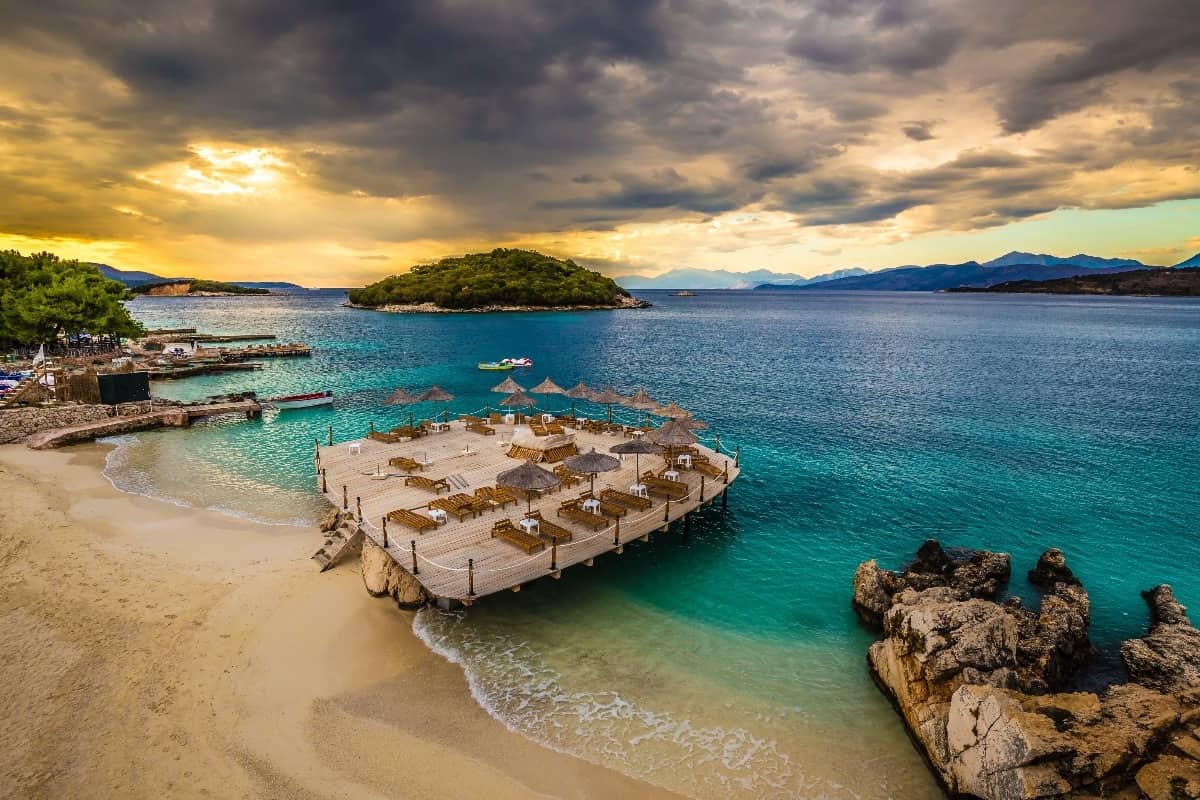
"Difficult season, we are in the red so far", - this was the universal sentence that you heard throughout the Albanian Riviera during this unusual summer from businessmen who have invested in the tourism industry. You could hardly find a hotel on the south coast, where you could enter without first measuring the temperature, disinfecting your hands several times without also filling out the form, to see if you had symptoms of COVID-19.
Many customers canceled their reservations due to the pandemic and many others found it difficult to arrive in Albania due to restrictions on movement outside the borders.
During this tourist season, tourist structures that have been operating in the Albanian market for 17 years also encountered problems. "This year has been a very difficult year for business. I can describe it as one of the most difficult years since we have been operating in this market for 17 years. First there was the earthquake, then the pandemic. The pandemic was a major problem, as we took it easy at first, we thought it would only be the first months of the season, but it has spread and has no end.", - says about Albanian Center for Quality Journalism Mirjeta Ismaili, general manager at Hotel Bonita.
In the absence of information on how they can act, the steps to enter the tourist season this year have been very small, as no one has known what will happen. This has caused the hotel structures to change their strategy, trying to attract as many customers as possible, who this summer, unlike other summers, were reluctant to make reservations.
"This has been a big problem, because we, in addition to the prices that we have changed, which are 30% lower compared to other years, we have also not had the flow of customers at the right levels", - says Mirjeta, who adds that the contracts with foreign tourist companies have also been cancelled.
Although Albania, like few countries, kept its borders open, the arrival of tourists, especially from the European Union, was hit hard due to its inclusion in the list of high-risk countries and the quarantine measures required after re-entry into EU countries.
And in these pandemic times, where nothing is certain, even the touristic structures, which during September and early November host students from Kosovo and other countries, do not have this reservation for sure.
"We usually followed the students at this time; we had 500-600 students, high school graduates from Kosovo, who went on excursions, that is, from September to the end of November, but this chance is gone.
So, from this moment we go back to minus. It is not at all like last year, it is not even 10%, because two of what we call seasons, i.e. spring and autumn, where we operated with graduates, are totally broken, there is no income from those", - says Mirjeta, who adds that during September, the reduction of the staff in the hotel she manages will begin, as they no longer have the opportunity to keep them at work.
"Keeping them and not paying them is not logical. There is no work, that's why you are forced to keep a basic staff, even with effort, because you don't have any kind of income", she concludes.
Warning and figures

Before the official start of the tourist season, there were no shortage of warnings about a strong blow to the tourism industry. Albania was assessed as one of the countries that would suffer the most from the COVID-19 pandemic with a decline in its economy of 5%, according to the International Monetary Fund and the World Bank, and up to 9% from EBRD.
Meanwhile, Visual capitalist, with data obtained from the World Tourism Organization, also compiled a map listing countries that have a high dependence on tourism, including countries where the tourism and travel industry contributed directly or indirectly to more than 15 % of employment. Albania was ranked 30th with an employment share of 22% in the country's economy. According to the report, the lack of a steady flow in tourism revenue would face many countries with severe effects on the economy. But, while the balance sheet of the economic loss from the tourism industry has not yet been made, the official figures of the first 6 months of 2020 may show a great loss.
According to INSTAT, in the first quarter of 2020, the utilization of the capacities of accommodation structures saw a decrease of 10,4% compared to the first quarter of 2019.
The number of nights of stay decreased by 9.4% compared to the same period of the previous year. Meanwhile, in the second quarter of 2020, the figures show an even greater decrease in visitors.
"The number of visitors has decreased by 75,6%, compared to the second quarter of 2019.
The number of net stays has decreased by 76,6%, compared to the second quarter of 2019", says INSTAT.
Summer from the point of view of tour operators
Besnik Vathi, who is a well-known name in Albanian tourism, acting for many years as a tourist operator, says that the impact on the tourism industry started before the pandemic came to our country.
"The peculiarity of this industry is that it suffered even before the pandemic came to our country. The impact in Albania began the moment the virus appeared, the fear of the spread of the virus began immediately with the appearance of the pandemic in China., - he says, adding that, - We don't have an influx of tourists in the winter. With the beginning of spring, a quarantine took place and all bookings that were planned for spring were canceled 100%. As a spring period, it is also the moment when reservations are made for the summer, and the conditions we were in caused the cancellation of the reservations for the summer as well."
In an interview for Albanian Center for Quality Journalism Vathi says that this is a difficult year for Albanian tourism, and according to him, it can reach 20%-30% of the realization of last year, these figures are quite low for a sector of the economy with a lot of weight. "A large part of hotels have closed, agencies have closed, while 30%-40% of businesses may not have closed, but have reduced activity to a minimum", - he says.
The only sure thing that can be said is that the consequences of this year in tourism are not lacking, but will this affect the following years? Besnik Vathi says that it is not easy to predict how deep and serious these consequences will be for the next years.
"If a business is hit, suspended, closed or lays off employees, to recover the state it had before the pandemic, it is not easy economically, as it needs income to put it to work, but even the laid-off employees may not be more ready for that business, as they may have left the country, may have changed their profile, etc."
Vathi adds that in these conditions it is very difficult to put them to work, always keeping in mind that we will return to a normal state with the release of the vaccine.
Besnik Vathi, regarding the number of people who rested this summer in Albania, says that he believes it is a smaller number than what is reflected in the media.

"I, unlike what is reflected in the media, have the impression that it is not true that more Albanians have rested in Albania. In total, they rested less than in other years. So it's not that Albanian tourism benefited from the closure, we all lost," he says ACQJ, adding that a part of those vacationing abroad this year vacationed in Albania, while those vacationing in Albania did not have the economic opportunity to go abroad or chose not to go on vacation due to fear of the pandemic.
Vathi says that the tourism sector should have been supported more by the government because, according to him, it was left in free fall.
"This sector after the opening was left in free fall and it was considered as if the blow was only with the closure in quarantine, despite the fact that we did not receive the blow in quarantine. Even during the quarantine, we were not obliged not to show up for work, but there was and is no activity".
He also states that in the recovery we will not be alone, but we will also be in competition with countries, which, not only consider tourism a priority as propaganda, but even do not consider tourism a priority at all, but we also take measures against countries that do not. they have it at all.
"For example, Germany is not a country known for tourism, but it has taken measures with salaries, donations, and various grants to get through the pandemic period. Those of us who prioritize it have left it in free fall", he says.
The measures that could have been taken to support this sector, according to Vathi, are numerous.
He emphasizes that these measures can be taken again and are related not only to employees, but also to business. "The business had to be supported with auxiliary measures, such as to pay rents, bank loan installments. It was necessary to see the possibility that in recovery one or two years would be exempted from the payment of taxes, so these would be direct measures", - he says, adding that there are also countries that applied very important indirect measures, such as Italy and France, which distributed holiday vouchers to citizens with low incomes, in order for these vouchers to be used in domestic tourism.
"So, that slogan, "Rest in English" that was translated from "Rest in Italy", should have been translated in full, accompanied by those measures that were accompanied in Italy or France; and not only to appeal to the people "Rest in Albania", as if this people was not born and was not Albanian and did not know Albania". - he concludes.
Lockdownand the tourists who were absent

With the spread of COVID-19, the whole world closed the borders and the movements outside them were only for specific categories of citizens, who felt it necessary to move. But the movement of people is one of the key elements of tourism. In Albania, the closing of the borders had major consequences in this sector.
Referring to the data from INSTAT, the arrivals of Albanians and foreigners in our country during the month of May were 46.488 people, a decrease of 94.4% compared to the month of May 2019.
At that time INSTAT would report that: "The number of foreign citizens who entered our country during the first five months of 2020 is 602.300, falling by 60,0%, compared to the same period of 2019. During the first five months of 2020, Mali i Zi has the lowest decrease in the entry of citizens to Albania with 51,1%, while Poland had the largest decrease with 89,0%, compared to the same period of 2019".
But the decrease in the entry of Albanian and foreign citizens into Albania would continue during the month of June, where it would mark a decrease of 66.3% compared to June of 2019.
During June, 179,594 foreign citizens entered our country, a decrease of 71.5% compared to the same period a year ago. The foreign citizens who had the biggest drop were those from Poland, where compared to June 2019, 95.3% fewer Polish citizens entered the borders of Albania.
A similar situation was also presented during the month of July, where INSTAT announced that: "Entries of Albanian and foreign citizens in the Albanian territory in July 2020 are 663.980. Compared to July 2019, this indicator results in a decrease of 61,5%.
In July 2020, the number of foreign nationals entering the Albanian territory was 387.716. Compared to July 2019, this number has decreased by 67,1%". During July 2020, the foreign citizens who preferred Albania the least were the Spanish, marking a decrease of 88.6% compared to the same period of 2019.
In a year where every sector of the economy was hit, where the country's economy shrank due to restrictions in the battle against COVID-19, what is certain is that the tourism sector was hit more than any other. And while the pandemic that has conquered the world still has no end, the question that arises is what measures will be taken by the Albanian state to facilitate many economic sectors to cope with the blow received by the pandemic, but also their recovery in the face of competition small neighboring countries.