


Urban buses can even show you a map of Berlin, but they don't know where to seat a pregnant woman.
Author: Elsa Dautaj, Harris Mecolli
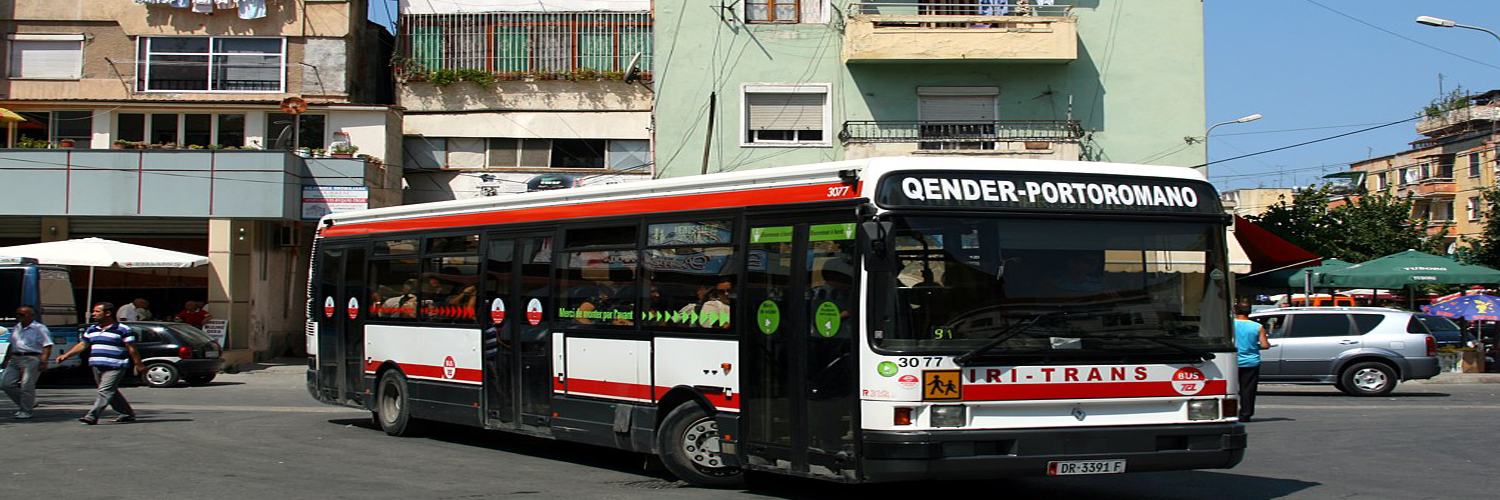
As soon as you enter the bus that connects Nish Tulla with the center of Durrës, you face a poster that reads: "Attends le départ de l'autobus avant de traverser; il te cache des motorists." And then it tells you, yes in French and only in French, that for more details, you can contact the phone number 04 26 10 12 12, and gives the address of the website, www.tcl.fr.

"I also asked in the office, no one knows we had cooperation with Albania," says Olivia Vansoen, spokesperson for Transport en commun lyonnais (Tcl), the company that administers the urban transport system in Lyon, in the second largest city of France. "We use the buses for 15 years, then we return them to the company that produces them."
All the cities of Albania that have any industrial area, or population that needs to move in significant numbers (bush-factory-bush, now recently also bus-shopping center-bush), have buses that are reminiscent of the paint and signs metropolises of Western Europe, but which testify to the messy present of the country. For the most part, Albanian urbanites are recycled here, two years before death, after a long life in Western Europe.

In Tirana, the yellow Berlin bus—advertisement with a German sticker on the end of it says that you can now check the Internet from inside the bus—brings you closer to the Crystal Center of the Paris Commune. The Hague and Hamburg want to say Kamez Institute and Center.

The one that used to run in Rouen, the capital of Normandy in France, connects the center with the Dynamo Plant. The area from Dajti is served by buses that used to cover the area Toulon on the French Riviera.

in Weight, a bus i RATP, which used to take people from the Arc de Triomphe to the train station in Paris, line 31, now leads from Uznova to the textile factory.
Even the twenty-seater van of Petri Baçi from the village of Podgorie near Korça, which takes people from the village to go down to the city, used to make its way to the train station - concentration camp in Mauthausen, Austria.
"It makes me wonder how that place is never made, that we take the garbage from here and bring it there," says Dave Marku, an 18-year-old from Durrës, who is currently studying in Lyon. “And we take the template and put them as they are. Leave the pollution to me.”
The country is full of second-hand cars, and most still bear the marks of the factories, offices, refrigerators or Western restaurants that once used them.
"By law it should be prohibited," says Eva Buhaljoti, marketing lecturer at the University of Tirana. "But this branding thing is more of an ethical issue than anything else."
Whether or not people bother to de-mark a car goes to the heart of the nature of our business. Logos don't matter to small companies, and their business is advertised by word of mouth. What is written there is irrelevant.

Buses are different, as they must contain instructions for emergencies—be it seats for the elderly or pregnant women, or emergency exits in case of accidents. You can't even find the instructions in Tirana, says a project manager in the capital. "I see what I see here in German."
Line administrator Maren Buss (I don't understand psse with two ss), who operates the beach in Durrës, is caught off guard when asked. "We can't change them that easily," he said. "They are copyrighted."
Partly this comes from the cost—it costs at least a million lek, probably more, to paint a bus. Cleaning it adds even more. A bus needs to carry at least three thousand passengers before it starts making money. There is no owner who does this, if he finds the space and is given the opportunity.
But it's no wonder that urban transport recirculates from richer to poorer countries.
"It's a normal phenomenon throughout central and eastern Europe," says Mariusz Józefowicz from Gdynia, Poland, who has a hobby of documenting the world's urban buses. "Only the conditions change. In Poland, they are completely cleaned, repainted in the colors of the company that operates them, and all previous owner information is removed."
"In Albania, such buses happen to show on the inside the line of a city in France, with the destination in Albania on a piece of paper in front of the mosque."

The Iveco van that connects Podgorie with Korça was brought to Petri Baç three years ago by Ibrahimi i Pojani, whose son lived in the north of Italy.
The son of Ibrahim from Pojan, now, had bought the van from an Afghan in Germany, and he bought it from Mr. Brixner from Mauthausen. In the Mauthausen concentration camp museum there is one statue famous Albanian, that of a partisan who hits a German soldier with the butt of his rifle.
Mr. Brixner says that he changes cars every ten years, and he knows almost nothing about Albania, because it rarely happens that the Albanian football teams play with those of Munich, which he follows.
Not even Baci knows about Mauthausen.
"What concentration camp, brother? What do you say, brother?" he says, sitting in a club near the Agency in Korça.
He took the van to the upholsterer, who put a sticker with the Albanian flag on the front of Mr. Brixner's data. Only a highly trained eye can now spot those numbers in green paint on an Austrian cell phone.

Whereas the Lyon buses were initially seen in Tirana.
Five summers ago, Ledia Dema laughed to herself when she saw that people at the Faculty of Natural Sciences boarded the STL bus from the middle door, not from the front door like in Lyon. "When I'm in them in Albania, I have to press the button to call the driver to stop at the coming station," says Edmond Bogdani, a retired social worker who has lived in France for twenty-odd years. "Normal that doesn't work."

Now I use Durrësi. Armir Asllani, 19, studies sculpture and takes the bus every day to go to school. "It would be very nice to be in France and understand," he says.
*Elsa Dautaj worked for this article in Durrës and Harris Meçolli in Tirana and Korçë. Fatjana Kazani also reported from Tirana