


Author: Denis Tahiri
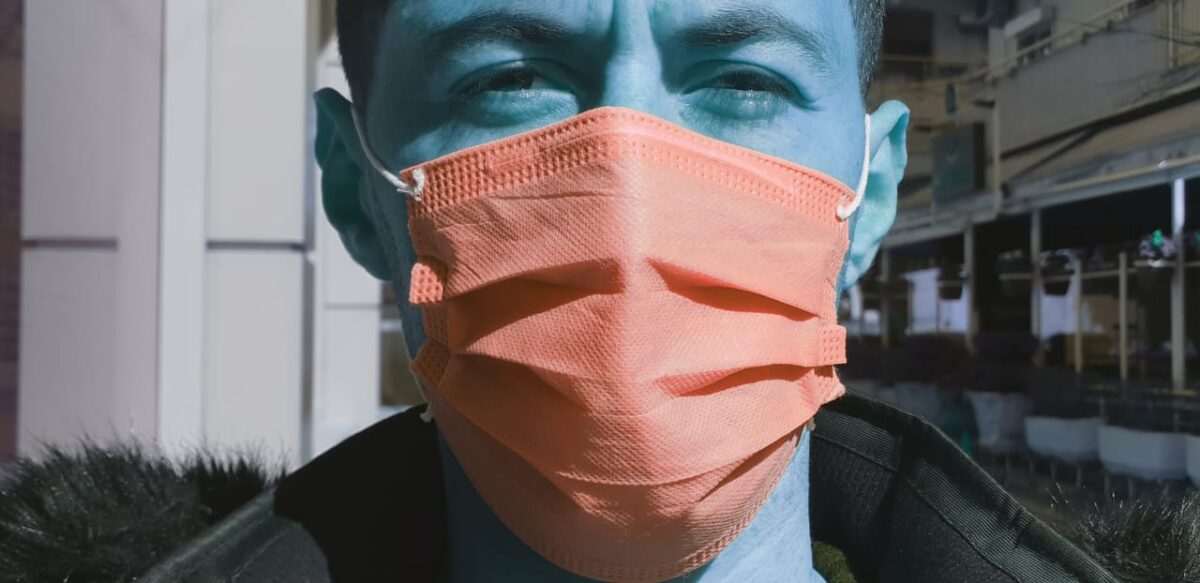
Why didn't you wear a mask? Mira responds with a joke adapted during the pandemic. "With the Shkodran people, the locals even deny the existence of Covid ," says the woman from Shkodra who has lived a life torn between quarantine and the freedom to go out on the streets without a mask. At the same time, she has a sense of humor and fear of infection.
But Mira's reaction by refusing to wear the protective barrier is clearly readable in the city of Shkodra and among other citizens. A short walk on the city's pedestrian street is enough and what catches your eye is a reality that seems to show that life in Shkodra continues normally. People wearing face masks are very few and this probably pushes Mira to continue the humor " you stand out because you are not from Shkodra, because you are wearing masks".

Since October 15, 2020, the day when the normative act for the mandatory wearing of a mask came into force as one of the anti-covid restrictive measures, the total number of fined citizens in Shkodër is 1410 people. This figure means that on average every day the police of Shkodra have fined less than 15 citizens. In fact, they can be found freely for every hour only during the pedestrian zone, not including the markets of Shkodra where the refusal to wear a mask appears the same.

"I can't say if this is a kind of reaction or not a protest against the police by the citizens of Shkodra. A city that at the beginning of the pandemic marked the first clash with government authorities, after the markets were considered outside the standards and hygienic-sanitary conditions and for this reason some of them were closed. If you will remember, at that time the prefect was penalized and replaced with the deputy interior minister Besfor Lamallari ," comments an official of the Shkodra Municipality on condition of anonymity, who insists under the same conditions of conversation with ACQJ that during the pandemic this city was used as a political case.

But currently in the capital of the north, according to the statistics of the Ministry of Health, over 1300 citizens are infected with Covid-19. Meanwhile, the loss of life due to Covid-19 in Shkodër has not been absent.
For active cases with Covid-19 (28.02.2021), Tirana has 22.887 citizens, Fieri 2667, Durres 1680, Vlora 1746, Shkodra 1373, Gjirokastra 1075, Berati 884, Korça 914, Elbasani 876, Lezha 826, Dibra 374 and Kukësi 336 .
But in the police data for the imposition of fines, Shkodra occupies the seventh place, leaving behind cities such as Lezha, Gjirokastra, Berati, Kukësi and Dibra.
As the most populous cities as well as the urban capital, the citizens of Tirana hold the first place for fines, not because they are not convinced but because, as ACQJ sources say, the actions of the police in the capital are more monitored and at the same time in the capital the number of inhabitants is higher. After the capital, they are not left behind for the fines received by Durrsak, Fierak, Vlonjat, Elbasanli and Korcar.
The collection of mask fines begins, but not without problems
" We were returning from Lushnja, where a Traffic Police patrol stopped us and asked me, who was a driver, for my license, while the other 3 colleagues for their ID cards. We knew that we were stopped for wearing masks even though all four of us had passed Covid. But again, the rule is for everyone and we had to wear masks ," recalls Matias, who does not hesitate to bring up a part of the communication with the traffic police officer.
"I asked him how we would pay the fine and he told us that it comes with the electricity bill and when we told him that none of us have a contract with OSHEE and consequently do not receive an electricity bill at the end of the month, the policeman told us - you are lucky, you do not have to worry about not having to pay it. But he cut the fine sheet for the four of us even though practically we cannot pay it since we do not appear in the OSHEE registers", he says, adding that he is worried that the imposed fine will create problems in the Services he receives from the state, since he is in conditions of impossibility due to problems that do not depend on him.
Even Klodiani has an experience similar to that of Matias. Although there was no contract with OSHEE, the police officer fined him.

" I was very surprised because even though the policeman was informed that I could not pay it because I did not have a contract with OSHEE, he still imposed the fine. So practically this fine is useless, because if there is no mechanism to collect it from all citizens, it is something that does not exert even the slightest pressure on the part of citizens who do not have a contract with OSHEE and can receive as many fines as they want because in the end they do not pay anything ," he says, adding that the policeman also commented while signing the measure: " But if you have a contract with OSHEE, why do you care, you do not have to pay anything."
The General Directorate of the State Police announces that 64,000 fines have been imposed across the country against citizens found to have failed to comply with the anti-covid measures, which is the compulsory wearing of a mask. But not all of them have been escorted by the police to the institution charged with carrying out their execution. When it comes to their validity, 55,000 fines have been delegated to the Electricity Distribution Operator. Of these, 22 fines cannot be levied, as OSHEE unofficially argues, the fined persons do not exist in the contract database. The other problem encountered that leads to non-payment of the mask fine is related to the irregularity in what the officers have signed, irregular personal data, inconsistency in the declared data starting from the name or number of the identification document.
ACQJ is informed that according to the legal provisions found before these deficiencies, OSHEE specialists have returned the fines to the police to complete them.
We asked the State Police what happens to the fines for masks that OSHEE returns to the police, the only answer we were given was: " The data is being filled in ", but what data was filled in and how the collection of almost 22 thousand phantom fines would continue, police officials were unable to give an answer. Unofficially, it is explained that the first step taken by the State Police is the distribution to the police stations and according to the local police stations where they were signed. But despite this explanation, in official documents there is no way to foresee the resolution of such situations and the procedures that must be followed by the police to collect a fine from a citizen who does not have at least a contract with OSHEE.
When collection of fines is done against the law
"Failure to use a protective barrier (mask) by individuals outside the home is punishable by a fine of 3000 (three thousand) lekë and, in case of repetition, 5000 (five thousand) lekë. The State Police and the Municipal Police have the right to issue an administrative measure for failure to use a protective barrier (mask), according to the fine model approved by them. The execution of the administrative measure will be carried out through the Electricity Distribution Operator, becoming part of the electricity bills. The manner of executing the administrative measure through the Electricity Distribution Operator is determined by a joint instruction of the minister responsible for energy, the minister responsible for finance and the minister responsible for health". This is what is stated in the approved normative act, while lawyers state that the inclusion of this fine in the electricity bill is illegal.
"Including administrative penalties for not wearing masks as part of the electricity bill is illegal, as a joint instruction of the ministers cited in the normative act on how these fines will be collected has not yet been issued," says lawyer Ledio Braho, who also comments on the collection of fines.
" It is discriminatory against people who have contracts in force with OSHEE compared to those who do not, since there are no binding mechanisms for collecting these fines against the latter."