


Author: Dallandyshe Xhaferri
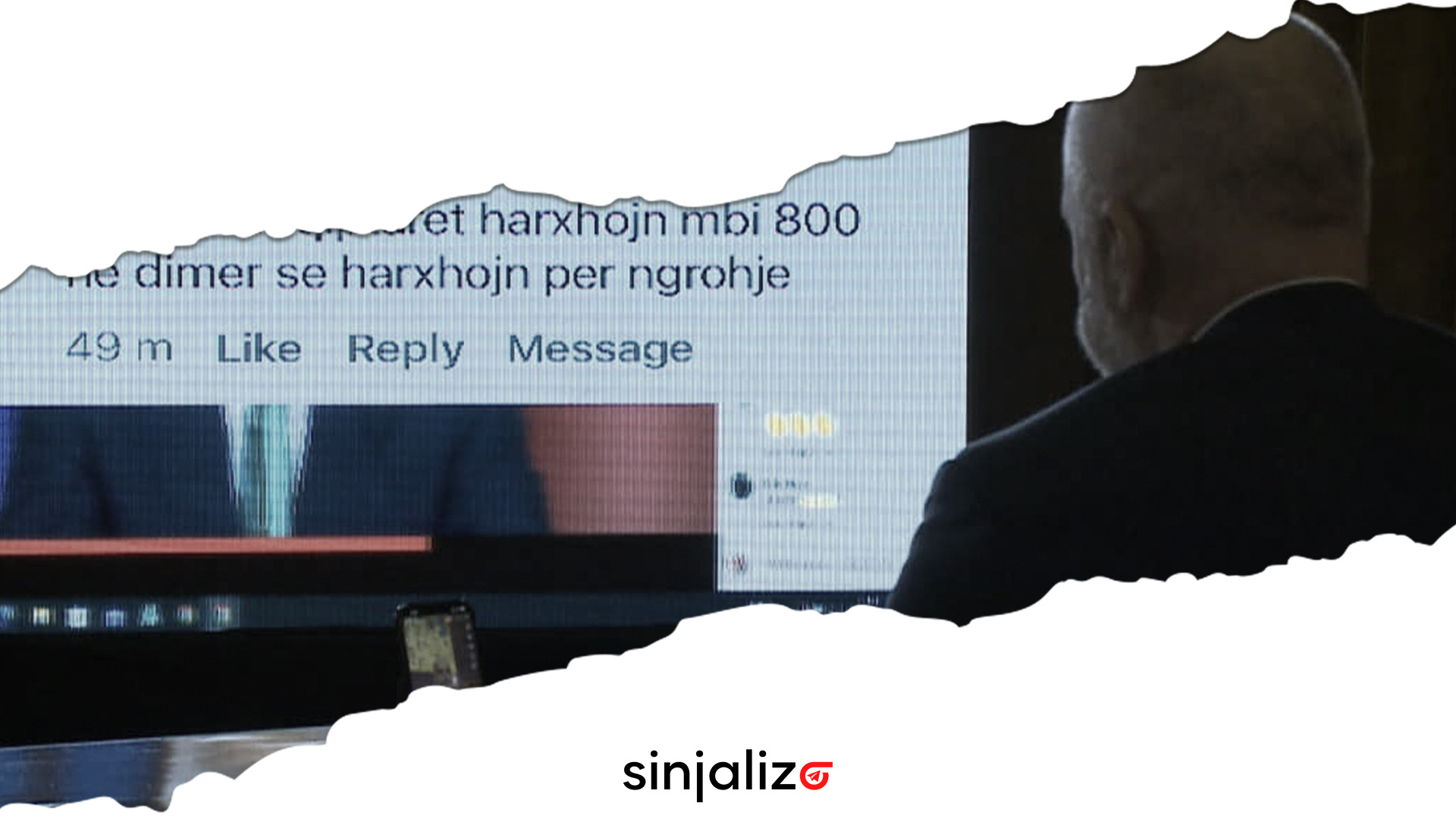
The number of followers on the official Facebook pages of the main political figures in the country reaches 1.6 million. More than half of the country's population, according to INSTAT figures. But one click on the "most relevant comments" option is enough to understand that behind the compliments and supportive messages, there are hidden fake identities or individuals who are thought to promote the propaganda of the holders of these public profiles for payment. Thus they become collaborators of the virtual world that politicians want, a world where the cult of the individual seems to be rising.
"Facebook has consistently allowed world leaders and politicians to use the platform to mislead the public or harass opponents, despite warnings that there was evidence of this," The Guardian wrote a year ago, when former Facebook communications expert Sophie Zhang revealed that Albania was among the countries where public opinion was being manipulated and political discourse was being distorted.
A whole propaganda machine is witnessed in Albania by young people who, through fake profiles, try to influence the political beliefs of citizens. The latter are more active during the election period.
How much does it cost in Albania? A salary of 10 to 26, support for a job or "turning a blind eye" by the authorities to obligations to the state. This is the scheme that is implemented, part of which are mainly young people engaged in politics. Juliana N. is one of them. The 23-year-old tells ACQJ that the publication of positive comments on the profiles of Albanian politicians is a job done by young supporters of political parties against a payment or other economic favors.
"I was involved during the last political campaign of the Socialist Party and I say that anyone who writes untrue comments is part of an organized group. They are a type of fan," she says, adding that "the payment for positive comments made on the Prime Minister's official website ranged from 100 thousand old lek to 260 thousand old lek ." According to her, the commentators' payments were lower than those of their supervisors, who made sure that each comment conveyed a clear and convincing message on the social network Facebook.
"During the period when I contributed to the SP, there were many cases where commentators were not paid, but as a form of reward for the work done, they did not pay taxes for family businesses," she explains.
Juliana N. also recalled the involvement of the administration in the machinery of manipulation in the interests of the government. "Not even the administration employees could avoid the virtual support they were supposed to give the government. During the election period of April 25, even people employed in the administration, such as teachers, were required to be active," she says.


Endri Fuga, the Director of the Office of Communication of the Prime Minister, denies that the government practices the inclusion of fake profiles as its virtual supporters.
"I see comments that speak positively and negatively. That curse and insult and praise. I see it in the prime minister and ministers as I see it in the opposition. I see it in Albania, I see it in Europe, I see it in the world," he told the Albanian Center for Quality Journalism. He emphasizes that fake profiles are a wrong practice, which the Prime Minister's office does not follow.


"We do not have this practice ," he denies and recalls that his image has been affected by negative comments from fake profiles.
"If you were in my place and read what is written about me, my family, every day by trolls and opposition politicians, I assure you that you would be much more disgusted than I am," Fuga said.
Fake commentators during the April 25 campaign were not absent even in the Democratic Party. On the condition of anonymity, a former commentator told the Albanian Center for Quality Journalism that the trolls in DP were paid, but not much.
"Most of our group of 30 people came to the office with personal computers and were asked to promote the former leader of the Democratic Party, Lulzim Basha, as a Western leader ," he says, noting that " some young commentators did not have a salary, while the people who performed the role of supervisors had a salary of 30 thousand lek per month."
"After the 3rd election loss and especially after Basha's departure, our group disintegrated. I don't know what happened to the others now," he concludes.
Asked by the Albanian Center for Quality Journalism, the former director of the Media Office for the Democratic Party, Patrik Sadikaj, denied the existence of a group of fake commentators, saying that during the election period only polls were carried out that had to do with recognition and the embrace of the DP program by the electorate.
How many comments are fake on the pages of Albanian politicians?
"Good luck and much success in the roads you will take. Thanks to you, Albania will have better roads. You are the only one who is developing Albania," says Migena Dushku, one of the fake commentators on Prime Minister Rama's official Facebook page.

Mostly, these fake commenters are profiles with female names, which, although they do not have an updated activity through posting attractive photos, manage to get "friend requests" not only from African or Asian profiles, but also from real profiles of Albanian male followers. This can be clearly distinguished from the comments made on these fake profiles, where it is shown that there is a lack of communication with the followers and an Albanian language translated verbatim from a foreign language, or comments of the same format and script. The opposite happens with fake profiles opened with male names, they have very few, 2-5 virtual friends and are not active at all.
Also, the lack of friends, profile picture is another distinguishing feature of fake accounts on social networks, specifically on Facebook.
But how did we distinguish fake profiles?
We first rated the profile picture of most commenting profiles. Most of the fake profiles had either perfect photos, or photos that through Google Reverse Image Search appeared to be stock photos. Most of the profiles either had minimal or no interactions in the duration of their activity, as well as minimal friends, or friends from other countries of the world, with no connection to the Albanian reality, or with inconsistent activity, where the previous months were fans/commenters /followers/liked topics diametrically opposed to the current ones, while in an immediate turn, they turn into ardent followers and commentators of Albanian politicians.


During the observations carried out by ACQJ, it turns out that no matter how many times a fake profile comments on the prime minister's profile, the repeated positive message is the same: encouragement for the further continuation of the policies undertaken so far.
In five of the post-videos published on Prime Minister Rama's official Facebook page, we observed 200 random comments in the first line of commenters, and commenters who had also earned symbols as the most frequent commenters or the most loyal commenters to the Prime Minister, out of hundreds of comments posted. Specifically, in the video of the opening of the Vlora Bypass , posted on July 14, 2022, in the video of two Indian tourists promoting Albanian beauties, in the one of the port of Saranda , of the NATO headquarters meeting in Brussels , and in the post-video where the Prime Minister was present at the inauguration of the new park in the city of Vlora.
According to our data, out of 1000 comments published by these five videos, 470 are published by fake profiles. In other words, 47% of the main comments on these post-videos of the prime minister are fake, while the fake profiles that wrote these comments are over 138, which means that a single profile has commented on average 4 times, but it is notice that many of the profiles are many times more active on the prime minister's profile than other profiles, leaving dozens of positive comments on each post.
Unlike Prime Minister Rama's posts, on the profile of former Democratic Party Leader Lulzim Basha, we mainly see fake supportive comments during the campaign period. In the video of Luan Hoti's conversation with business representatives in Durrës, out of 200 comments at the beginning of the comments list, there were 20 fake comments, 8 of which were from the same profile.
Former Prime Minister Berisha has one of the most followed profiles on Facebook. His official profile is followed by 1.1 million followers, but his last five video posts average 872 views, while our observations show that comments from fake profiles are absent.

Specifically, we analyzed the two videos of the former Prime Minister made on September 22 in the Assembly of the Parliament of Albania , the video-post from the statement of the member of the Presidency of the Democratic Party Mimoza Hajdarmataj, the video-post published on September 21 about the speech of the athlete Krista Kovaçi during the conversation with Berisha, and the video-post of the conversation of the former Prime Minister with the literary critic Lili Sula.
All five of these videos have been commented on a total of 895 times, although the number of followers of the former Prime Minister's profile is approximately half of the population of Albania. This can indicate either a large number of fake followers, or a lack of interest on the part of the latter.
Unlike the politicians of the two largest political parties in the country, President Bajram Begaj counts 3,3 thousand followers and comments on his posts range from 5 to 25, all made by real profiles.
How much does it cost to buy followers, comments and likes?
" Buying followers, likes and commenters is very simple, all you need is a debit card or cash," says the Information Technology (IT) expert. According to him, there are many sites in Albania that offer 10,000 (ten thousand) comments for $4.
"You can also buy personalized comments, where the buyer decides what will be written, but they cost money. The price ranges from $50 to $80," he explains.

"The person who writes these dictated comments has an active profile on social networks, almost like a real person. Mostly these profiles publish posts related to travel or gastronomy," he continues.
The use of social networks in the political confrontation and the consequences in democracy
According to the expert and lecturer of Communication Sciences, fake comments aim to manipulate public opinion.
"The strategy of fake users on social networks and the engagement of people to generate content, comments and reactions to accounts, mainly those of politicians, clearly aims to manipulate public opinion," says Çela, adding that "the commenters are mainly people from Africa, Indonesia and India who have no connection to either the content of the messages or the Albanian reality."

The Pedagogy of Communication Sciences, Edlira Gjoni, thinks that the Albanian public is faced with a river of false information, unverified or distributed by unreal profiles, which burdens the audience's ability to separate truth from lies.
" The most negative consequence is that a person can make wrong decisions when they are overloaded with false information, because they act under the pressure and untruth of the online reality that is offered to them without any verification filter," she says, adding that "creating wrong opinions, receiving truncated information leads citizens to make wrong decisions."

"Such citizens fall prey to political, economic or social fraud and are very vulnerable to making decisions about voting, for example, or about investments, payments and other wrong decisions that come as a result of the suspicious content coming from these fake profiles. A real danger to society," concludes Gjoni.
Afrim Krasniqi, Executive Director of the Albanian Institute for Political Studies, says that social networks have long been used for political warfare, " starting from the fact that in Albania the mentality still persists that the more followers and commenters you have, the more successful you are."
"Until recently, nearly 100 people in the Palace of Congresses formed the leader's online army and their task was to attack opposing opinion. From there, this was passed on to foreign companies, as we saw in the recent campaign that Israeli companies controlled social networks and directed them where their leaders wanted ," he recalls.
In his judgment, the real consequences of this activity are felt by people who are afraid of power, which are the majority of the older generation.

"When a simple person sees that a decision by the Prime Minister receives thousands of positive comments and 'likes', he begins to believe that his fate depends on these people who seem numerous and can destroy his house, can take his wealth and can destroy him. These false messages from the virtual world are addressed to these categories who must remain silent and accept everything that comes from above ," he emphasizes.
Krasniqi concludes the analysis by warning that "these mechanisms distort the concept of democracy, free thought and media freedom . "