




Ida Ismail
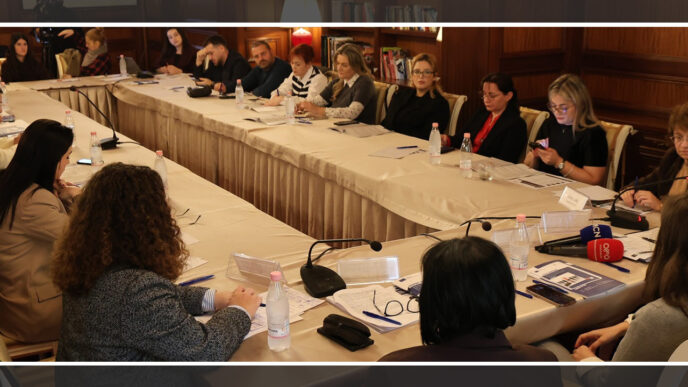
The Together for Life association has presented a monitoring report on how public institutions handle complaints and whistleblowing on corruption in the health sector. The report highlights that despite the establishment of relevant structures, whistleblowing on corruption by citizens and employees, contrary to what is reported by the media , remains very few.
At a time when citizens complain every day about not receiving dignified service in public health institutions, the almost total lack of complaints about corruption in public health institutions raises more doubts than certainty. This is the main finding of the monitoring report, which analyzed the way in which health institutions handle complaints and reports of corruption.
According to the report, no formal complaints of corruption were reported in the monitored institutions, except for one isolated case, which is unclear whether it constitutes a genuine complaint or not. In a country where public perception of corruption in healthcare is high, this is seen as an indication of silence out of fear, distrust, or lack of information.
HIDACCI data also reinforce this picture: According to the 2024 Annual Report, although units responsible for reporting in public institutions have been established and are functioning, there is no internal reporting of corruption in the health sector.
As for external reporting carried out directly to the HIDACCI, it is not clear from the report whether the 6 reports carried out against public institutions were carried out by employees of health institutions.
The representative of the High Inspectorate for Declaration and Control of Assets and Conflict of Interest, Majlinda Thomaj, states that the HIDACCI has been engaged since the initial phase of implementing the law on whistleblowing.
"Currently, for the year we are talking about, 194 responsible units have been created in the public sector and 540 responsible units in the private sector," she says.
Together for Life's monitoring highlights a recurring pattern in several health institutions:
- The "Shefqet Ndroqi" University Hospital officially declares that there has been no reporting, neither written nor electronic. The official website lacks a clear transparency program and does not provide direct information on denouncing corruption.
- The Institute of Public Health has provided a partial response, stating that there have been no complaints of corruption, but delegating the responsibility of information to another institution.
- The University Trauma Hospital does not provide clear data on the number of complaints. Neither the official response nor the website can identify any complaint register.
- Elbasan Psychiatric Hospital has set up an internal committee for managing complaints, but according to the institution, no complaints have been filed, either physically or electronically.
- The Healthcare Services Operator confirms that there have been no registered complaints regarding bribery or corruption.
- The Mandatory Health Insurance Fund (FSDKSh) admits that it does not have a dedicated structure for complaints against corruption. Complaints are handled in a general manner and delegated to the relevant directorates, lacking a specific and independent mechanism.
Structures that exist only on paper
The report also highlights overlapping roles and institutional confusion. In some cases, whistleblowing units, anti-corruption coordinators, and internal audit function without a clear separation of powers, sometimes even by the same employee. This increases the risk of conflict of interest and undermines the credibility of the process.
In other institutions, complaints units exist only formally, without staff, financial resources, and technical capacity. Even more problematic is the hierarchical dependence of these structures on the heads of institutions, calling into question their impartiality.
Although most institutions have adopted transparency programs under the right to information law, they do not include concrete elements for anti-corruption complaints. Public registers of complaints, standard complaint formats, and clear information on procedures are lacking.
The Together for Life report concludes that in the health sector, complaints mechanisms exist but do not function properly. Without independence, staffing, transparency and real protection for whistleblowers, these structures risk remaining mere administrative formalities.
The main recommendation is to build a comprehensive inter-institutional strategy, in cooperation with civil society, to promote a culture of reporting and guarantee real protection for those who dare to speak out. /acqj.al