


Denada Jushi
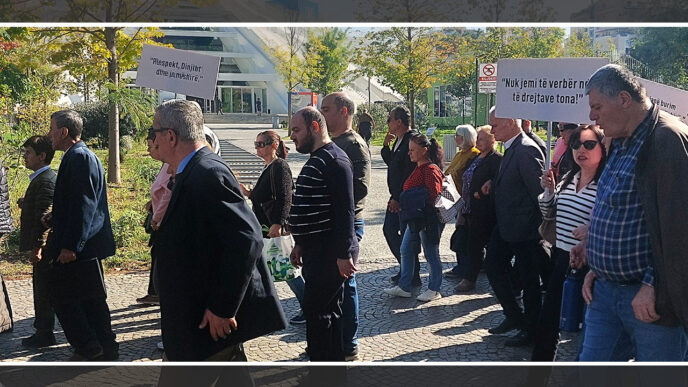
While the Prime Minister, with the new duties assumed after the arrest of the Mayor of Tirana by SPAK, vows to carry out a radical reform of water management and to finally remove water tanks from the terraces of buildings (a pledge that became a headline for Mayor Veliaj after the November 2019 earthquake), at six in the morning, JK, a resident for years on Kavaja Street, an area in the heart of Tirana, gets up early, not only because she has to go to work, but also because she has a luxury that she cannot afford to miss: tap water.
"He comes until four in the afternoon, then stops. He comes back again from 7:30 to ten in the evening. I don't have a deposit, so I spend the afternoon doing nothing. In the evening, when I should be resting, I wash the dishes and clothes," she says.
In Tirana it is promised 24-hour water for decades, but this still remains a promise far from reality. There is no thought of water consumption in the capital's taps.
"I'm not sure about the quality. In the building opposite, the water smells bad. Who knows what kind of water contamination has occurred. We bought a filter that costs 100 thousand lek per year just to drink water and wash fruit," says another resident of the "21 Dhjetori" area.
These stories are just a fragment of a much larger picture: 21st century Tirana, a rapidly growing capital city, filled with tourists and luxury towers, but unable to guarantee an uninterrupted supply of drinking water for its residents.
In the last decade, Tirana has become a giant construction site. The official population has exceeded one million inhabitants, while it is estimated that due to internal migration and tourism, the real figure is higher. Every year, hundreds of thousands of tourists visit the capital, increasing the demand for basic Services.
But the water supply network has not been able to keep up with this pace. The average supply in 2024 is 17.3 hours per day, a slight increase from 16.3 hours in 2023, but still far from the promised 24 hours. Residents of the peripheral areas we interviewed in Sauk të Ri e të Vjetër, Liqeni i Thatë, Yzberisht and Kashar say they face long and repeated shortages.
On the ground, the feeling among citizens is clear: water is unreliable in terms of quantity and quality. Many families buy bottled water or invest in filtration equipment, paying double for a service that in theory should be guaranteed by the state.
Experts like Bilbil Daci, an expert in this field, say that Albania has water for four million inhabitants, but governments only project to benefit.
"The water supply situation in Tirana is dramatic. It is not a lack of resources. The amount of water available to UKT is enough to supply four million residents 24 hours a day. The problem is the design and management of the network. Pseudo-designers take the money and are not held responsible for the damage they cause," explains Daci.
Technical losses: 40% of water disappears in the network
One of the problems our country has been facing for years is the structural defects of the network. Daci explains that the main problem is not illegal connections or abusive uses, but precisely the lack of network efficiency.
"Technical losses in UKT are around 40%. This water goes nowhere, is not sold and is not even used for irrigation. It is simply lost due to design errors. As a result, even though the city has enough water, only a portion reaches the consumer.
"Supply remains limited and uneven, central areas have better schedules, while the suburbs suffer from shortages. This is absurd when you consider that Albania ranks second in Europe in terms of water quantity. A blessing that is not properly utilized."
UKT's financial data shows a stark contrast. In 2023, the company made pre-tax profits of 13 million euros, about 30% of revenue. In 2024, net profit was 990 million lek, or 20% above turnover, well above the average economic rate of 9%.
And naturally the question arises: why doesn't an institution that earns so much guarantee 24-hour water?
"Because the cost of producing one cubic meter of water is only 65 old lek, but it is sold ten times more expensive, as if it came from China," Daci says ironically.
Meanwhile, on the other hand, there is no transparency on the debts that public institutions may have towards UKT, nor on the real use of profits for investments in the network.
Sinjalizo contacted this institution to learn more about water supply, problematic areas, and water safety, but has not received any response so far.
Water quality: a threat to public health
While UKT states in public statements that it conducts regular analyses, the lack of transparent reporting has reduced citizen trust.
Dr. Ilir Alimehmeti, an infectious disease physician, confirms that the tap water in Tirana is not safe to drink, and this fact was also sanctioned by the Tirana Court in 2021.
“The risks are of two types: microbiological and chemical,” he explains.
According to the doctor, contamination with bacteria such as Escherichia coli and Streptococcus fecalis indicates the entry of sewage into the network. The level of contamination varies by area: less on Bulevardi i Ri, but very dangerous in Astir and Kombinat, due to the depreciation of the pipes and the lack of constant pressure. “If the pressure were 24 hours, the pollutants would not penetrate,” he emphasizes.
Chemical pollution is another problem. High levels of chlorine often exceed legal limits, making the water potentially carcinogenic.
"There are cases of gastroenteritis and hepatitis A that follow the map of water pollution in the city. Most are easily resolved, but there are also serious cases. Meanwhile, identifying tumor cases related to chemical substances such as chlorine or heavy metals is more difficult."
These facts are enough to understand the risk of contamination. However, according to him, this data is often not officially reflected. Private laboratories are reluctant to publish analyses due to pressure from the Municipality and UKT.
Meanwhile, political rhetoric promises European dreams of modernization. The European Investment Bank has provided 1 million euros in technical assistance to improve supply and reduce losses.
But the projects for storage, filtration plants and a new network have not brought the promised results. Dr. Mehmeti calls for an urgent meeting of the Municipality and the Health Commission to implement the law “not for facade, but to protect the health of citizens”.
Consequences for citizens: no deadline for 24-hour water
Studies in the Kombinat area have shown that disruptions and pollution from sewage systems increase the risk of infections. Until the analyses are made public and verified by independent institutions, citizens remain in uncertainty and are forced to buy bottled water, paying twice for a basic right.
Questions about a specific plan have not been answered. Public statements talk about “maintenance and improvement works,” but residents say outages often last longer than warnings and it is not known what is actually being done.
The conclusion remains unclear: Tirana is building towers, hosting tourists and organizing international events, but it still does not have a 24-hour supply of drinking water. For experts, the problem is not technical, but political, financial and now also medical.
"The problem is not technological or natural. This situation will not change with new investments, if they continue to be used for profit, not for supplying the city," concludes Bilbil Daci.
Meanwhile, Dr. Ilir Alimehmeti warns: "The village that seems to want no leader, and the fact that citizens do not drink tap water is the biggest alarm for public health."
Until then, Tirana citizens, like JK and thousands of others, will continue to wake up early, make plans according to the water schedule, and buy water to drink, in a capital city where everything seems modern, except for the most basic service: drinking water.