


Ida Ismail
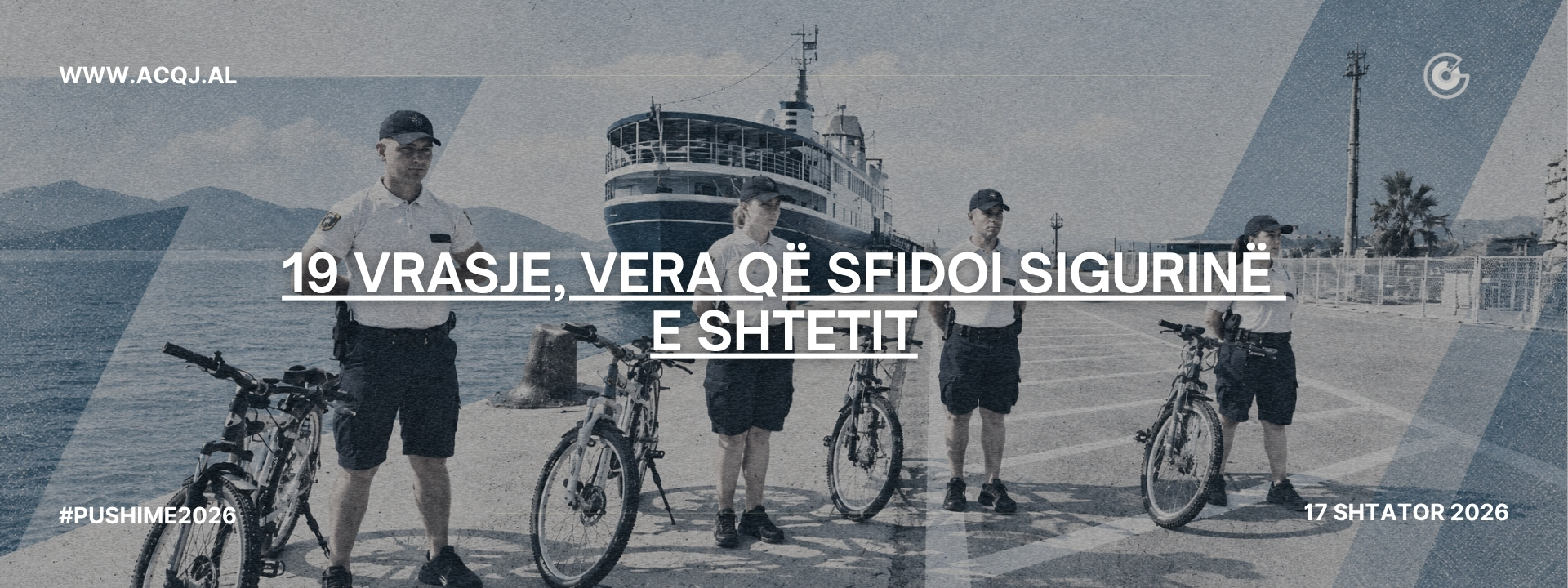
The summer of 2026 remains a black mark on public safety: 19 victims, including a foreign tourist. Gunfights in crowded areas, rampant violence in nightclubs, and the scandal of police officers working privately as security guards all shattered the narrative of record tourism numbers. While the government promised “the safest season Albania has ever seen,” the reality on the ground proved that the increase in blue uniforms did not stop the surge in crime.
Plan with 1635 officers and the "black spot" areas
To manage the influx, the State Police deployed a Task Force of 1635 police officers. Protection was focused mainly on what the authorities themselves defined as high-risk areas.
The Director of the Department of Public Order and Security, Dhimitraq Ziu, drew a risk map: "The areas that we consider to be black spots remain the axes towards Lezha, Shëngjin and Tale, the road towards Vlora, the beaches of Himara and Saranda, as well as the Durrës-Golem and Lushnjë-Fier axes."
In addition to the increased presence of police officers, Ziu also announced the establishment of provisional stations from Thethi and Valbona to Lalëz and Ksamil, covering both the coast and mountain tourism.
Political promises reached their peak on June 26, when Interior Minister Besfort Lamallari declared that security would be the main card of the country's image:
"When a tourist chooses Albania, they are not simply choosing a beach or a mountain, but a country that protects them with professionalism. Let's make the 2026 season the safest in history, so that every visitor leaves with beautiful memories and Albania continues to be a success story that inspires and attracts the world."
Official statistics show a dramatic trend that defies any preventive rhetoric:
- May-September 2023: 18 murder cases (19 victims)
- May-September 2024: 17 cases (22 victims)
- May-September 2025: 17 cases (18 victims)
- May-August 2026: 16 murder cases (18 victims)
The toll worsened in September. On September 3, another murder brought the number of victims to 19, while another attempted murder was recorded on September 13. Before the season had officially ended, with 19 lives lost, 2026 surpassed the 2025 toll and equaled that of 2023.
The event that brought the issue of tourist security beyond borders was the murder of 20-year-old Portuguese Luis Miguel Varela Mendes in Ksamil. In the early hours of August 18, Mendes was in a nightclub, where after a conflict with several people he was stabbed to death. The incident occurred at the peak of the tourist season, in one of the most frequented destinations in the country and precisely at a time when security had been declared a national priority.
For tourism expert Lyto Alliu, such events affect the perception of security and the image of Albania as a tourist destination: "The case shows the effect that crime has on a tourist's decision to return or to recommend Albania."
On the other hand, security expert Fatjon Softa finds the cause in the lack of prevention of events: "Risk areas, problematic subjects and spaces where alcohol, weapons or spontaneous conflicts can produce serious consequences must be identified in advance."
Beyond prevention, the justice system takes the biggest hit. Legal expert Alban Duraj recalls that during 2025, criminal offenses increased by 17.4% (about 38,345 cases). According to him, the overloaded system and delays caused by the vetting process make arrest only the first steps on a long road to punishment: "Justice must prove guilt in a regular process and within a reasonable time. The judicial system continues to face the consequences of vetting, the departures of judges and prosecutors, as well as the high workload of the courts," says Duraj.
The police at the service of private individuals and the shadow of crime in businesses
An event in Saranda brought to light another dark side: the degradation of state authority. After security guards at a nightclub raped a crime boss in Saranda, investigations revealed that two police officers were working illegally as private guards in the same premises. They were suspended after not only failing to notify the authorities, but also failing to intervene to prevent the clash.
"The problem arises when public function overlaps with private interest," warns Fatjon Softa, calling for the Police to maintain the guarantee of order and not the perception that it is linked to business interests.
Tourist safety was not only called into question by the murders. In Orikum, a clash between businessmen caused panic among vacationers. An Albanian from Italy recounted the cancellation of her vacation:
"They registered us as tourists at the border, but when we saw the crash at the hotel we had booked, we canceled everything. We came to rest, not to risk our lives."
This uncertainty is also fueled by the financing of coastal businesses with dirty money. The bar where the Portuguese tourist was killed was targeted as a potential source of criminal assets. In the first 7 months of 2026 alone, SPAK has imposed preventive seizures of over 440 million euros in assets (mainly hotels and coastal properties), suspected of having been created with financial resources obtained from illegal activities, mainly from international drug trafficking.
Political rhetoric about events
While the opposition denounces the mismanagement of the season and the failed order, where according to it, murders and assassinations have dominated the tourism chronicles, the executive sees other factors as obstacles. Prime Minister Edi Rama during his podcast "Flasim" stated that the drop in reservations in this season, which was expected to be the most successful, came from the protests, describing them as:
“Direct damage to the local and national economy.”
However, the consequences of the summer of 2026 leave behind an inescapable question: If danger zones were identified and police forces were increased on the ground, why did crime continue to dictate the balance of the summer?/ acqj.al