


Author: Dallandyshe Xhaferri
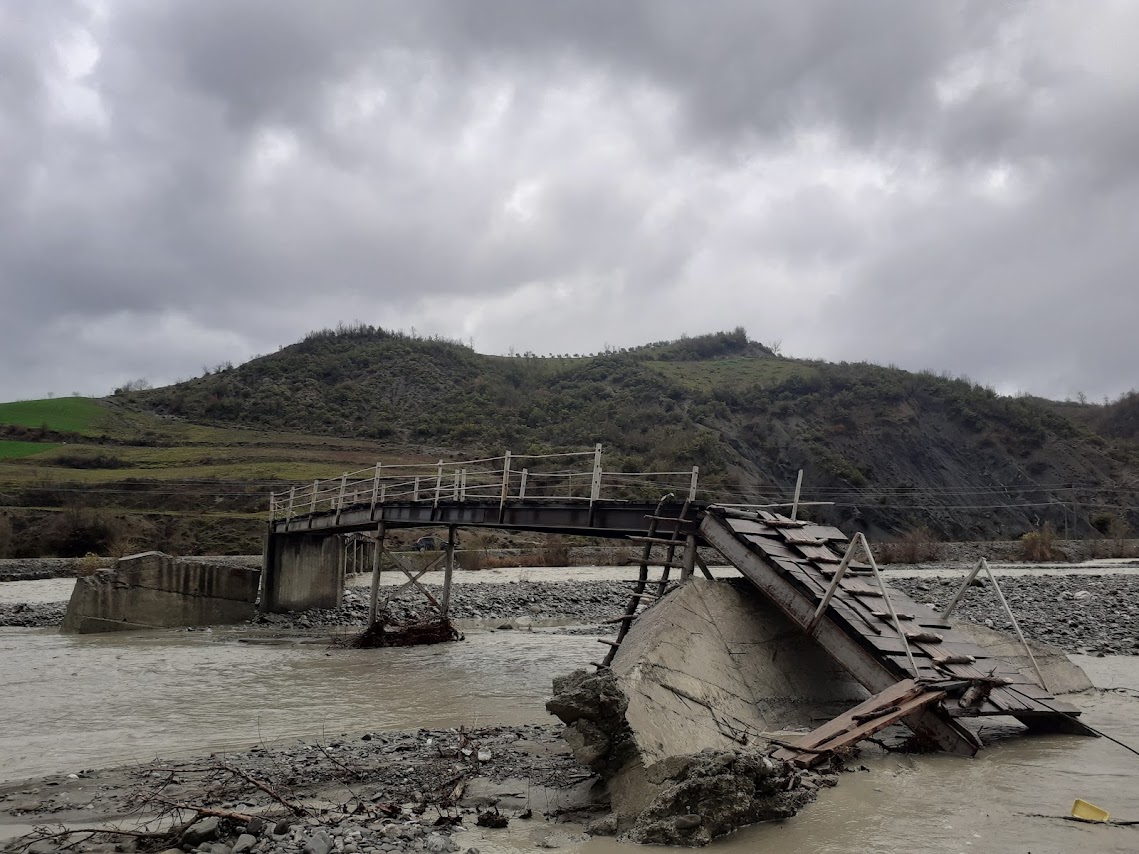
Bujar Xhaferri, the headman of the village of Liras, in the Pishaj municipality of Gramsci, insists that the residents are facing the indifference of the state for 10 years. The village is located only 15 kilometers from the city of Gramsci, and the most difficult days for the residents were during the winter months, when they were trapped by the rains. The dissatisfaction of the representative of the local government is related to the bridge, which is the only way of communication with the area. Therefore, he has decided to express himself on the "Sinjalizo" platform, requesting that the case be made public.
" Since January, the bridge has been impassable. The wooden supports have rotted and part of the concrete has collapsed ," the mayor of Liras describes the concern.

The village of Liras has 200 inhabitants who can currently be said to be completely isolated. The bridge is the only connecting road to Gramsh and the three surrounding villages of Tërvoli, Gjergjovina and Kabash and to the area known as the tourist spot of the Holta canyons. It also includes the cave of Kabashi and the castle of Tërvoli, which have become destinations and favorite places of local and foreign tourists. The biggest problems appeared during the winter of this year.
" During the summer the river dries up due to the hydroelectric power plant, but during the winter it is a problem because the Holta River flows back and forth. We cannot cross it on foot, neither we nor the children ," Elona Tërvoli, a resident of the village, tells "Sinjalizo".
" During the school year, children cannot cross the river alone, because the current could take them away, but we, the parents, cannot accompany them every day, because life here, in the village, is very busy in the mornings with livestock work ," she adds.

"Sinjalizo" contacted residents of the area who are seeking preliminary help, so that next winter they do not face the same worries and dangers for themselves and their children. It turns out that despite the official requests to the Ministry of Infrastructure and Energy and to the Municipality of Gramsh, on the part of the residents, no work has been carried out to improve its condition.
" The bridge was built in 2008, but every year there have been problems due to the flow of the Holta River ," recalls another village resident, who on condition of anonymity added that none of the institutions took care of maintenance.
Officially, the Gramsh Municipality insists to "Sinjalizo" that a contract for the repair of the bridge has not been signed, as they are still in the first phase of submitting offers from the companies competing to win the tender.
" This procedure (tender opening) was canceled the first time, after the Bid Evaluation Commission found that the Economic Operator had not submitted a suitable bid. The procedure has been relaunched once again and is currently in the bid submission phase, " explains the Gramsh Municipality in its written response.
According to data from Open Procurement, it is noted that the open tender for interventions on this bridge is worth 2,9 million lek, also foreseeing interventions on the embankment.
The state of bridges in Albania
But the residents of Liras are just one of the many cases of citizens who risk their lives by crossing amortized bridges and left in oblivion.
The former Deputy Minister of Infrastructure and Energy Artan Shkreli says that unlike cultural objects and public buildings, which have almost been replaced or disappeared during the period of political transition, infrastructural objects such as bridges have remained the same.
" Mainly during the 1960s and 1970s, the construction of industrial, residential, and public buildings experienced a huge development, " Shkreli further stated.
" Today, almost two decades after the beginning of the 21st century, we are able to take stock to understand what happens to the engineering works built and considered modern in the last century ," the former senior official analyzes.

According to him, all bridges built during the 1950s, 1960s and 1970s should be intervened to improve their condition, including small bridges (less than 10 meters in length).
" Over 60% of bridges, even small ones, definitely require intervention. Until the intervention, they require detailed monitoring. Preferably, on bridges with high vehicle access, monitoring devices should be installed in place, while others can be temporarily monitored by designated experts ," Shkreli continues.
According to the report on the state of the bridges in the country, provided by "Sinjalizo" through the official response from the Ministry of Infrastructure and Energy, it turns out that the Vora bridge shows the exposure of the connecting points of the beams.
Engineers raised the alarm first
In 2018, engineer Xhevahir Ngjeqari told the media that the Vora bridge, although it had only been open for a few days, had to be destroyed to be rebuilt due to depreciation.
" This bridge is not capable of handling capacities over 3.5 tons, which means no more than an SUV ," the expert said at the time, emphasizing that asphalting and pedestrian curbs did not increase its stability.
" Based on the report, several interventions are being made, such as the one on the Vora bridge due to the great alarm the report raised about it ," says Shkreli, who emphasizes that the interventions carried out were not profound, but life-saving.

Causes of damage to bridges
After the tragedy that happened in Genoa, Italy in 2018, where as a result of the collapse of the "Morandi" bridge built in 1967, 48 people lost their lives, the Ministry of Infrastructure and Energy in cooperation with the Albanian Road Authority and the Construction Institute started analyzing the situation of all bridges in Albania.
" The two main causes that led to the creation of this tragedy were: the increase in the flow of cars, which was not calculated at the beginning, and the degradation of construction materials as a result of the activity of atmospheric and chemical agents on concrete and iron," explains Artan Shkreli, emphasizing that these pathologies are also observed in Albanian bridges, which were built during the same period and with the same materials. "Regardless of whether they are suspended, with three columns or combined ," he says.
According to the report drawn up three years ago on the state of bridges in the country, the bridges were divided into three categories, which included: bridges with good bearing capacity, bridges that need intervention and bridges that need to be demolished to build new ones.
Who is responsible for passenger safety?
" The inspection of bridges on the national road network in the country is carried out every 6 months by maintenance companies ," the Ministry of Infrastructure's response states, adding that there is also no shortage of observations during natural disaster events (floods, earthquakes or landslides).
" There are no tenders for bridge maintenance as they are included in the overall performance maintenance framework for roads ," the Ministry of Infrastructure emphasizes in its official response to "Sinjalizo".
For 10 years in Albania, a method has been applied that is based on the realization of the criteria to achieve the required service.
ARRSH has announced that it administers the bridges located in the national network with a length of 3 km, which includes 650 bridges with a length of over 732 meters and nearly 10 bridges with a length of less than 3000 meters.
Meanwhile, Artan Shkreli has emphasized that the monitoring appears to be truncated and not carried out properly in the rural axes, which are not under the monitoring of the companies, nor of the ARS, but of the respective municipalities.
" The calculations for interventions on the bridges of national axes, for their maintenance, should be carried out by the ARA, since they are administered by it ," emphasizes Shkreli, joining the concerns of residents and experts.