


Author: Wendy Biba
"The difficulties are not over. The beginnings remain. As far as I got here, I came because I saw it as necessary and I had no other choice. " With these words, a 66-year-old man who lives in the "Streha Tirana" social center begins his story. Economic impossibility has forced him to make this choice, since his income as a pensioner is low.
" I have not received any assistance from the government, nothing. I have been in Tirana for 28 years. What I have not done, I have applied, they did not accept me initially, I was a resident of Lapraka and the answer they gave me was: No, because you are newcomers, and at the same time there were applications from people from other countries," he says, indicating that he has now lost hope for economic aid from state structures, but it is his family who are helping him as much as they can.
" I don't want to disturb their comfort, I don't want to be a problem for them, they have their own lives. As for me, I came here because I saw it as necessary and I had no other way out," concludes the 66-year-old.
And while the cost of living increases every day, where the war in Ukraine and the ongoing economic crises have made it even more sensitive for the citizens' pockets, Albania is the only country in the Balkans, which does not have a legally approved living minimum, of which would provide an affordable living even for the respectable layers of the society.
From the International Labor Organization (ILO), the World Bank, the IMF, the trade unions, the Ombudsman, and from the Parliament of Albania, suggestions have been addressed from time to time to the government for determining the official indicator of the minimum wage, but Albania continues not to have one official access to this standard of living.
The People's Advocate has carried out two reports on the "Living Minimum in Albania", one in 2016 and another in 2021. None of these reports aimed, according to the People's Advocate, "to fill the legal gap and directly affect the guarantee of the living minimum for thousands of Albanian citizens who live in poverty", has not been taken into account.
" The value calculated in his studies for the living wage for 2019 is approximately 17.875 Lek. This indicative value is 9.9% higher than the minimum pension for urban areas, 37.5% higher than the unemployment benefit and about 3 times higher than the economic assistance, while 45.5% lower than the minimum wage. According to him, in 2022-2023 the living wage should be higher," states the Ombudsman institution, which, among other things, recommends that the methodology for calculating the living wage in the Republic of Albania be drafted and approved.
This institution also suggests that the vital minimum be reflected in the entire legislative package that guarantees and ensures social protection. It also emphasizes that the subsistence minimum should become a major part of the national social protection and health system.
"It is necessary, that in the formulation of the vital minimum, the objective of ensuring the existence of the individual in accordance with the human dignity provided for in the Constitution and the law is taken into consideration and properly assessed."
In his response to ACQJ, the People's Advocate emphasizes that in addition to a dignified life, the individual must be given minimum access to cultural, social and political life.
How much do those in need benefit from social schemes in Albania?
Social protection schemes in Albania are many and different. According to the data provided by the Ministry of Health and Social Protection, the number of beneficiaries from the economic assistance program is about 64 thousand families, while the number of beneficiaries from the payment program for persons with disabilities is 143,247 people.
In order to have a clear overview of the economic benefits for the needy, ACQJ requested information from several municipalities in the country. In Kukës, often considered the poorest district in the country, the Directorate of Social Services and Health Care, says that there are 4734 families or 21,207 people who receive economic assistance, while 517 families or 1450 people are part of the 6% fund, part this of the municipality's budget dedicated to families in need. According to the data forwarded by this municipality, the head of the family receives a monthly sum of 2170 ALL, the second member of the family 1430 ALL, the same amount as that which benefits the children of the family over 18 years old. As for the members who are over the working age, the aid is in the amount of ALL 3310.
Meanwhile, in the Blesh Municipality, the number of families with economic assistance last month was 699. "The amount of economic assistance is based on family members. The head of the household receives 2000 lek, the wife receives 1800 lek, children under 18 receive 900 lek, while children over 18 receive 1200 lek ," this institution officially states.
At a time when the price of a loaf of bread is 100 lek, the big question that arises is what these families can afford with the amounts of financial support that benefit from state institutions.
Albania facing the Region and Europe
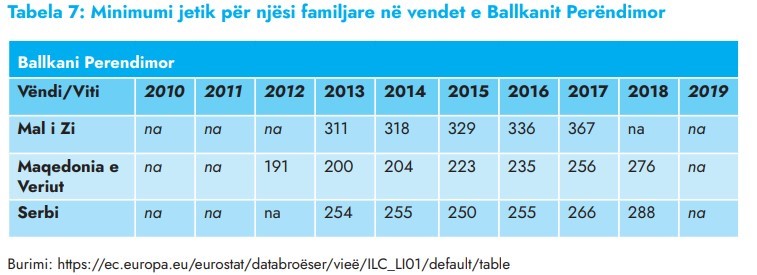
A 2021 UNDP report shows data on the living wage for Montenegro, Serbia and North Macedonia. “ There is no data for Bosnia and Herzegovina, Albania and Kosovo to allow for a comparison between them,” the report says.
Montenegro shows the highest value defined as a vital minimum, followed by Serbia and North Macedonia. While Albania is not at all on the list of countries in the region as it does not have a living minimum defined by law.
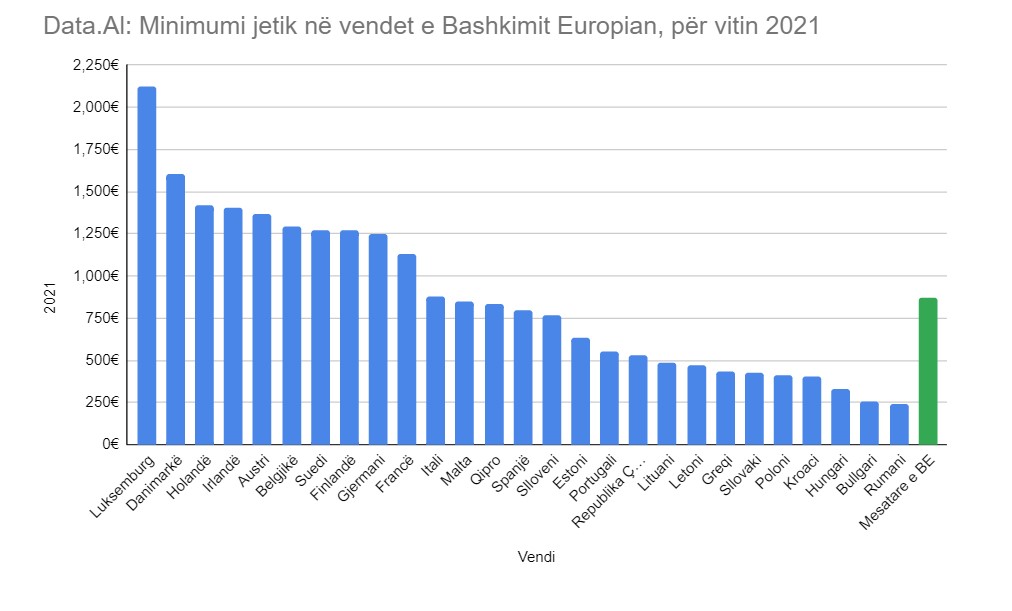
In the countries of the European Union, the living minimum is many times higher than in the countries of the region, where if we compare it with Albania according to the social assistance that citizens in need receive, they are several dozen times higher.
Within the EU, the country with the highest level of living minimum for 2021 is Luxembourg, with a value of 2 euros/month per individual. The second country with the highest minimum living wage is Denmark with a value of 124 euros/month, followed by the Netherlands, Ireland, Austria, etc. These countries have a high GDP per capita, excellent health care systems, high levels of education and social Services.
On the other hand, some European countries have a lower standard of living due to factors such as economic instability, political instability and conflicts. The countries with the lowest value of the living minimum within Europe are Romania (242 euros/month), Bulgaria (258 euros/month) and Hungary (331 euros/month).
The value of the living minimum has clearly increased year after year from 2012 to 2021, which shows that the minimum living costs have increased. Specifically, the average of the European Union for the year 2012 marked the value of the vital minimum of 679 euros/month, while in 2021 it was 869 euros/month, which shows a 28% increase in living costs, a value that despite the absence of a legal minimum vital in Albania, or the non-indexation of social assistance for a long time, is reflected in the prices and living costs of Albanian families as well.
Non-existence of the vital minimum, Priest: Cause of non-affordability from the State budget
In a conversation with the economy expert, Rezart Prifti, he explains that for the calculation of the living minimum, there is a formula that includes diet, living, etc. and with the calculation of this formula, a pretty high value comes out.
" A lot depends on the country and what aspects are included in the formula, which means that in America the minimum living standard also includes internet access or activities related to pleasure, while in Albania they can only count survival," he says.
But unlike EU countries or beyond, in which the living minimum also includes the mundane needs of an individual, the method used to calculate the living minimum in Albania is the one known as the Absolute Poverty Method. According to this method, the food poverty line and the non-food poverty line are calculated. Both of these poverty lines are calculated as the cost of basic food and non-food needs, and when added together they give the poverty line as the minimum requirements that must be met to live. The minimum cost of the monthly food basket, in Albania, according to the daily rate of calories for 1 adult, so that the latter has the necessary caloric input 7,427 ALL, according to INSTAT, for the year 2019. However, this is a calculation which it is not defined by law and is kept only for statistical purposes.
The priest adds that the Albanian state has refused to define the minimum living wage by law for over a decade. For the priest expert, the essence of the rejection is the fact that it would have to change the entire system of payments and salaries, as well as create chaos in the social security system.
" If the minimum is set at 300 Euros, the minimum wage, the pension scheme, the scheme for individuals in need, etc. would change. So it is not a small reform, but a fundamental change in the schemes, which leads the state to collapse," he says, adding that he has received many suggestions from the People's Advocate or international institutions, which have been rejected because the state is unprepared to move to such a stage.
" Moreover, the government is unprepared in terms of budget and in terms of the structures it has"
Asked if this living wage could become a reality soon, Prifti says that “ determining the living wage is a process that will take a long time.” Among other things, Prifti says that none of the social support schemes that the Albanian government currently has are up to the economic and social changes to cope with groups in need, because these schemes have never changed.
" They do not have the effect they should have and are simply indulgences that are leftovers from the structures that Albania has," he says, adding that even though Albania has been in the free market for 30 years, we still discuss social assistance schemes.
" A country that has prosperity does not discuss them but rather development policies, entrepreneurship and free initiative policies, infrastructure and education," he concludes.
21 thousand signatures in the CEC for the approval of the living minimum
In 32 years as a country with a democratic system of government, none of the governments in Albania has dared to open the debate on the minimum wage. Currently, more than 21 signatures from citizens have been deposited in the Central Election Commission, to give life to a legal initiative for this cause.
Emiljando Kita, an activist in the Political Organization, which has collected citizens' signatures, says that the seats are at the stage where the CEC has verified 21.300 signatures and declared them true and correct, and the vital minimum is being compiled to be sent to Parliament.
He also adds that political organizations have appealed to all citizens, saying that one company is not enough.
" The firm is to bring the problem to the attention of the government and the opposition, the members of Parliament, who are not listening to our concerns," he says.
The initiative is only a first step that guarantees that the request of the citizens will be heard by the parliamentarians, but in the end the decision-making power remains with the latter.
Despite these steps, many families who survive through social assistance provided by the state, with ridiculous amounts that do not even exceed 10,000 lek per month, do not see the day when this assistance will meet even their minimum human needs.