



Author: Julia Mallon
Disinformation is a global problem. It is everywhere, including the United States, where misinformation related to the recent presidential election, the pandemic and vaccines have fueled the polarization of the American electorate.
American experts agree that something must be done, but whether or not it is the responsibility of the government, social media companies, education, or third parties is a topic of debate.
"I cannot say what kinds of regulations would be advisable or effective. I can only say that efforts must be made by all actors, calling for work from politicians, professional journalists, technology companies and educators,” said Jonathan Anzalone, Assistant Director of the Center for News Literacy at Stonybrook University in New York.
Disinformation and its impact on democracy has been the focus of various conferences, congressional investigations, studies and books. It has ignited grassroots movements and has been linked to a growing distrust of the media.
According to a 2019 study by the Pew Research Center, 50% of American adults surveyed said fake news/information is a big problem. 68% said fake news/information has an impact on Americans' trust in government.
In April, former US President Barack Obama described disinformation as a threat to democracy in his keynote address at Stanford University.
"People are dying because of misinformation," he said, referring to the misinformation and disinformation surrounding vaccines.

The Role of the United States Government
To what extent, if any, the US government should be involved in dealing with this problem is part of the ongoing debate and the focus of many groups.
Following the attack on January 6, 2021, at the US Congress building, the Stanford Internet Observatory (SIO), the University of Washington's Center for an Informed Public (CIP), Graphika and the Atlantic Council's Digital Forensic Research Lab ( DFRLab) formed what is called the Electoral Integrity Partnership (EIP).
Their goal is to "create a model for the cooperation of the whole society and facilitate cooperation between partners committed to free and fair elections".
The EIP made key recommendations for the federal government, Congress, state and local officials, and social media platforms to help achieve this by combating misinformation.
In its final report , the EIP recommended that the federal government take a clear role in “identifying and countering” election-related disinformation and recognize elections as a national security priority.
One of the group's recommendations at the central and local levels is to “establish reliable channels of communication with voters,” including a .gov website and the use of traditional and social media. This is an election-specific example of disinformation handling.
Other experts agree that the government can and should take decisive action to combat the broader problem of disinformation.
Martha Minow, a Harvard law professor and author of Saving the News: Why the Constitution Requires Government Action to Protect Free Speech, says there are three well-supported government initiatives needed to combat disinformation.
"The government should hold digital platform companies accountable for their product in the same way that other media are accountable under copyright law, defamation and fraud law, and privacy and other laws," Minow says.
Minow believes that consumer protection laws should be used to hold media companies accountable for content they run that violates established consumer protection standards against fraud and misrepresentation. She also believes that the country should increase the supply of quality information through greater support for public, non-profit and local media, as well as media education.
During his speech, President Obama acknowledged the way technology companies have evolved and said he would support renewing a section of the so-called Communications Decency Act that exempted what are now technology companies from maintaining responsibility for the content produced on their platforms.
"This provision of the Communications Decency Act was intended to protect new Internet-based companies from legal burdens and grow the sector," Minow says. She believes the current law gives an 'immunity' from liability, such as fraud and defamation, and treats platform companies differently from any other media.
"Internet-based companies are now among the largest and most well-capitalized companies in history, and they don't need what is essentially a subsidy, giving them an edge over other media companies," Minow says. "Reinstating the act may mean removing the advantage or making it conditional on accountability requirements, duties to disclose moderate practices, or other specified responsibilities."
Meanwhile, some states are beginning to respond to calls for a greater government role in the fight against disinformation, especially around elections. Connecticut, along with Colorado and California, have employed what amounts to a disinformation czar in each of their states. Their role includes monitoring sites and trying to weed out misinformation and fake news before it goes viral.
Technology Companies and the Role of the Media
Along with advocating for the initiation of government regulations, some experts believe that major social media platforms and the media in general should play a more important role in limiting disinformation.
According to the Pew Research Center , “Journalists are not blamed most for creating fake news and information, but Americans say the news media are most responsible for regulating it.”

And a recent report by a commission at the Aspen Institute, a nonprofit organization that is "committed to realizing a free, just, and equal society," agrees. The Commission on Information Disorder recommended increased transparency, especially within social media platforms.
Two of these key recommendations include what is called, "high-throughput content discovery." The commission believes there should be a "legal requirement for all social media platforms to regularly publish content, source accounts, reach and impression data for posts they organically distribute to large audiences."
Similarly, the Aspen Institute commission recommends what it calls content moderation platform disclosure. This requires "social media platforms to disclose information about their content moderation policies and practices and to produce a time-limited archive of moderated content in a standardized format, available to authorized researchers." Minow also believes that social media platforms should face more regulation if they are to be legal.
Relying solely on self-regulation has failed because, "private companies are motivated to make profits, and the dominant model of social media and increasingly conventional media focuses on advertising and keeping viewers and users 'engaged,'" Minow said. "The companies themselves show that the problem is bigger than any one of them to solve."
During his speech, President Obama also said that technology companies should be more transparent about how they operate and that regulatory structures should be designed in collaboration with companies, experts and affected communities.
“In a democracy, we can rightly expect companies to subject the design of their products and Services to a certain level of evaluation. At the very least, they should share that information with the researchers and regulators who are charged with keeping us safe,” President Obama said.
The Role of the Education System
According to a study by the Pew Research Center, only 26% of adults surveyed could correctly classify all five factual statements presented to them, only 35% of American adults surveyed could correctly classify all five opinion statements presented to them, and 96% of U.S. high school students surveyed failed to challenge the credibility of an unreliable source.
To combat the information gap of the average American, one of the Aspen Institute's key recommendations is to generate what it calls citizen empowerment.
Specifically, the commission recommends that the US should "invest and innovate in online education and platform product features to increase user awareness and resilience against online misinformation."
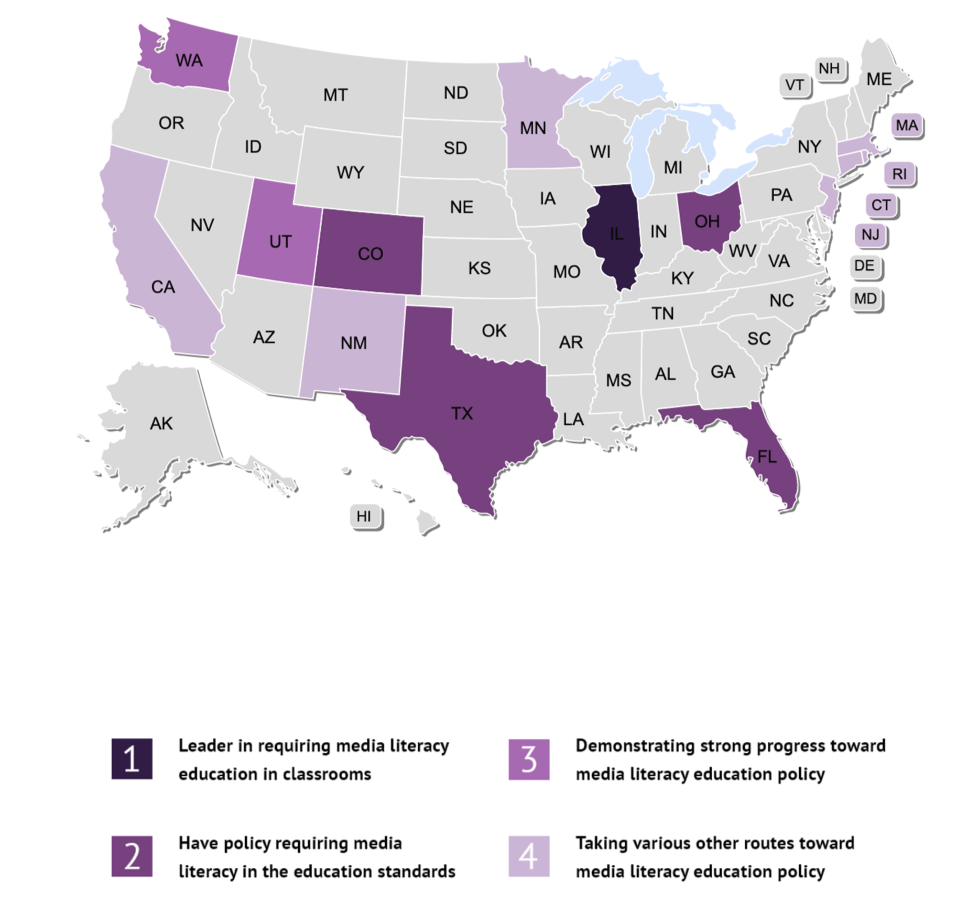
To address this challenge, many colleges and high schools have launched what are called media literacy programs across the US and internationally. Media literacy is the ability to analyze and evaluate information from media outlets to determine what is true and what is false.
Erin McNeill, president and founder of the nonprofit organization Media Literacy Now, has followed media literacy and related policies for ten years.
"There's the question of whether we're going to engage in education or legal regulation of the situation," says McNeill. "If we educate all of our students as they enter the workforce, they will be better prepared for how to deal with these really big challenges right now in the media system."
The Center for News Literacy, based at the State University of New York at Stony Brook, has been a leader in media education since 2007.
“Our focus is on educating the public,” says Stony Brook’s Anzalone. “Which we wouldn’t do if we didn’t think it would have an impact.” When it comes to the education vs. regulation debate, Anzalone believes it’s a collaborative effort.
Stony Brook's JRN 101: News Literacy course description states, “Armed with critical thinking skills, a strong grasp of relevant history, and practical knowledge of the news media, Media Literacy students learn how to find reliable information that they need it to make decisions, take action, make judgments and share information responsibly through social media.
The program at Stony Brook goes beyond teaching media education courses at the college level. The center's staff educates grade nine and middle school educators on how to teach media literacy and provides an extensive collection of resources on the topic. They also have free online courses available. These courses include: "Understanding the News" and "News Science in the Age of the Coronavirus."
One of the challenges the program at Stony Brook and other organizations has faced is that each city, town, or county across the U.S. has its own school system that decides whether and how media education courses will be part of the curriculum. theirs.
"Obviously, it's very difficult to do on a large scale, with the decentralized education system in the United States," Anzalone said, but he's optimistic.
"With the challenges we are currently facing comes the opportunity to revitalize our civic life and strengthen our democracy by teaching people how to find the reliable information that is essential to their lives," he said.